There’s a particular kind of honesty that appears when a field stops talking exclusively about possibilities and starts talking about constraints.
Quantum computing is entering that phase now.
Early May brought a small but meaningful example of it: France’s Quobly and the Hon Hai Research Institute, the research arm of Foxconn, released an open-source Python toolbox for Quantum Phase Estimation (QPE) on GitHub. The project, called qpe-toolbox, is designed to help researchers simulate complete QPE pipelines while working within the realities of fault-tolerant quantum hardware. At its core, it focuses on molecular Hamiltonians and quantum chemistry applications, smoothing out the increasingly complicated relationship between elegant theoretical algorithms and the messy realities of actual machines.
Which sounds deeply technical. Because it is.
But beneath the terminology lies something more revealing about where quantum computing stands right now as a field: somewhere between scientific ambition and engineering adulthood.
For years, conversations about quantum computing have been dominated by the language of inevitability. Everything was “coming soon.” Drug discovery would accelerate. Materials science would change overnight. Entire industries would supposedly reorganize themselves around computational power that still mostly existed in diagrams, roadmaps, and keynote slides glowing blue against black backgrounds.
And to be fair, the underlying science remains extraordinary.
Quantum Phase Estimation itself is one of the foundational algorithms in quantum computing. In theory, it enables highly precise calculations that could eventually make certain chemistry and materials simulations dramatically more efficient than classical approaches. The problem is that theoretical quantum algorithms tend to assume idealized conditions: stable qubits, negligible noise, and coherent operations sustained long enough for meaningful computation. Reality, meanwhile, behaves more like a nervous system held together with tape and hope.
Qubits decohere. Gates fail. Error correction consumes enormous resources. Hardware architectures impose compromises that no one likes to talk about during investor presentations.
Somewhere in the middle of all this, researchers still need tools.
That’s where projects like qpe-toolbox become interesting. Not because they announce a breakthrough headline large enough to dominate social feeds for 48 hours, but because they reveal the quieter infrastructure work happening underneath the field’s public narrative.
The toolbox attempts to bridge a gap quantum computing has struggled with for years: the distance between algorithm design and hardware implementation.
Historically, those worlds have often developed almost independently. Theoretical researchers build mathematically elegant approaches. Hardware teams wrestle with cryogenics, calibration drift, connectivity limitations, and error rates that stubbornly refuse to behave. Then eventually someone has to figure out whether the algorithm survives contact with the machine.
Sometimes it does.
Often, it becomes painfully obvious that a theoretically efficient algorithm requires impractical hardware resources once mapped onto real systems.
That tension is becoming harder to ignore as quantum computing matures. Which is probably healthy.
The qpe-toolbox leans directly into this reality by allowing researchers to simulate full QPE workflows while accounting for fault-tolerant constraints earlier in the process. Instead of treating hardware limitations as an afterthought, the framework incorporates them into algorithm development itself.
That shift matters more than it might initially appear.
Because the future of quantum computing likely won’t belong to teams building algorithms in isolation or hardware in isolation. It will belong to researchers capable of navigating the uncomfortable middle ground where both influence each other continuously. Co-design — that slightly awkward phrase appearing more frequently across technical papers — is becoming less of a conceptual ideal and more of a survival mechanism.
And honestly, there’s something strangely reassuring about that.
The earlier phase of quantum computing hype often felt detached from physical reality. There was a persistent atmosphere of futurism polished to the point of abstraction. Every announcement hinted at imminent transformation. Every incremental milestone arrived wrapped in language suggesting civilization itself was standing one firmware update away from reinvention.
But engineering disciplines eventually lose patience with mythology.
At some point, systems either work under constraints or they don’t.
This is partly why open-source tooling feels significant right now, even when it doesn’t produce dramatic headlines. Open-source ecosystems tend to expose friction instead of hiding it. They reveal edge cases. They force assumptions into public view. They allow researchers outside carefully managed corporate environments to test, challenge, and refine ideas in less curated conditions.
There’s a humility embedded in that process that quantum computing arguably needs more of.
Not pessimism. Just realism.
Because despite the extraordinary progress made over the past decade, fault-tolerant quantum computing remains profoundly difficult. The scale of error correction required for practical applications is immense. Resource overheads remain staggering. Timelines continue shifting in ways that make even optimistic researchers increasingly cautious with predictions.
And yet the field keeps moving forward anyway.
Quietly, unevenly, sometimes frustratingly slowly — but forward.
That’s what projects like qpe-toolbox actually represent. Not a sudden leap into the long-promised quantum future, but the less glamorous work of building usable infrastructure around difficult science. The field is starting to look less like speculative futurism and more like a genuine engineering ecosystem.
Which changes the emotional texture of quantum computing conversations in subtle ways.
There’s less theatrical certainty now. More discussions about architectures, interoperability, optimization strategies, compiler design, and practical implementation details. Less cinematic language about changing the world overnight. More acknowledgment that difficult technologies mature through incremental coordination between many imperfect systems.
Oddly enough, that makes the space feel more credible.
Because most transformative technologies do not arrive fully formed in moments of dramatic revelation. They emerge through years of tooling, abstraction layers, debugging, standardization, failed prototypes, revised assumptions, and infrastructure nobody outside the field notices.
The internet looked like this once too.
Artificial intelligence certainly did.
And perhaps quantum computing is finally entering its own version of that quieter phase — the phase where progress becomes less visually exciting but substantially more real.
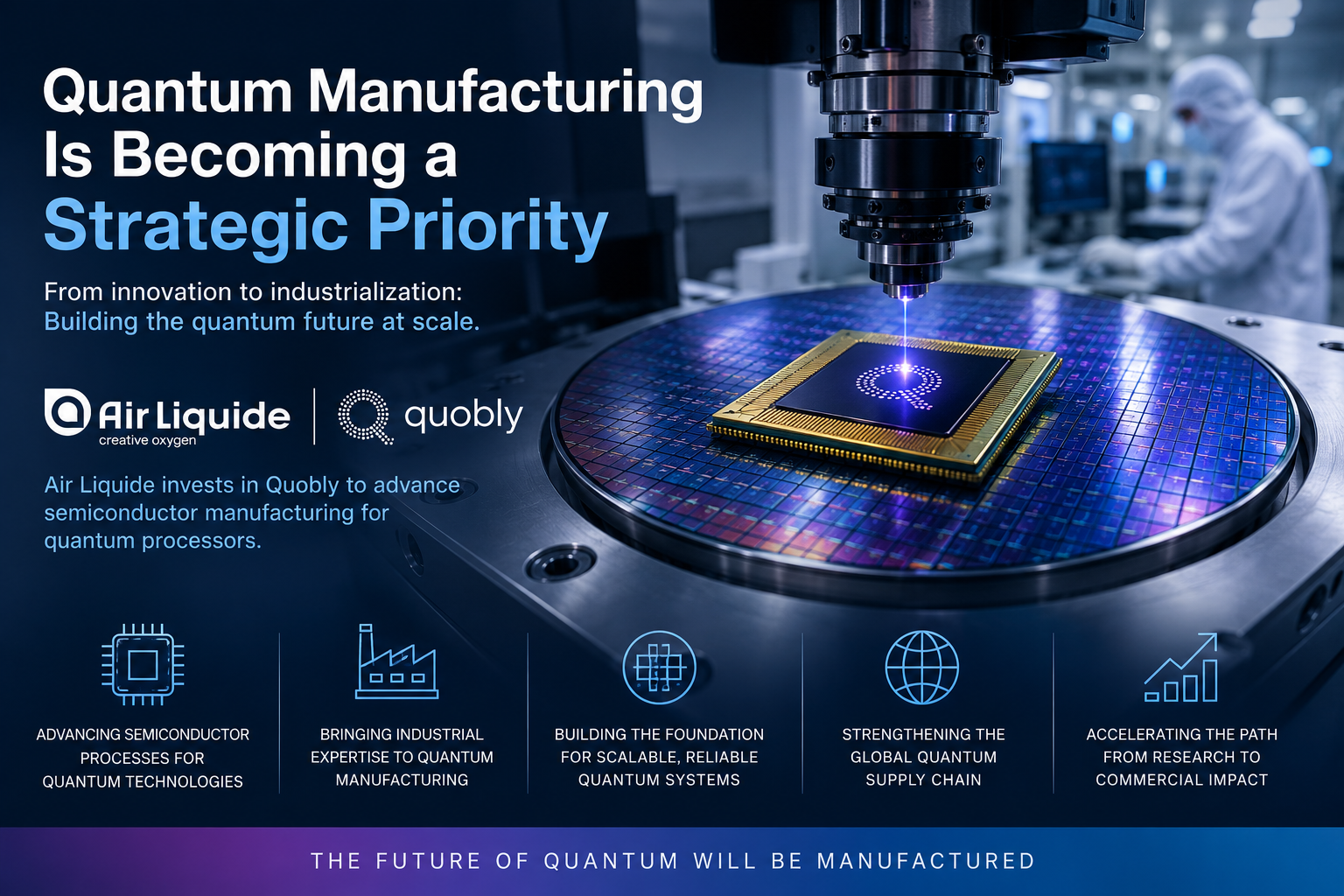
There’s also something culturally interesting about who released this project. Quobly, based in France, and Hon Hai Research Institute, connected to one of the world’s largest electronics manufacturers, represent very different parts of the global technology ecosystem. One emerges from Europe’s growing push toward sovereign deep-tech capability. The other sits adjacent to the vast industrial infrastructure that already underpins much of modern electronics manufacturing.
That collaboration feels emblematic of where advanced computing research is heading generally: increasingly international, increasingly interdisciplinary, and increasingly dependent on ecosystems rather than isolated breakthroughs.
No single lab is going to solve quantum computing alone.
And maybe that realization is beginning to soften some of the competitive mythology surrounding the field.
Not entirely, of course. There’s still enormous geopolitical pressure around quantum technologies. Governments continue investing heavily. Companies still race for advantage. Everyone wants to claim proximity to the future before the future fully arrives.
But underneath the branding and strategic positioning, there’s a quieter reality emerging: building practical quantum systems requires enormous coordination between software, hardware, physics, manufacturing, error correction, and computational theory.
Which means the most useful contributions are sometimes the least glamorous ones.
A toolbox.
A simulation framework.
A better way to test assumptions before expensive hardware time gets wasted.
No dramatic music required.
And maybe that’s why the release feels notable beyond its technical utility. It reflects a field gradually becoming more comfortable with the unromantic parts of progress. Less obsessed with spectacle. More focused on operational maturity.
There’s a kind of stillness in that transition.
The noise level drops. The work becomes harder to explain casually at dinner parties. The headlines become smaller. But the foundations quietly get stronger.
Quantum computing may still be years away from fulfilling its largest promises. Possibly longer than many early narratives suggested. But projects like qpe-toolbox suggest something important nonetheless: the ecosystem is starting to organize itself around reality instead of aspiration alone.
And in emerging technology, that may be one of the clearest signs of genuine progress there is.