A few years ago, the industry was still selling possibilities. Companies competed on abstract promises, inflated qubit counts, and carefully staged demonstrations that felt more like signals to investors than signals of readiness. The ecosystem often resembled a science fair wrapped in venture capital language. Everyone could see the outline of a future machine, but very few people wanted to talk honestly about the wiring behind the walls.
That mood is changing.
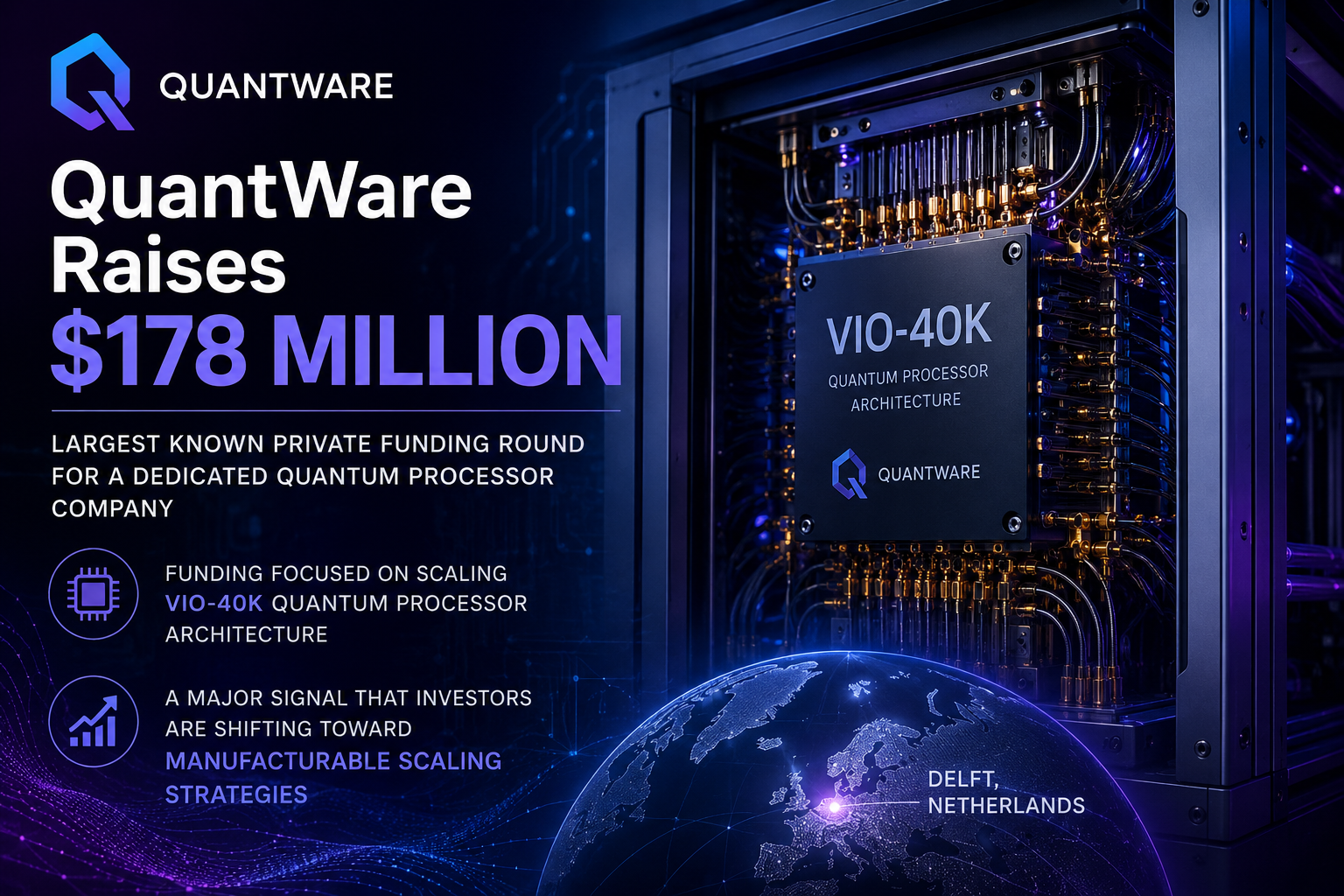
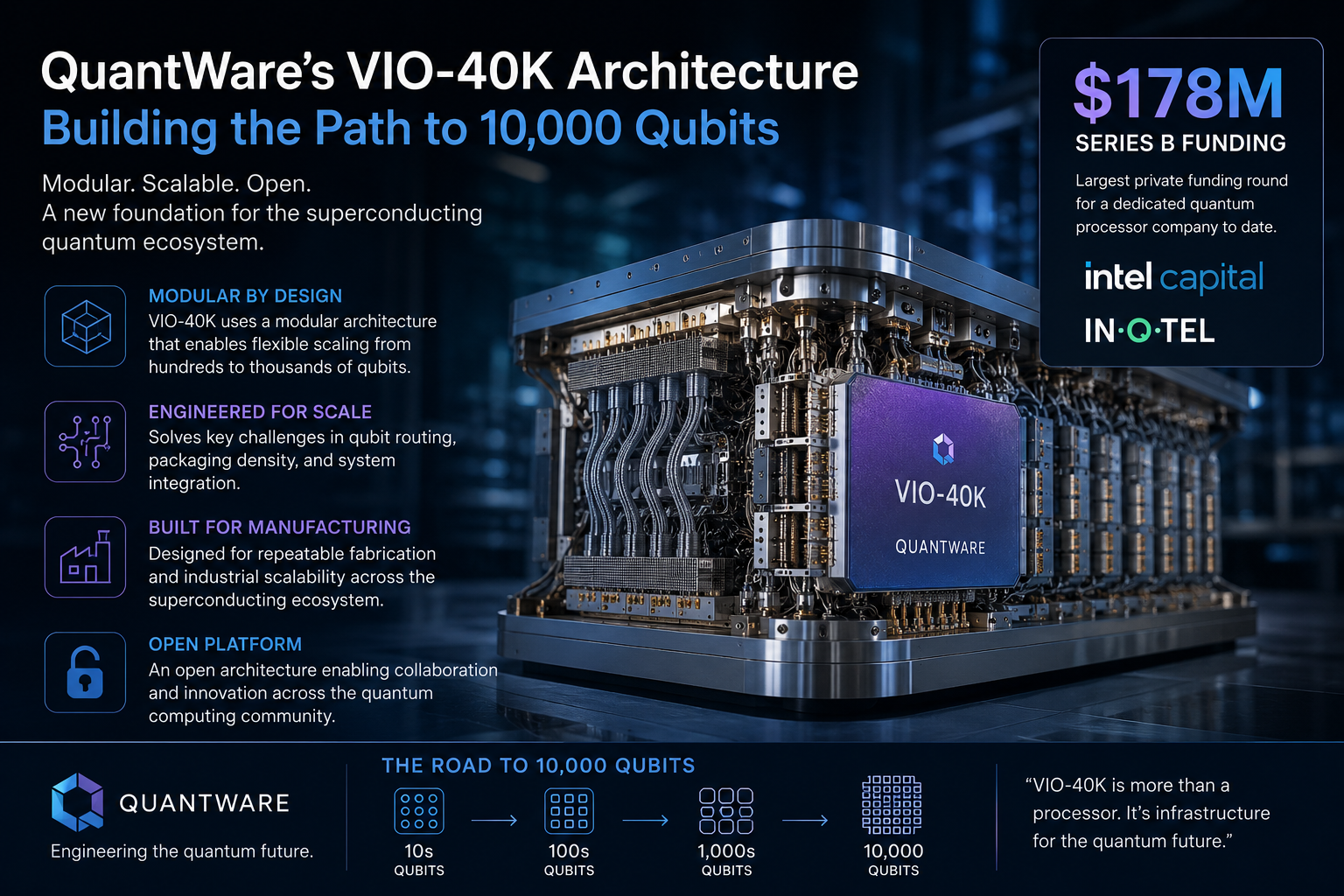
This week, Dutch quantum hardware company QuantWare announced a $178 million Series B round, reportedly the largest private funding round raised by a dedicated quantum processor company to date. Backed by names like Intel Capital and In-Q-Tel, the raise centers on something that sounds deceptively technical: the company’s VIO-40K architecture.
But beneath the engineering language sits a much larger shift in the quantum conversation.
The industry is beginning to admit that scaling quantum computing was never just about qubits.
It was about everything surrounding them.
The refrigeration systems. The routing layers. The packaging. The interconnects. The manufacturing tolerances. The brutal physical reality of trying to control fragile quantum states inside machines colder than deep space while preventing noise, heat, vibration, and interference from collapsing the entire system.
In other words, quantum computing is starting to leave the era of theoretical ambition and enter the era of industrial architecture.
And honestly, that may be the more important milestone.
QuantWare’s VIO-40K platform is designed around modular scaling for superconducting quantum systems. Rather than focusing exclusively on building one giant monolithic processor, the architecture attempts to solve a bottleneck that has quietly haunted the superconducting ecosystem for years: how do you physically route and connect thousands of qubits without creating an unmanageable engineering nightmare?
Because once systems move beyond small research-scale devices, the limitations become painfully tangible.
Wires begin competing for space. Packaging density increases. Signal integrity becomes harder to preserve. Cooling requirements intensify. Tiny inefficiencies multiply into large systemic instability. The machine itself starts feeling less like a computer and more like a living infrastructure problem.
That is the strange thing about quantum computing at scale. The challenge stops being singular.
Everything becomes connected to everything else.
A routing decision affects heat. Heat affects coherence. Coherence affects error rates. Error rates affect computation reliability. Reliability affects commercial viability.
And suddenly the problem is no longer “Can we build qubits?”
It becomes:
Can we manufacture a system that survives reality?
That question matters because the broader superconducting quantum ecosystem is now colliding with the same uncomfortable truth at the same time. There is growing recognition that no company reaches large-scale fault tolerance through physics breakthroughs alone. The industry also needs repeatable manufacturing pipelines, scalable packaging strategies, stable fabrication methods, and architectures designed for operational expansion rather than laboratory beauty.
This is where QuantWare’s positioning becomes interesting.
The company is not simply trying to build its own quantum computer in isolation. It is increasingly framing itself as infrastructure for the superconducting ecosystem itself. An open modular platform changes the conversation from “our machine versus your machine” into something more collaborative and ecosystem-oriented.
That matters more than people realize.
Quantum computing has often suffered from fragmentation. Different hardware modalities compete for legitimacy while startups race toward proprietary differentiation. But underneath the public competition sits a quieter reality: the field may not mature fast enough unless parts of the infrastructure become interoperable and manufacturable across organizations.
The semiconductor industry evolved partly because standards, tooling ecosystems, and manufacturing specialization emerged around it. Quantum may ultimately require something similar.
And perhaps that is part of what investors are responding to here.
Not just a quantum processor.
A scalable systems layer.
There is also something geopolitically important about this announcement arriving from the Netherlands. Europe’s role in quantum computing has sometimes been overshadowed by the visibility of U.S. hyperscalers and China’s state-backed initiatives, yet Europe continues building deeply influential infrastructure across the ecosystem. The region has become particularly strong in photonics, cryogenics, advanced materials, semiconductor-adjacent manufacturing, and quantum networking research.
The Netherlands itself has quietly become one of the more strategically important quantum hubs in Europe.
Not loud. Not theatrical.
Dense with engineering talent.
And increasingly connected to the supply chain realities that quantum computing will depend on long term.
When you look carefully at this funding round, you can almost feel investors shifting from fascination toward industrial positioning. The emotional texture is different now. Less “future fantasy.” More “strategic infrastructure.”
That distinction matters because infrastructure funding tends to behave differently than speculative funding.
It implies timelines that stretch longer.
Partnerships that run deeper.
National interests that become more visible.
The involvement of In-Q-Tel especially signals that quantum computing is continuing to move closer to national security relevance, particularly around secure communications, optimization, materials science, sensing, and eventually cryptographic disruption. Quantum is no longer sitting exclusively inside university labs or venture-backed startup ecosystems. It is attaching itself to state priorities, industrial competitiveness, and long-term technological sovereignty.
You can feel governments watching more carefully now.
Not because quantum computers are suddenly about to replace classical systems tomorrow. They are not.
But because the countries and ecosystems that solve manufacturing scale, error correction pathways, and systems integration first may shape the next era of computational infrastructure itself.
That is the larger subtext beneath announcements like this one.
And maybe that is why this funding round feels significant beyond the headline number.
The story is not simply that QuantWare raised $178 million.
The story is that investors are placing increasingly large bets on the invisible layers of quantum computing. The parts most consumers will never see. The routing architectures. The packaging systems. The industrial scalability problems.
The connective tissue.
In many ways, this mirrors what happened during earlier computing revolutions. The breakthroughs that changed industries were not always the flashy public-facing moments people remember. Often, they were manufacturing advances, tooling shifts, or infrastructure decisions that quietly enabled scale behind the scenes.
The internet needed fiber infrastructure.
AI needed GPU ecosystems.
Cloud computing needed hyperscale data centers.
Quantum computing may ultimately need modular architectures like this to move beyond scientific demonstration and into operational reality.
And right now, the industry feels caught in that in-between state.
Still experimental.
Still uncertain.
Still fragile in places.
But increasingly shaped by engineers thinking less about isolated qubits and more about systems that can survive contact with the real world.
That is a different phase entirely.
You can almost hear it in the language now. Fewer mystical promises. More discussion about packaging constraints, fabrication repeatability, modular scaling, and infrastructure interoperability.
Less magic.
More architecture.
And oddly enough, that may be the clearest sign yet that quantum computing is growing up.