For decades, quantum physics has occupied a strange place in the public imagination. It is simultaneously one of the most rigorously tested areas of science and one of the most misunderstood. Every few months, headlines emerge promising breakthroughs involving teleportation, parallel universes, or computers capable of solving impossible problems overnight. The reality is usually far more nuanced. Yet occasionally, beneath the sensational framing, there is a genuinely important development quietly reshaping the foundations of future technology.
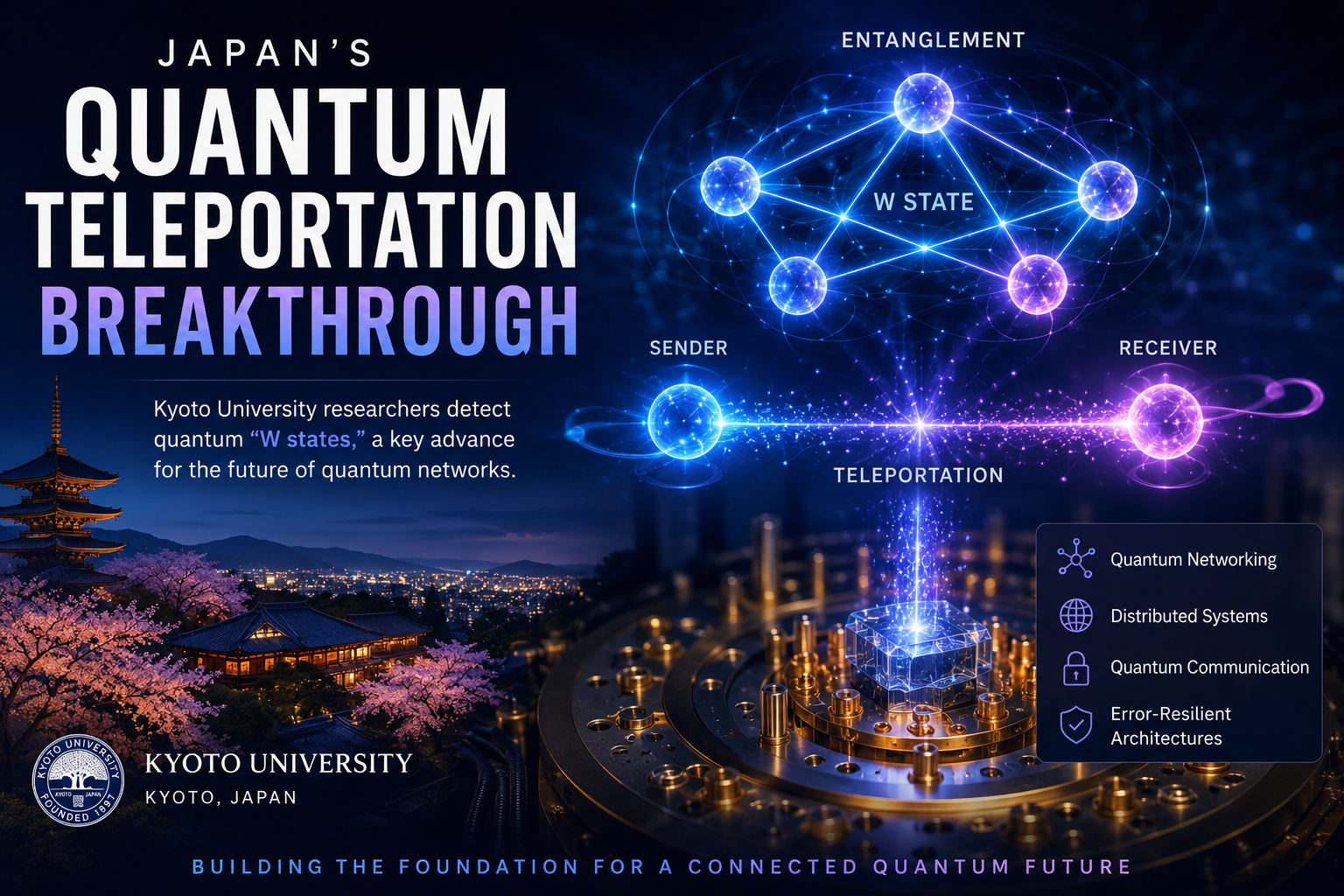
That appears to be the case with recent research emerging from Kyoto University involving the detection of quantum “W states,” a specific type of multipartite entanglement that could play a significant role in the future of quantum networking and distributed computing systems.
Predictably, many headlines immediately translated the story into the language of “teleportation breakthroughs.” Technically speaking, that description is not entirely wrong. Quantum teleportation is a real phenomenon rooted in entanglement, where information about a quantum state can be transferred between particles without physically moving the particles themselves. But the word “teleportation” carries enormous science-fiction baggage, often creating the impression that researchers are on the verge of transporting humans or objects across space like something from a movie.
That is not what is happening here.
The actual significance of Kyoto University’s work is much more subtle — and arguably much more important in the long run.
To understand why, it helps to step back and look at what entanglement really represents inside the broader quantum landscape. Entanglement occurs when particles become linked in such a way that the state of one particle is directly related to the state of another, even across distance. Albert Einstein famously described it as “spooky action at a distance,” partly because it appeared to violate conventional intuitions about locality and information transfer.
For quantum technologies, entanglement is not merely an interesting side effect. It is foundational infrastructure.
Quantum computing, quantum networking, quantum cryptography, and quantum communication systems all depend on the ability to create, maintain, measure, and manipulate entangled states with extraordinary precision. The challenge is that quantum states are incredibly fragile. Environmental noise, heat, vibration, and measurement itself can destabilize these systems almost instantly. This is one reason quantum engineering has proven so difficult despite decades of theoretical progress.
What makes W states particularly interesting is their resilience.
Unlike simpler forms of entanglement that can collapse if a single particle is disrupted, W states distribute entanglement across multiple particles in ways that preserve partial coherence even when portions of the system are lost. In practical terms, they offer a potentially more durable framework for building multipartite quantum systems — systems where many nodes or devices remain entangled simultaneously.
That may sound highly abstract, but the implications are substantial.
One of the largest engineering challenges facing quantum computing today is scalability. It is relatively straightforward, at least by quantum standards, to demonstrate a small number of functioning qubits in controlled laboratory conditions. The difficulty emerges when researchers attempt to scale those systems into larger networks capable of meaningful computation or communication. As complexity increases, instability grows rapidly. Errors accumulate. Coherence fades. Systems become exponentially harder to control.
This is where better handling and detection of multipartite entangled states could become transformative.
If researchers can reliably generate and verify complex entanglement structures like W states, it may strengthen the foundation for distributed quantum architectures — systems where multiple quantum devices communicate and cooperate across networks rather than relying on a single monolithic processor. Many researchers increasingly believe this modular approach represents one of the most realistic pathways toward practical quantum infrastructure.
In that sense, the Kyoto University research is less about teleportation in the popular sense and more about networking.
The future of quantum technology may depend just as much on connecting quantum systems as building them individually.
This mirrors the evolution of classical computing in important ways. Early computers were isolated machines, enormously powerful for their time but limited in scope. The real transformation occurred when networking technologies allowed systems to communicate, distribute workloads, and exchange information across vast infrastructures. The internet did not emerge because a single computer became infinitely powerful. It emerged because systems became interconnected.
Quantum technology may now be approaching a similar inflection point.
Better entanglement management could eventually support quantum communication protocols that are more stable, secure, and resistant to error. It could improve quantum repeaters — specialized devices needed to extend quantum communication across longer distances. It could also strengthen error-resilient architectures, one of the most important prerequisites for fault-tolerant quantum computing.
That last point deserves particular attention because error correction remains one of the defining obstacles in the entire field. Quantum systems are inherently noisy. Maintaining coherence long enough to perform useful operations is extraordinarily difficult. As a result, much of modern quantum engineering revolves around finding ways to preserve fragile states while minimizing accumulated computational errors.
Advances involving multipartite entanglement may help address part of that problem by creating systems that are inherently more robust under disruption. Researchers are effectively searching for architectures capable of surviving the instability that naturally emerges in quantum environments.
This is why developments like Kyoto University’s matter deeply inside the scientific community even if they do not immediately translate into consumer-facing products.
The most consequential technologies are often built through layered foundational advances that appear incremental to outsiders. Few people paid attention to packet-switching protocols when the early internet was being developed. Semiconductor refinements rarely generated public excitement before the personal computing revolution. Infrastructure breakthroughs often look small in isolation because their significance only becomes visible when viewed as part of a larger technological trajectory.
Quantum science operates similarly.
There is also a broader geopolitical dimension quietly surrounding these developments. Countries around the world increasingly recognize quantum technologies as strategic infrastructure with implications for cybersecurity, communications, defense systems, and economic competitiveness. Japan has steadily expanded its quantum research investments alongside efforts from the United States, China, Canada, and the European Union.
Japan’s strength in precision engineering, advanced materials, and photonics positions it uniquely within the global quantum race. Research emerging from institutions like Kyoto University reflects a larger pattern: nations are no longer treating quantum research purely as theoretical science. They are treating it as long-term infrastructure development.
And importantly, much of that infrastructure will emerge quietly.
Unlike consumer technologies that explode into public consciousness through visible products, quantum advances often unfold inside laboratories, networking protocols, and highly specialized research collaborations long before the broader public notices their implications. The real breakthroughs are frequently technical rather than theatrical.
That may explain why the “teleportation breakthrough” framing feels simultaneously misleading and understandable.
The word captures attention because it hints at the extraordinary nature of quantum mechanics itself. But the deeper story is not about science fiction becoming reality overnight. It is about researchers steadily solving the invisible engineering problems required to make future quantum systems functional at scale.
In many ways, that is even more interesting.
Because the future of quantum technology likely will not arrive through one dramatic breakthrough moment. It will emerge through hundreds of foundational advances — improved networking methods, more stable entanglement structures, stronger error correction techniques, and better system architectures — gradually transforming quantum systems from fragile experiments into operational infrastructure.
Kyoto University’s work appears to belong to that category.
Not flashy.
Not immediately commercial.
But quietly important in exactly the way foundational technologies often are.