

$150 billion.
It’s the kind of figure that doesn’t land all at once. It sits there, almost abstract, until you begin to trace where it’s meant to go—into factories, into systems, into something still forming. And then it starts to feel less like an announcement and more like a signal.
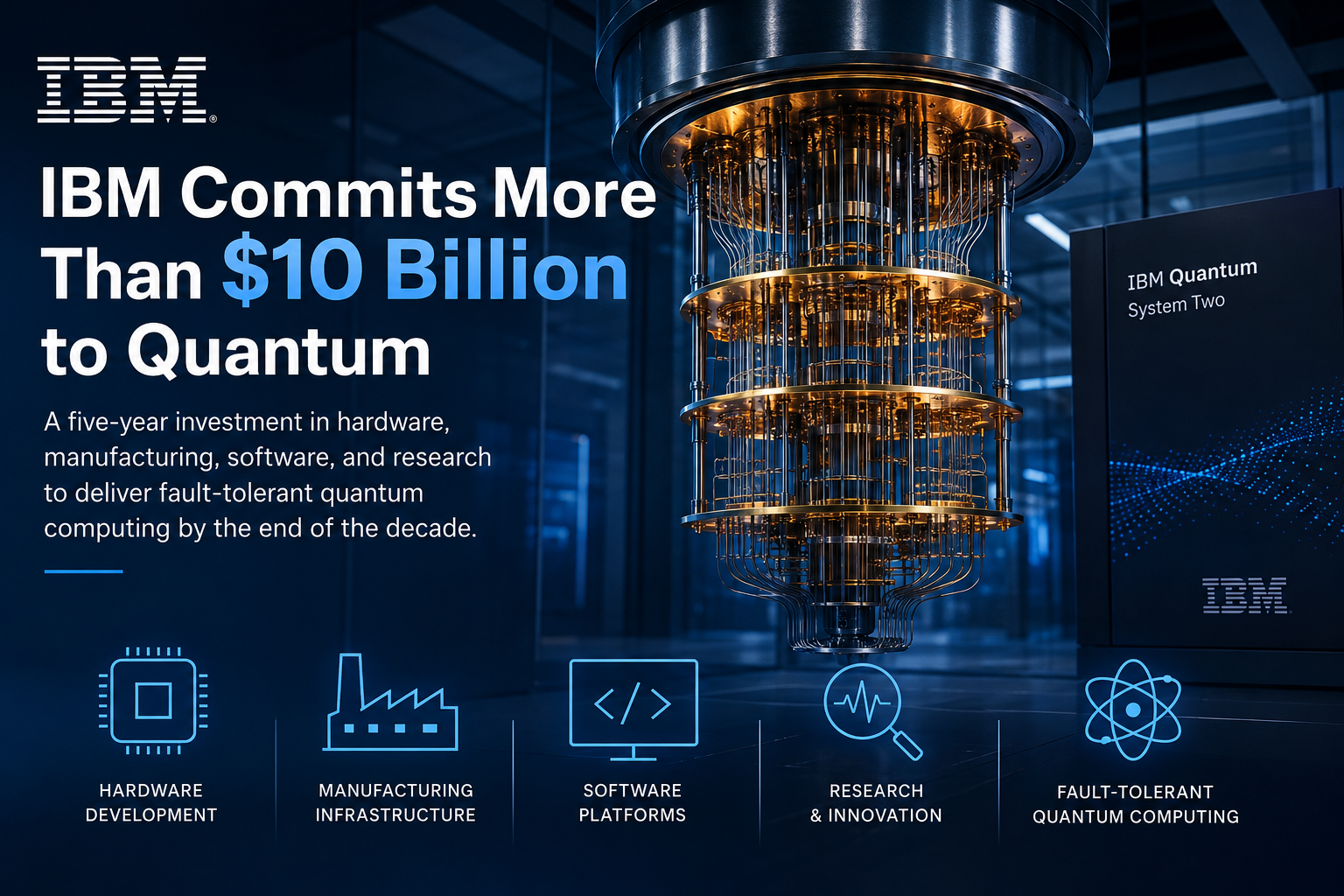
When IBM revealed its plan to invest $150 billion in the United States over the next five years, it wasn’t just a financial commitment. It was a declaration about where computing is going—and who intends to shape it.
But the story doesn’t really begin with the full $150 billion. It narrows, quietly, into a smaller number that carries more weight: over $30 billion dedicated specifically to quantum computing and advanced systems.
That’s where things start to shift.
The infrastructure beneath the idea
Quantum computing often lives in language that feels distant—superposition, entanglement, error correction. It’s easy to place it somewhere abstract, somewhere not quite “now.”
But this investment feels different.
Because it isn’t just about research.
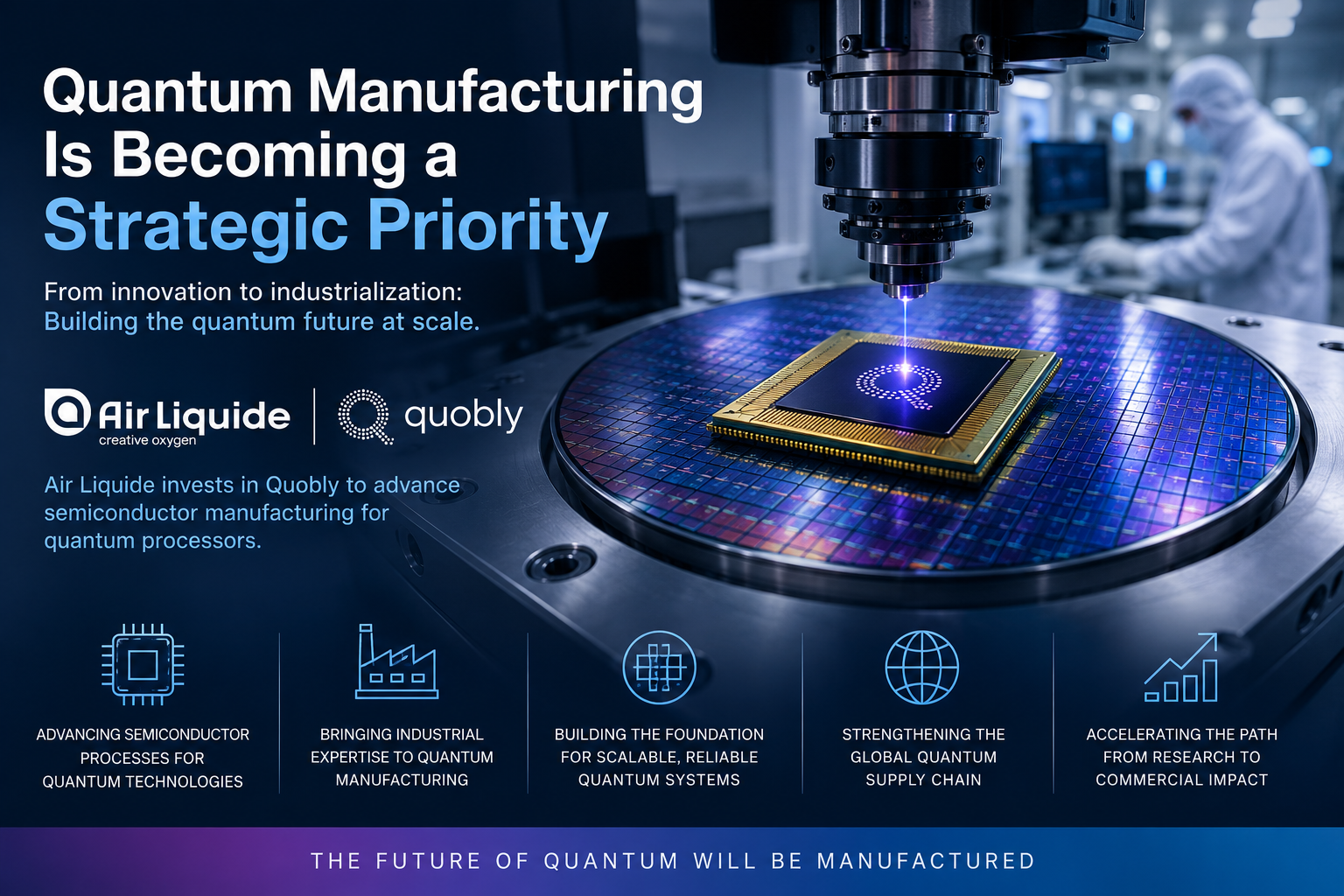
It’s about manufacturing.
There’s something grounding about that word. Manufacturing implies physicality. Facilities. Supply chains. People walking into buildings where machines are being assembled—not imagined.
And that’s where this move becomes more than technological optimism. It becomes industrial.
IBM is positioning quantum not as a distant breakthrough, but as something that needs to be built—piece by piece—within a national framework.
If you pause on that for a second, it reframes the entire conversation.
Quantum isn’t just a scientific race anymore.
It’s becoming an infrastructure race.
A quieter layer: sovereignty
There’s another thread running underneath this announcement, one that doesn’t always get named directly.
Control.
Over the last few years, there’s been a growing awareness that the future of computing—AI, quantum, advanced semiconductors—is tied to where and how systems are built. Not just who designs them, but who owns the process of bringing them into the world.
IBM’s investment leans heavily into domestic production.
At first glance, it reads like alignment with policy—tariffs, supply chain resilience, economic incentives. And yes, analysts have pointed out that these large-scale commitments often sit at the intersection of strategy and politics.
But there’s something deeper here.
When computation becomes foundational—when it starts to shape security, medicine, finance, materials—then where it lives matters.
Not just technically.
But geopolitically.
And suddenly, a quantum computer isn’t just a machine. It’s a position.
The tension between promise and time
There’s a quiet contradiction that sits inside all of this.
On one hand, the scale of investment suggests urgency. A sense that something important is already underway.
On the other hand, even the people building these systems don’t fully agree on when quantum computing will reach widespread, practical use.
Some estimates suggest five years.
Others stretch that horizon to decades.
That gap—the space between investment and certainty—feels important.
Because it tells you this isn’t just about immediate return.
It’s about positioning.
It’s about being ready for a future that isn’t fully defined yet.
And maybe that’s what makes it feel a little different from past technology cycles. There’s less clarity. More ambiguity. A kind of collective leaning forward without a clear endpoint.
The convergence you can almost feel
If you step back, this investment doesn’t sit in isolation.
It’s part of a broader pattern.
Large technology companies are making similar commitments—hundreds of billions directed toward AI infrastructure, manufacturing, and next-generation computing systems.
And slowly, the edges between these domains start to blur.
Quantum computing doesn’t stand alone. It intersects with AI, with high-performance computing, with simulation. It becomes part of a larger system—one that’s less about a single breakthrough and more about integration.
Even now, hybrid models are emerging—classical systems working alongside quantum ones, each handling different parts of a problem.
It’s less dramatic than the idea of a sudden leap.
More like a gradual stitching together of capabilities.
And if you listen closely, that’s where the real movement is happening.
The human layer beneath the scale
There’s something else that gets easy to overlook when the numbers get this large.
The people.
An investment like this isn’t just capital. It’s engineers, researchers, technicians, operators. It’s the slow accumulation of expertise—the kind that builds quietly over time and then, suddenly, feels essential.
Quantum computing, for all its complexity, still depends on human understanding. On intuition. On the ability to work within systems that don’t behave in familiar ways.
And that’s where it gets interesting.
Because the field itself requires a kind of thinking that doesn’t always follow straight lines. It’s iterative. Sometimes nonlinear. Often uncertain.
It mirrors, in a strange way, how many people already experience the world—processing patterns, holding multiple possibilities at once, navigating ambiguity.
There’s a certain kind of mind that feels at home in that space.
And as the field grows, it quietly expands what it means to “fit” in technology.
What this might actually mean
It’s easy to read an announcement like this as a headline.
A big number. A bold claim.
But if you stay with it a little longer, something else starts to come into focus.
This isn’t just about building faster computers.
It’s about building the conditions for a different kind of computation to exist at scale.
That means infrastructure.
Supply chains.
Talent pipelines.
Policy alignment.
And a willingness to invest before the outcome is fully clear.
It’s a long game.
And maybe that’s the part that lingers.
Because in a world that often feels driven by immediacy—quarterly results, short-term gains—this kind of investment suggests something slower. More patient. Almost… deliberate.
The feeling underneath it all
If you sit with this long enough, the announcement stops feeling loud.
It becomes quiet.
Not because it lacks significance, but because its impact will unfold gradually, almost imperceptibly at first.
New facilities will open.
Systems will be tested.
Partnerships will form.
And somewhere along the way, quantum computing will shift from something we talk about…
to something we begin to rely on.
Not all at once.
But in pieces.
And maybe that’s the real story here.
Not the scale of the investment.
But the subtle transition it represents—
from imagining the future…
to start building it.









Alysa
I found this piece to be very engaging and highly informative.
This website is a primary resource for useful information.передає