There’s a moment in the research that doesn’t announce itself. It doesn’t arrive with the usual language of breakthroughs or milestones. It sits there quietly, almost easy to miss, like a shift in light rather than a change in structure. For years, quantum entanglement has been described as something instantaneous—two particles linked across space, one responding the moment the other is measured. Clean. Complete. Almost too perfect.
But that word, “instantaneous,” has always carried a kind of tension. It feels like a placeholder, something we accepted because we couldn’t yet see inside the moment itself. Now, for the first time, that moment is opening.
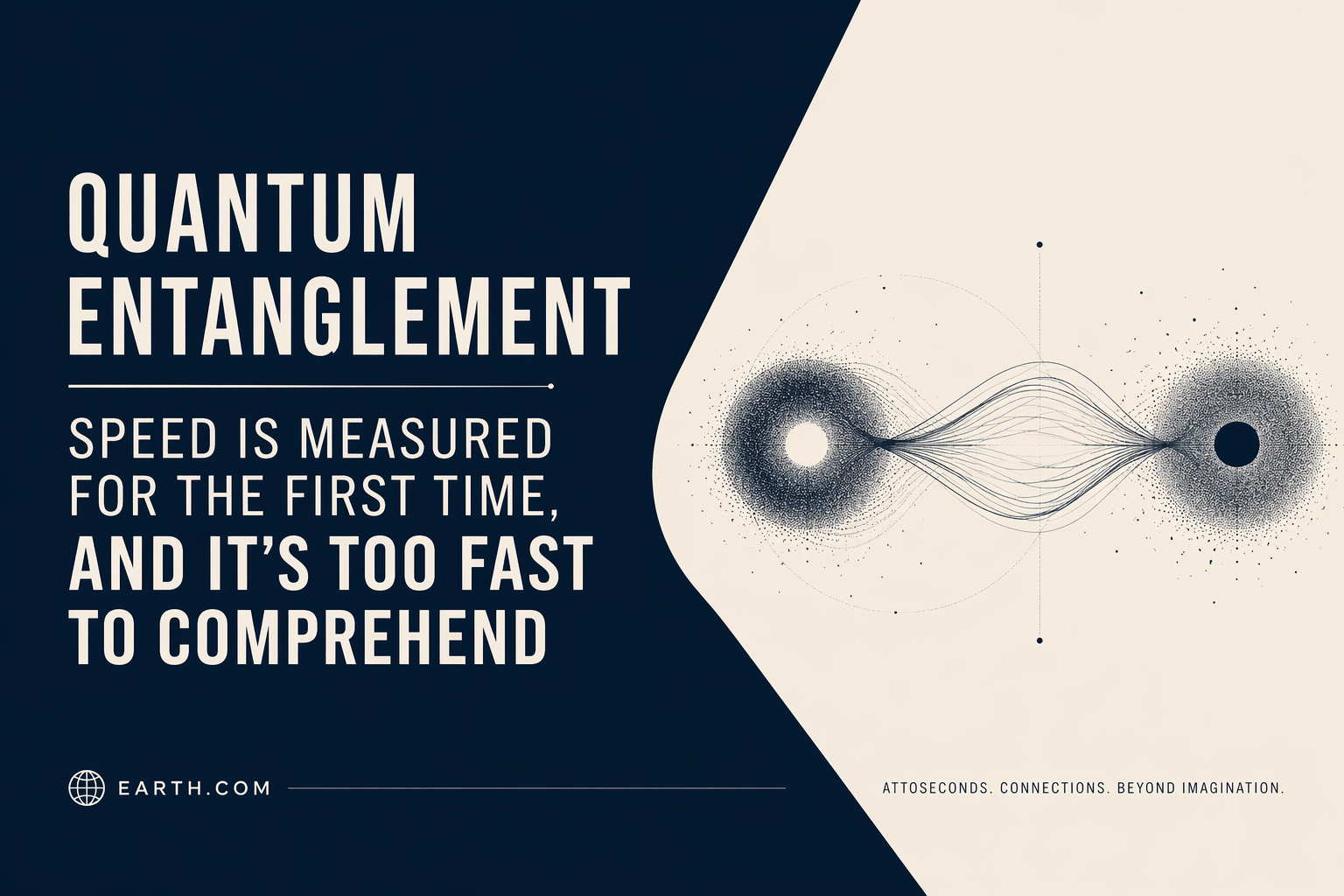
Researchers are beginning to measure entanglement not just as a result, but as a process. And what they’re finding unfolds at a scale that resists intuition. Attoseconds—so brief they exist almost outside of perception—are now measurable, observable, and slowly becoming understandable.
It changes the tone of the conversation.
The experiment, when described simply, feels almost grounded. An atom is struck with an intense laser pulse. One electron absorbs enough energy to break free and leave. Another remains behind, altered by the interaction. That part is straightforward. But what happens in between—the act of leaving—is where something more subtle begins to take shape.
The electron that escapes doesn’t depart in a clean, singular instant. There’s no precise timestamp marking its exit. Instead, it exists in a kind of uncertainty, a superposition where its departure is spread across a range of possibilities. Even the electron, in a sense, doesn’t “know” exactly when it left.
That detail lingers.
It reframes the idea of transition. Leaving isn’t a point. It’s a stretch. A process that carries ambiguity with it. And it’s within that ambiguity that entanglement forms.
We’ve often described entanglement as a connection across space, something almost spatial in its strangeness. But this research suggests something quieter and maybe more profound. Entanglement is also tied to time. The timing of the escaping electron is linked to the energy state of the remaining one. If one shifts higher, the other is likely to leave earlier. If one settled lower, the departure occurs later, sometimes by only a few hundred attoseconds.
Not random. Not isolated.
Connected, even before the system fully separates.
That changes the shape of the story. It’s no longer just about two particles sharing a state across distance. It’s about how their histories begin to overlap before they’ve fully become independent. Something forms in the in-between.
There’s a quiet shift happening here, one that doesn’t immediately translate into headlines about faster machines or sudden breakthroughs. But it matters. Because it moves quantum science from observation toward understanding.
Up until now, much of quantum engineering has focused on preservation. Keeping fragile states intact long enough to use them. Extending coherence. Reducing noise. Stabilizing systems that don’t naturally hold together. It’s been a kind of careful maintenance.
But if we can see how entanglement begins—if we can understand the conditions that give rise to it—then the approach changes. We move from maintaining to designing. From holding something together to shaping how it forms in the first place.
That distinction feels small at first. It isn’t.
It’s the difference between reacting to complexity and working with it.
There’s a pattern here that extends beyond physics. We tend to notice systems once they’ve already taken form. Once they’re visible, measurable, and defined. But the real leverage often exists earlier, in the phase where things are still forming. Where the structure hasn’t fully settled, and the outcome isn’t yet fixed.
That’s where this research is pointing. Into that early phase.
Into the part that feels too small to matter, until it suddenly does.
The ability to measure these attosecond differences comes from increasingly precise tools. Carefully timed, layered, and synchronized laser pulses allow researchers to detect subtle variations in when and how these interactions occur. It’s not just about seeing more clearly. It’s about asking better questions.
Before, the question was simple. Are these particles entangled?
Now it’s different. How does that entanglement form? What conditions shape it? What patterns exist inside the moment itself?
Those questions open new pathways. In quantum communication, it could mean designing entanglement more deliberately from the start. In computing, it could shift the focus toward creating more stable initial states rather than merely preserving them. In security, it adds nuance to how we think about information and connection at a fundamental level.
None of this happens all at once. It builds slowly.
Quietly.
Layer by layer.
There’s also something else unfolding here, something less technical but harder to ignore once it settles in. Time, at this scale, doesn’t behave the way we expect. It’s not just faster. It’s less defined. Less rigid. The idea that an event doesn’t have a single, knowable moment of occurrence challenges how we think about sequence and causality.
It introduces softness into something we usually treat as fixed.
And once that softness is there, even in a controlled experiment, it begins to shift the assumptions built on top of it.
I keep returning to the image of the electron leaving. Not as a jump, but as a kind of spill. A wave extending outward, gradually separating from its origin.
It’s not dramatic. It’s almost quiet.
But within that quiet motion, something forms that later appears instantaneous when viewed from a distance.
That’s the part that stays with me.
Not the speed. Not the scale.
The realization that what looks immediate is often just something happening faster than we can see. And now, with just enough resolution, we’re starting to notice the shape of it.
Not fully. Not completely.
But enough to understand that the beginning of something—no matter how small, how fast, or how easily overlooked—is rarely as simple as it first appears.