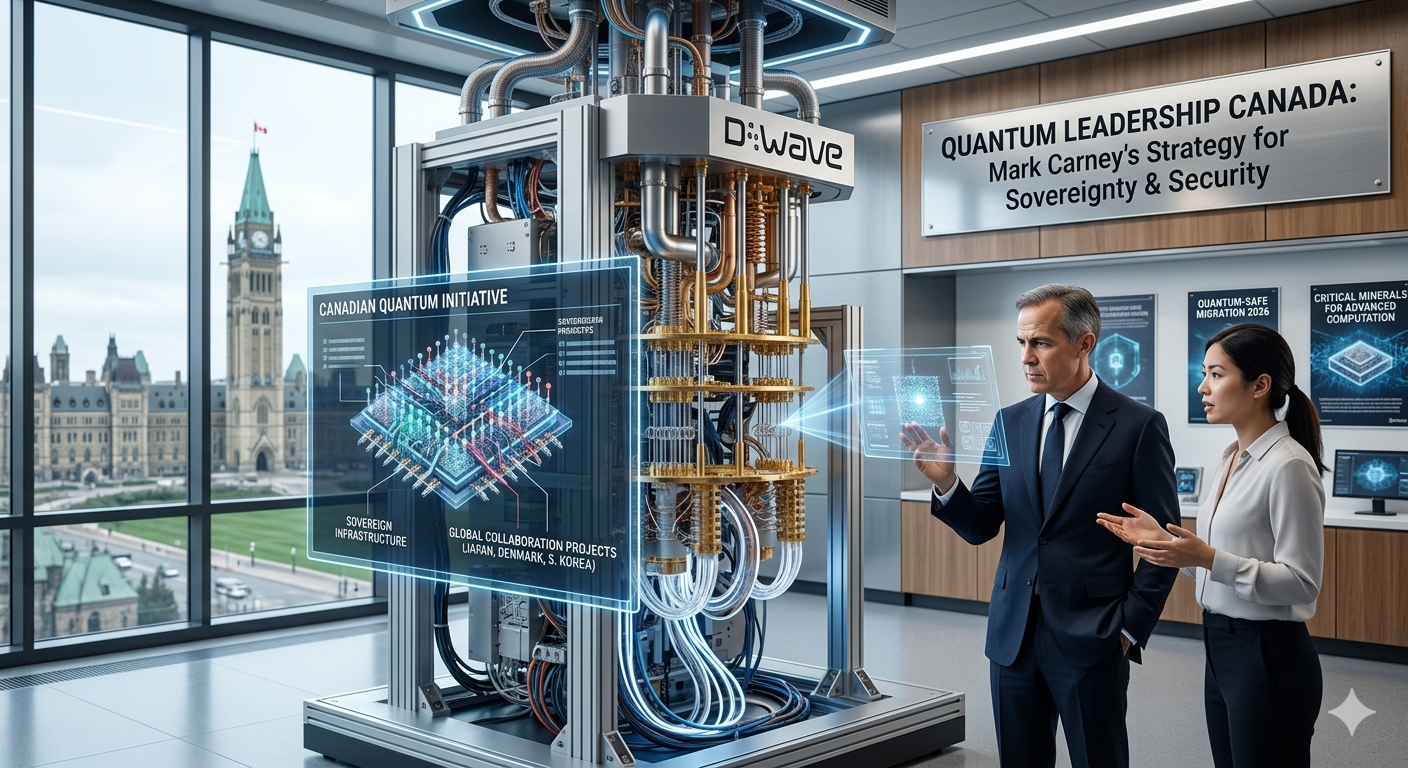
In the rapidly shifting global technology landscape, the “Quantum Decade” has officially arrived. For Canada, a nation that has punched above its weight in quantum research for decades, the stakes have shifted from theoretical excellence to industrial survival. Under the leadership of Prime Minister Mark Carney—a figure whose background in global finance and central banking brings a uniquely pragmatic lens to deep tech—Canada is positioning itself not just as a participant but as the “trusted laboratory” of the democratic world.
As a tech writer following this sector, I’ve seen the narrative evolve from “what is a qubit?” to “how do we secure the Northern supply chain?” Here is how Canada is charting its course through the quantum mist.
The State of Play: From Lab to Layout
The current state of quantum in Canada is one of aggressive transition. While the country has long been home to “Quantum Valley” in Waterloo and world-class hubs in Vancouver and Montreal, the focus has pivoted toward sovereign infrastructure.
The recent milestone at the University of Saskatchewan serves as a perfect microcosm of this shift. By acquiring the country’s first university-owned, full-stack quantum computer, Canada is signaling that these machines are moving out of private corporate black boxes and into the hands of national researchers. This isn’t just about speed; it’s about open architecture—ensuring that Canadian scientists aren’t just renting time on foreign clouds but are building the underlying systems themselves.
Mark Carney’s “Quantum Realism”
Prime Minister Mark Carney has framed quantum technology as a pillar of both economic resilience and national security. His policy approach treats quantum not as a standalone “gadget” sector, but as an integrated layer of the national infrastructure.
Under Carney, Canada has committed to a bold vision:
- Defense as a Catalyst: Carney has linked quantum development to NATO commitments, earmarking a portion of the increased 5% GDP defense spending for “frontier technologies.” This includes $900 million specifically for the Defence Industrial Strategy, recognizing that quantum sensing and computing are the next frontiers of electronic warfare and intelligence.
- The Cybersecurity Wake-Up Call: Recent breakthroughs (such as Google’s rapid scaling of error-corrected qubits) have shortened the “Y2Q” timeline—the day quantum computers can crack modern encryption. The Carney government has responded by mandating federal departments to migrate to quantum-safe cryptography by 2026, viewing this as a “national modernization effort” akin to the 20th-century build-out of the electrical grid.
The Strategy: Leadership Through Collaboration
Canada knows it cannot outspend the United States or China in a pure “qubit arms race.” Instead, it is positioning itself as the Global Collaborator. This is a strategic play to ensure Canada remains indispensable to the global supply chain.
1. The “Trusted Ally” Brand
Canada is leveraging its reputation as a stable, rule-of-law-abiding partner. By signing the Comprehensive Strategic Partnership with Japan in March 2026, Carney has secured a bridge between Canadian quantum software and Japan’s manufacturing and hardware prowess. Similar R&D partnerships with South Korea and Denmark focus on “co-innovation”—essentially saying, “We provide the brains and the materials; you provide the scale.”
2. The Materials Advantage
You can’t build a quantum computer without specialized materials. Canada is leaning into its “Critical Minerals Strategy,” leveraging its vast reserves of the elements needed for superconducting circuits and quantum dots. By tying mineral exports to technology sharing, Canada ensures it isn’t just a “hewer of wood and drawer of water” in the digital age, but a gatekeeper of the physical building blocks of quantum hardware.
“Our margin for delay is smaller than we thought. Being left behind could mean Canada’s timelines are at the mercy of international trade relationships.” — Recent policy briefing on Quantum-Safe Migration.
The Economic Engine: The Canadian Quantum Champions
The launch of the Canadian Quantum Champions Program (CQCP), with nearly $100 million in initial funding, represents a shift toward commercialization. The goal is to move beyond the “startup phase” and create “scale-ups.” Companies like D-Wave, Xanadu, and Photonic Inc. are no longer just experiments; they are the anchors of a market projected to reach billions by the early 2030s.
Canada’s strategy is essentially a three-pronged fork:
- Hardware Sovereignty: Owning the machines (e.g., the USask project).
- Software Dominance: Leading in quantum algorithms for BFSI (Banking, Financial Services, and Insurance).
- Security Leadership: Becoming the world’s first “quantum-safe” economy.
Looking Ahead: The 2029 Horizon
The Carney government’s aggressive timeline suggests they anticipate meaningful quantum threats—and opportunities—as early as 2029. By integrating quantum into defense, energy, and trade policy, Canada is attempting to “future-proof” its sovereignty.
In the world of tech writing, we often talk about “disruption.” But for Canada, quantum isn’t just a disruptor; it’s a foundation. If the Carney administration’s bets pay off, Canada won’t just be using the quantum computers of the future—it will be the one providing the security, the minerals, and the logic that makes them run.
Mark Carney’s speech on Canada’s commitment to NATO and quantum
This video provides direct context on how the Canadian government is linking its defense spending and infrastructure goals to advanced technologies like quantum computing and AI.