The first thing that stands out isn’t what’s being said—it’s what’s being managed. You can almost picture it: a system that doesn’t sit still, that refuses to hold its shape unless something is constantly adjusting it. Not fixing it once, but tending to it again and again. Small corrections, happening faster than attention can follow. And somewhere in that motion, you start to realize this isn’t really a story about building a quantum computer. It’s a story about keeping one alive long enough to matter.
There’s a quiet shift in this conversation that doesn’t announce itself but changes everything once you notice it. The focus moves away from capability—from what quantum could do—and settles, almost reluctantly, on something more grounded. How do you work with something that won’t stay still? How do you operate a system that is, by its nature, unstable? And that’s where the conversation begins to deepen.
For a long time, quantum computing has been described in terms of potential. Exponential speedups. Entire classes of problems are collapsing into solvable ones. A horizon that always feels just close enough to keep attention, but far enough to avoid accountability. But what emerges here is something quieter and more honest. The real challenge isn’t building quantum systems. It’s operating them.
What NVIDIA’s Nic Harrigan makes clear, without ever overstating it, is that quantum computers are not passive machines. They don’t wait for instructions and return answers. They require constant interaction—continuous calibration, continuous measurement, continuous correction. They behave less like tools and more like environments that have to be maintained.
And that’s where AI begins to enter the picture.
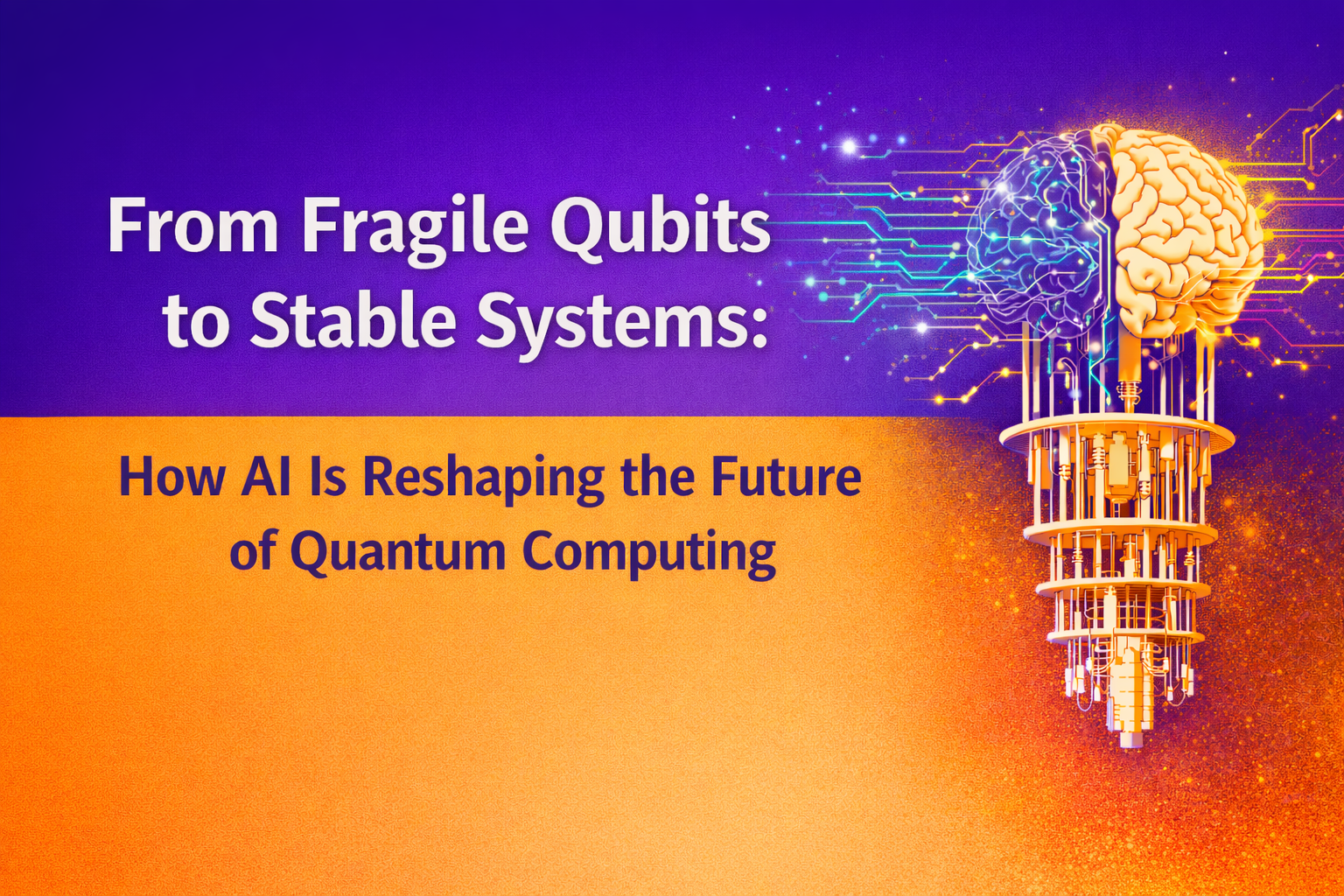
Not as an enhancement. Not as a layer on top. But as something embedded within the system itself—watching, adjusting, learning in real time. Because the reality is, quantum systems move too quickly and generate too much complexity for human intervention alone. The noise is constant. The variables are shifting. The margin for error is narrow and unforgiving.
So AI becomes something else entirely.
It becomes a form of stability.
There’s something quietly profound in that shift. We tend to think of AI and quantum computing as separate frontiers, each advancing on its own trajectory. But here, they begin to look intertwined. Interdependent. Almost as if one is learning how to hold the other steady long enough to be useful.
And once you see that, the timeline begins to feel different.
If AI can manage calibration, assist with error mitigation, and interpret outcomes as they happen, then the path to usable quantum computing compresses. Not because the underlying physics has changed, but because the system surrounding it has become more adaptive. More responsive. More capable of sustaining itself.
There’s a quiet movement happening—from physics to engineering. From breakthrough to operation.
Instead of asking whether we can build quantum computers, the question becomes whether we can operate them reliably enough to matter. And that’s a different kind of challenge. Less theoretical. More practical. Closer to the ground.
What’s interesting is how this begins to reshape access. For years, working with quantum systems required deep specialization and physical proximity. It was a space defined by expertise and limitation. But as AI absorbs more of the operational burden, that barrier starts to soften. Not disappear, but shift.
You don’t need to understand every layer of the system to begin interacting with it.
You just need a way in.
And when that happens, something else follows. The ecosystem expands. New participants enter—researchers from adjacent fields, developers, curious technologists. And with them come new questions. Different perspectives. Unexpected use cases.
That’s often where real progress begins.
Not just in solving known problems, but in discovering new ones.
There’s also a kind of restraint in how this is discussed. No sweeping claims. No illusion that quantum computing is suddenly ready to transform everything. The challenges are still present. Noise hasn’t disappeared. Error rates still matter. Scalability is still unresolved.
But the approach to those challenges is changing.
Instead of trying to eliminate instability, the focus shifts to managing it. Working with it. Building systems that can adapt to it in real time. And that feels like a more sustainable path forward.
There’s a moment where the conversation brushes up against something that lingers. The idea that quantum computing may not arrive as a single, defining breakthrough. Not a moment where everything suddenly works. But as a gradual integration into existing systems.
Hybrid models. Classical and quantum working together. AI embedded throughout. Layers forming around the core technology, making it more usable, more accessible, more real.
And if that’s the case, then the future of quantum doesn’t look like a replacement. It looks like an extension.
Something that quietly integrates into workflows, into infrastructure, into decision-making processes—often without announcing itself.
That kind of progress is easy to miss. It doesn’t demand attention. It accumulates.
For the quantum curious, this can feel disorienting. There’s no clear line between before and after. No single moment that signals arrival. Just a series of small, meaningful shifts. AI stepping into the control loop. Systems stabilizing slightly. Access widening, just enough.
And over time, those shifts begin to matter.
Because what this conversation ultimately reveals is something simple, but easy to overlook. Quantum computing isn’t just a hardware problem. It’s a systems problem.
And systems don’t become useful all at once. They become useful when the layers around them—control, interpretation, accessibility—are strong enough to support them.
That’s what AI is beginning to provide.
Not the breakthrough itself.
But the structure that allows breakthroughs to hold.
And once that structure is in place, something changes. Not suddenly. Not visibly. But enough to feel it.
The system steadies.
And then, almost quietly, it begins to work.