For years, quantum computing has carried this familiar rhythm—almost like something we’ve all agreed to repeat without questioning it too closely. It’s coming. It’s powerful. It’s still ten to fifteen years away.
And for a while, that felt reasonable. Comforting, even. A future we could keep pointing to without needing to fully engage with it.
But the delay was never about ambition. Or funding. Or even imagination.
It was something quieter. More physical.
Qubits don’t behave like the systems we’re used to. They flicker. They drift. They respond to things we can’t always see—tiny fluctuations in temperature, invisible interference, the kind of noise that doesn’t announce itself but still changes everything.
They don’t fail loudly. They just… stop being what they were.
And that has been the real tension underneath all of this. Not building quantum systems—but keeping them stable long enough to matter.
When you start to look at it that way, something else becomes clearer.
The race was never just about more qubits.
It was about control.
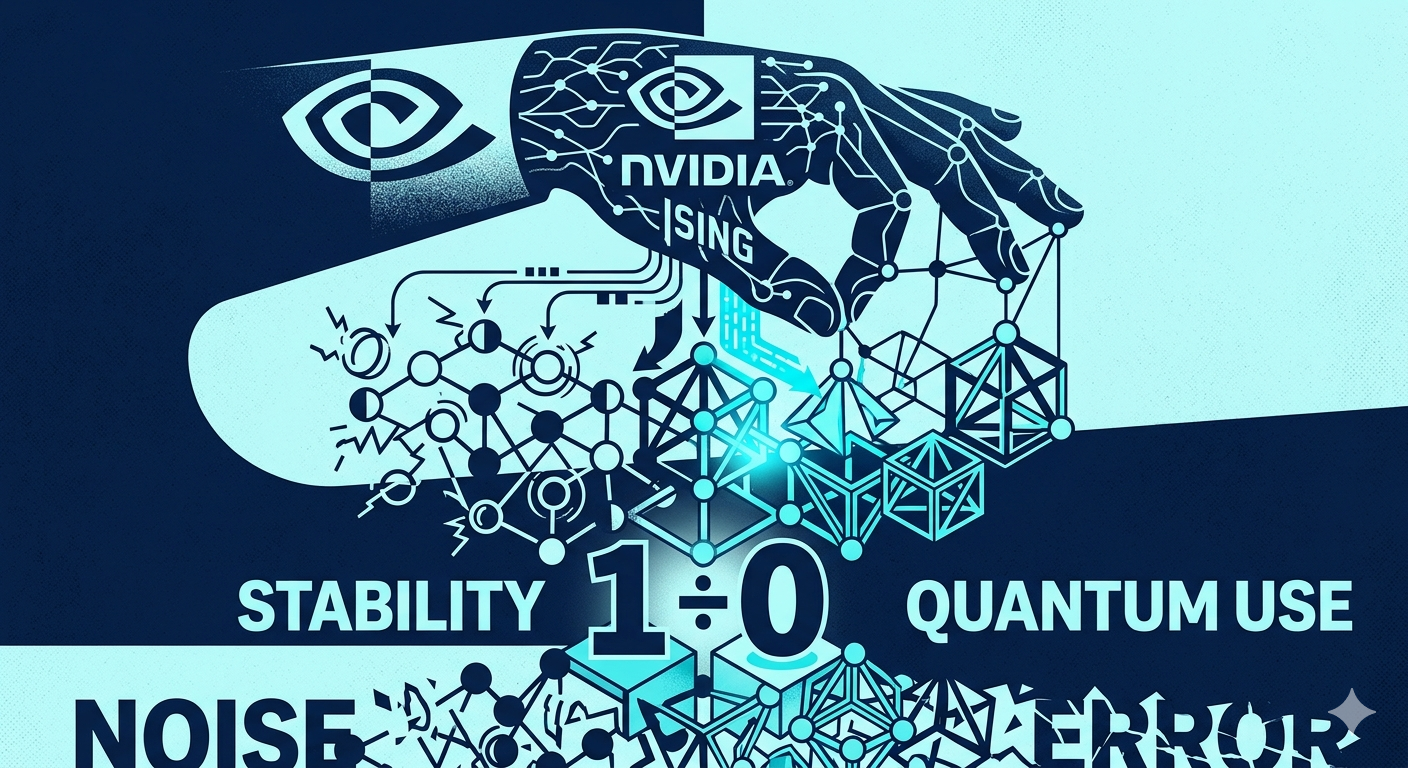
What NVIDIA is doing with Ising doesn’t feel like a headline-grabbing breakthrough at first glance. It’s not a new type of qubit. It doesn’t promise exponential leaps in raw compute power.
It does something more subtle.
It stabilizes the system around the qubits.
And that changes the shape of the problem.
Instead of treating quantum as something you build and then struggle to maintain, Ising approaches it like a living system that needs constant adjustment—small, continuous corrections happening faster than a human could realistically manage.
Calibration, which used to take days, compresses into hours.
Error decoding, something that quietly determines whether a computation survives or collapses, becomes faster. More precise.
Not perfect. But closer.
And in quantum, closer matters more than it sounds.
There’s something almost familiar in this shift.
It reminds me of how certain kinds of thinking work—especially when your brain doesn’t move in straight lines.
You don’t eliminate noise.
You learn how to work with it.
You build systems around it that gently, continuously guide things back into place.
Not rigid control.
Adaptive control.
That’s what this starts to feel like.
AI stepping in not as a layer on top, but as something embedded in the process itself—watching, adjusting, recalibrating in real time.
A kind of quiet intelligence sitting just beneath the surface, keeping everything from slipping too far.
And when that layer exists, the timeline begins to bend.
Not suddenly. Not dramatically.
But enough to feel it.
Because if the system can hold itself together—even imperfectly—you don’t need to wait ten years just to keep it running. You can start building on top of it sooner.
That’s the part that lingers.
What NVIDIA seems to understand—maybe more than most—is that every frontier technology eventually reaches this moment where hardware alone isn’t the constraint anymore.
It becomes about orchestration.
About the invisible systems that make complexity usable.
We’ve seen it before in AI. In distributed systems. Even in something as simple as cloud infrastructure.
The breakthrough isn’t just capability.
It’s control at scale.
So now the center of gravity shifts a little.
Away from just the physical machines—the cryogenic setups, the intricate hardware—and toward the layer that keeps those machines operational.
The part you don’t always see.
But the part that decides whether anything actually works.
There’s a line that stays with me from all of this, even if it isn’t said directly:
Quantum computing was never just about building something powerful.
It was about building something stable enough to trust.
And trust, in systems like this, is never absolute.
It’s built slowly. Iteratively. Through thousands of small corrections that most people will never notice.
For someone standing just outside the field—curious, maybe a little unsure where to look—this is the signal worth paying attention to.
Not the loud announcements.
Not the race for bigger numbers.
But the quiet emergence of a missing layer.
The part that makes everything else usable.
And once you see it, it’s hard to unsee.
Because it suggests something slightly uncomfortable, but also… oddly grounding:
The future of quantum might not arrive as a single breakthrough.
It might arrive the way this did—
through systems that learn how to hold themselves together
just long enough
for us to begin.