There’s a particular kind of fear that moves quickly in technical spaces. It doesn’t build slowly or ask for context. It arrives fully formed—clean, dramatic, easy to repeat.
“Quantum will break Bitcoin.”
It’s the kind of statement that feels definitive. Almost cinematic. Like something already decided, just waiting for the timeline to catch up.
But when you sit with it—really sit with it—it starts to loosen. Not disappear. Just… lose its sharp edges.
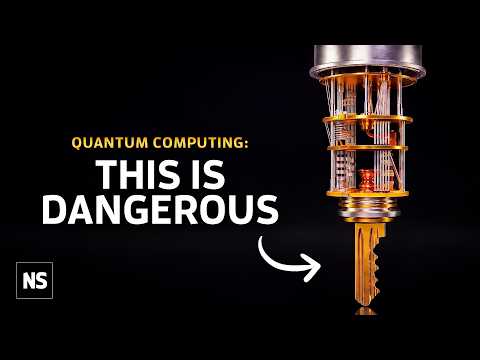
Because what this video does, quietly, is separate what is possible from what is present. And that gap—the space between theory and reality—is where most of the noise lives.
The idea of a “quantum apocalypse” for Bitcoin tends to anchor itself to one metric: qubits. The more qubits a quantum computer has, the closer it gets to breaking the cryptographic systems that secure digital assets.
For a long time, the number floated around felt almost safely distant—millions of qubits required to crack Bitcoin’s encryption. A scale so large it pushed the threat comfortably into the future.
Then the number shifted.
More recent research suggests that the requirement might be lower. Not millions, but hundreds of thousands. Something closer. Something that sounds, at least on paper, like progress.
And that’s where the tension begins.
Because a smaller number feels like movement. It creates the impression that we’re advancing toward a threshold—something that could eventually be crossed.
But what often gets lost is where we’re starting from.
Today’s most advanced quantum systems operate with a few hundred qubits. Not hundreds of thousands. Not even close. And even those systems are unstable—prone to noise, error, and collapse before meaningful computation can fully unfold.
So when the number shifts from ten million to five hundred thousand, it doesn’t mean we’re halfway there.
It means we’re still at the very edge of the beginning.
There’s another detail that gets repeated often enough to feel precise: ten minutes.
It sounds specific. Measured. Like a known vulnerability.
And in a way, it is.
Bitcoin processes transactions in roughly ten-minute intervals. Blocks are added to the chain, confirming activity and locking it into the ledger. The theory goes that if a quantum computer could derive a private key from a public key within that window, it could intercept a transaction before it’s finalized.
It’s a compelling idea. Clean. Contained.
But it depends on something that isn’t always present.
A public key.
In Bitcoin, a public key isn’t permanently exposed. It becomes visible when a transaction is made—when funds are spent from an address. Until that moment, what’s visible is a hashed version of that key, not the key itself.
So the so-called “attack window” isn’t always open.
It appears briefly, during use.
Which means that for many users—those holding Bitcoin in unused addresses—there is nothing for a quantum system to target. No exposed key. No entry point.
The vulnerability isn’t universal.
It’s conditional.
And that changes the narrative in a way that doesn’t always make it into headlines.
There’s also a larger context that tends to fade into the background of these conversations.
If a quantum computer existed today that could break Bitcoin’s encryption, Bitcoin wouldn’t be the first or most important system at risk.
It would be everything.
Banking infrastructure. Government systems. Military communications. Power grids. The entire architecture of modern digital security is built on cryptographic assumptions that would be challenged simultaneously.
Bitcoin is just the most visible example.
Not the only one.
And when you zoom out to that scale, something else becomes clear.
There is no scenario where this problem is ignored.
The incentives are too high. The dependencies are too deep.
Work on quantum-resistant cryptography—often called post-quantum cryptography—is already underway. Standards are being developed. Systems are being tested. Transitions are being planned.
Not as a reaction to a crisis, but as a preparation for one.
Quietly. Methodically.
This is where Bitcoin’s nature as a protocol—not a product—starts to matter.
It isn’t fixed.
It evolves.
Over time, Bitcoin has undergone upgrades, adjustments, and refinements. Not without friction, not without debate—but with the capacity to change when needed.
And that includes its cryptographic foundations.
If a quantum threat moves from theoretical to practical, there are pathways for adaptation. New address formats. Updated signature schemes. Migration strategies that allow users to move funds into more secure structures.
It wouldn’t be instant.
It wouldn’t be seamless.
But it wouldn’t be static either.
What the “quantum apocalypse” narrative misses is time.
Not in the sense of deadlines, but in the sense of pacing.
Technological shifts of this magnitude don’t arrive overnight. They build. Incrementally. Unevenly. With breakthroughs and setbacks layered together.
And alongside them, defenses evolve.
Sometimes faster.
There’s something almost familiar in the way this fear circulates.
It simplifies a complex system into a single moment of failure. A collapse. A before and after.
But most real systems don’t behave that way.
They adapt. They shift. They absorb pressure and redistribute it.
They change shape before they break.
That doesn’t mean the quantum threat isn’t real.
It is.
But it’s not immediate. And it’s not isolated.
It exists as part of a broader transition—one in which both the capabilities of quantum systems and the defenses against them are evolving simultaneously.
A race, but not a one-sided one.
And maybe that’s the more accurate way to hold it.
Not as an impending collapse, but as a system in motion.
Where risk exists, but so does response.
Where vulnerability is real, but so is resilience.
The phrase that lingers is quieter than the headlines.
Not apocalypse.
Not inevitability.
Just… potential.
A quantum ghost in the machine.
Not gone. Not fully formed.
But not yet something you can touch.