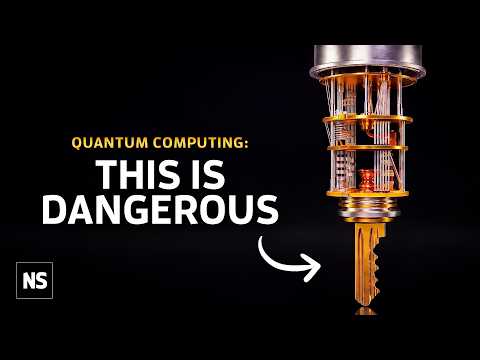
I watched this one twice. Not because it was hard to follow, but because it moves in a way that’s easy to underestimate. It feels simple at first, almost like it’s walking you through familiar ground. And then, somewhere in the middle, you realize it’s quietly rearranging how that ground is shaped beneath you.
The video leans into a core idea of quantum computing: that the way we process information is not fixed. It only feels fixed because we’ve built an entire digital world around one assumption—that information is binary. Ones and zeros. On or off.
That assumption has worked. It’s built everything.
But it’s also… limiting.
And what the video begins to show, almost gently, is what happens when that assumption loosens.
At the center of it all is the qubit.
Not just as a technical object, but as a shift in perspective.
A classical bit has to choose. It exists as a 0 or a 1. There’s something comforting about that. It aligns with how we tend to think—clear states, defined outcomes, certainty as the end goal.
A qubit doesn’t choose in the same way.
It exists in a superposition, meaning it can hold multiple states at once until it’s measured.
That’s the part people often repeat. But what stays with me is how it actually feels when you let it sit for a second.
It’s not just “both at once.”
It’s unresolved.
Open.
A system that carries possibility forward instead of collapsing it immediately.
The video moves through this without overcomplicating it. It doesn’t get lost in equations. It stays close to intuition but doesn’t oversimplify. It lets the strangeness remain.
And that matters, because quantum computing isn’t just faster computing.
That’s one of the quiet corrections happening underneath the explanation.
It’s not about doing the same thing quicker.
It’s about doing something different entirely.
There’s a moment where the idea of parallelism comes into focus—not in the way we usually think about parallel processing, where multiple tasks run side by side, but something deeper.
Quantum systems can explore many possible solutions simultaneously—not by duplicating effort, but by existing in a space where those possibilities haven’t collapsed yet.
And that’s where the advantage begins to emerge.
Not in speed alone, but in how problems are approached.
You start to see why certain problems—optimization, cryptography, molecular simulation—keep coming up in quantum conversations.
These are problems that don’t resolve easily. They branch. They expand. They resist being narrowed down into a single linear path.
Classical systems push through them step by step.
Quantum systems… move differently.
They hold the problem’s shape more fluidly, allowing multiple paths to exist until something forces a resolution.
There’s something almost familiar about that if you’ve ever experienced a mind that doesn’t move linearly.
Where multiple ideas exist at once. Where clarity doesn’t come from forcing a decision too early, but from letting things stay open long enough to see the pattern.
Quantum computing feels a bit like that.
Not chaotic. Just… less constrained.
The video also touches on entanglement, though it doesn’t dwell on it.
Two qubits linked in such a way that the state of one is tied to the state of another, no matter the distance between them.
It’s one of those concepts that feels almost poetic when you first hear it, and then quietly becomes technical as you realize how it’s used.
Because entanglement isn’t just strange.
It’s useful.
It allows quantum systems to coordinate in ways classical systems can’t—creating relationships between pieces of information that persist even when they’re separated.
And then there’s the fragility.
This is the part the video doesn’t shy away from.
Quantum systems are incredibly sensitive. Noise, temperature, interaction with the environment—any of it can disrupt the state. Collapse the system. Introduce errors.
It’s not just a challenge. It’s the challenge.
And this is where the tone of the video shifts slightly—from explanation to realism.
Because for all the potential, quantum computing is still being built.
Still being stabilized.
Still finding ways to exist outside controlled environments.
That tension—between possibility and limitation—is what makes this moment in quantum feel so specific.
We’re not in the purely theoretical phase anymore.
But we’re not fully in deployment either.
We’re in between.
And the video sits right in that space.
There’s a subtle clarity that emerges when you see it framed this way.
That the real story isn’t “quantum will replace classical.”
It won’t.
It will sit alongside it.
Handling the kinds of problems that don’t fit neatly into binary logic, while classical systems continue to manage everything else.
A hybrid world.
Layered.
And that’s where this starts to feel less like a distant future and more like something already forming.
Because pieces of this are already here.
Cloud-based quantum systems. Early algorithms. Research pushing into error correction, scalability, practical use cases.
Not complete. But not hypothetical either.
There’s a moment, toward the end, where the explanation settles into something quieter.
It doesn’t try to predict timelines.
It doesn’t overstate impact.
It just leaves you with the sense that computing, as we’ve known it, is expanding.
Not breaking.
Not being replaced.
Just… widening.
And that’s what stayed with me.
Not the mechanics, not the terminology, but the shift in how problems are allowed to exist before they’re solved.
That space where multiple outcomes are still alive.
Where resolution hasn’t been forced yet.
Where the system is holding complexity instead of collapsing it too early.
Because that’s the part that feels most relevant—not just to quantum computing, but to how we think in general.
The instinct to resolve quickly.
To reduce.
To decide.
And the quiet possibility that sometimes, the better approach is to hold more than one state at once… just a little longer.
Quantum computing doesn’t make that easy.
It doesn’t make it comfortable.
But it does make it possible.
And maybe that’s the real shift.
Not just in machines.
But in how we start to understand what thinking itself can look like.