India has built a 1,000-kilometer quantum communication link. That’s the headline. It’s clean, measurable, and easy to repeat. But when you stay with it a little longer, the meaning starts to shift. Because this isn’t just about distance. It’s about what holds across that distance—and what doesn’t.
We’re used to thinking about communication as something that can be copied. Data moves, gets duplicated, intercepted, stored, and replayed. The entire architecture of modern networks assumes that information can exist in multiple places at once without consequence. That’s the convenience. That’s also the vulnerability.
Quantum communication doesn’t follow that rule.
It resists duplication.
At its core, it relies on photons—particles of light—carrying information not as fixed bits, but as quantum states. These states are delicate. They don’t tolerate interference well. And that fragility, which once felt like a limitation, is becoming the system’s defining strength.
There’s a moment when this clicks—not intellectually, but almost physically. The realization that in a quantum network, if someone tries to listen, they don’t just access the message. They change it.
Not metaphorically. Literally.
The act of observation disturbs the state. The system registers it. The signal carries evidence that it’s been touched.
It’s a strange inversion of how we think about security. Instead of building higher walls, you build something that cannot be quietly entered.
And suddenly, trust isn’t enforced. It’s revealed.
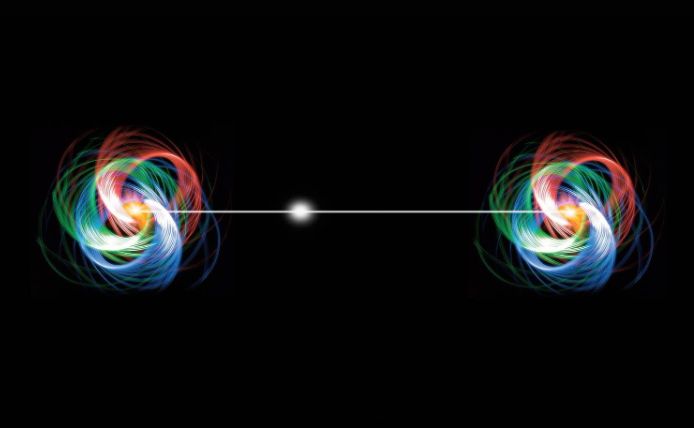
The video walks through this with the familiar analogy of entanglement—two particles linked in a way that feels almost narrative, as if they’re holding on to each other across space. You change one, the other responds instantly. Not faster than light in the way headlines like to exaggerate, but in a way that collapses the distance conceptually.
It’s one of those ideas that people often file under “interesting but abstract.”
But here, it’s being used.
Not in a lab. Not in isolation. Across 1,000 kilometers of real infrastructure—fiber lines stretching through environments that aren’t controlled, aren’t clean, aren’t predictable.
And that’s where the weight of this lands.
Because quantum systems aren’t supposed to like the real world.
They lose coherence. They degrade. They drift.
So when something holds across that kind of distance, it’s not just a technical milestone. It’s a signal that the boundary between theory and deployment is thinning.
Not gone. But thinner than it was.
There’s also a quiet acceleration embedded in this story.
The original goal was 2,000 kilometers over eight years. This milestone reaches halfway in roughly two. That compression of time matters. Not because it guarantees anything, but because it suggests a pattern we’ve seen before in other technologies.
Once something becomes buildable, timelines shift.
Not linearly. Faster.
And that’s where this starts to move from “interesting development” into something more structural.
Because this isn’t just about one network. It’s about the beginning of many.
Underneath the technical achievement, there’s a layer that feels more strategic. Less visible, but just as present.
Quantum communication is becoming part of the national infrastructure. Not experimental infrastructure. Foundational.
The National Quantum Mission (NQM) isn’t just funding isolated projects. It’s building an ecosystem—communication networks, computing capabilities, sensors, and startups. A full stack, even if it doesn’t look like one yet.
And that matters because security, at this level, isn’t just about protecting data. It’s about controlling how that protection is implemented.
Who builds the system?
Who defines the protocols?
Who ensures there are no unseen vulnerabilities embedded deep in the architecture?
There’s a word that appears in the background of this effort—Atmanirbhar. Self-reliant. It’s easy to read it as policy language. But in this context, it feels more like a design principle.
Build the system yourself, or inherit the risks that come with someone else building it for you.
But what stays with me isn’t the policy. It’s the shift in how security itself is being imagined.
Right now, most of our digital protection is based on complexity. Mathematical problems that are hard to solve. Hard, but not impossible. Just… time-consuming.
Quantum-secured communication doesn’t rely on difficulty.
It relies on detectability.
If someone interferes, you know.
That changes the posture entirely.
It moves security from prevention to awareness. From trying to make systems impenetrable to making them transparent to intrusion.
And there’s something about that shift that feels more aligned with how systems actually behave under pressure.
Not perfect. But observable.
If you bring this down to a more personal level—the part the video gestures toward—it starts to feel less abstract.
Banking systems. Payment networks. Critical infrastructure. The invisible layers that hold daily life together.
You won’t see quantum communication directly. There won’t be a moment where it arrives in your hands as a product.
It will sit underneath.
Quietly reshaping how data moves. How trust is established. How breaches are detected—not after the fact, but as they happen.
And maybe that’s why this doesn’t feel like a breakthrough in the traditional sense.
It feels like groundwork.
There’s a particular kind of stillness in systems that are about to become foundational. They don’t demand attention. They don’t need to.
They just start working.
And over time, they become assumed.
Like the internet once did.
Like encryption once did.
The 1,000-kilometer milestone isn’t the endpoint. It’s not even the most important number in the story.
It’s a marker.
A point where something that was once fragile enough to exist only in controlled environments is now holding its shape across distance, across noise, and across the unpredictability of the real world.
And once that happens, the question changes.
Not “can this work?”
But “how far can this go?”
There’s a quiet recognition that comes with that.
That the future of security may not come from building stronger barriers, but from building systems that cannot be touched without leaving a trace.
That communication might evolve from something that can be copied and intercepted into something that resists both.
And that somewhere, across a thousand kilometers of fiber, light is already carrying that idea forward.
Not loudly.
Just consistently.
Already in motion.