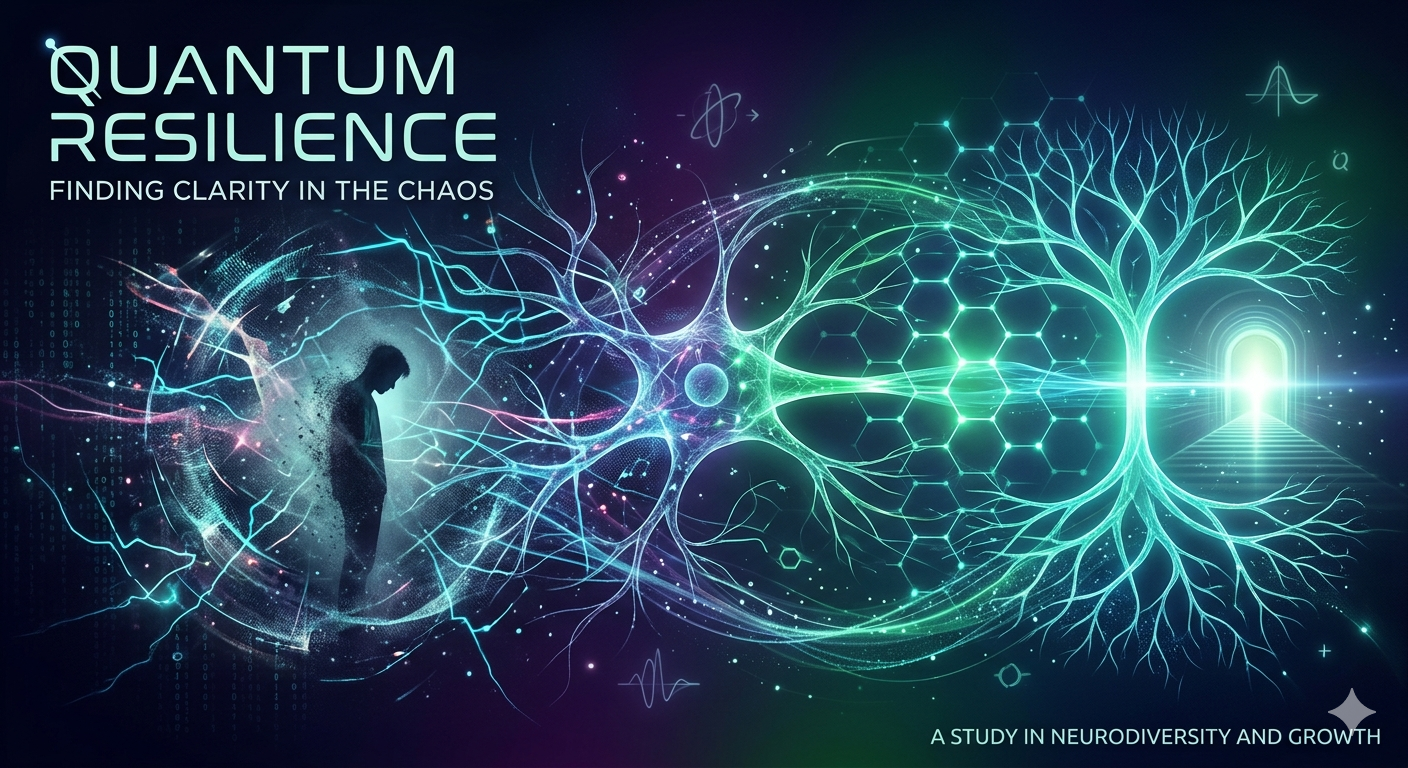
The world doesn’t move in straight lines, though we’ve spent centuries trying to convince ourselves it does. We build clocks and calendars, draw grids over maps, and expect the gears of our lives to click into place with mechanical certainty. But if you sit still long enough—long enough to notice the way light filters through a leaf or the way a thought feels before it becomes a sentence—you start to see the fraying edges of that model.
There’s a quietness in the way life actually functions. It’s not a laboratory; it’s a bustling city at rush hour [02:59]. It’s noisy, crowded, and fundamentally uncertain. And yet, it works.
The Architecture of Noise
We often think of “noise”—the sensory overwhelm, the internal static, the unpredictable shifts in our environment—as a bug in the system. We strive for a “quiet room” in the mind, assuming that clarity only exists in the absence of disturbance. But quantum biology suggests something more resilient: life doesn’t just tolerate randomness; it depends on it [03:38].
Inside a plant cell, energy doesn’t travel like a hiker on a single, well-marked trail. It moves like water released onto a hillside [01:14:27]. It spreads. It explores multiple possibilities simultaneously, sensitive to the entire landscape before settling on a path. It finds its way not through force, but through fit.
There is immense relief in this realization. If the very building blocks of our existence navigate through a “noise-assisted transport” [01:23:14], then perhaps our own moments of overwhelm aren’t failures of focus. Perhaps they are the moments where we are sampling the landscape, waiting for the right nudge to move us forward.
The Internal Compass
Consider the migrating bird, flying through a featureless night [01:27:42]. It isn’t following a map in the way we understand maps. It isn’t calculating distance. Instead, it maintains a conversation with the planet itself—a fleeting, quantum-level sensitivity to a magnetic field that is otherwise invisible [01:31:17].
For those of us who navigate the world with a neurodivergent lens, this feels familiar. We often lack the “standard landmarks” others use. Our sense of direction is frequently a relationship rather than a destination—a subtle tilt, a quiet bias, a feeling of this way rather than that way [01:34:48]. It is a process of constant realignment, refreshed moment by moment.
Resting in the Probable
We are creatures who like solid ground. We want to know exactly where we stand. But the deeper science goes, the more the ground reveals itself to be a series of probabilities rather than certainties [01:49:56].
Quantum biology teaches us a restraint that is almost medicinal:
- Efficiency isn’t about speed; it’s about reliability in a changing environment [01:06:50].
- Order isn’t about stillness; it’s about coordination [44:27].
- Understanding doesn’t require closure. Sometimes, a question fades not because it was answered, but because it is no longer needed [01:54:02].
The “Quantum Shift” in our own lives isn’t a dramatic leap into a new reality. It is a long, patient process of quiet alignment [02:00:36]. It’s noticeable that the static we’ve been fighting might actually be the texture that keeps us from getting stuck.
Tonight, let the questions be soft. You don’t need to master the mechanics of your transformation. You only need to stay sensitive to the patterns. Like energy finding a leaf’s center, or a bird finding a distant shore, you are already fluent in the rules of the deep world. You are finding your way, not by force, but by fit.