When people talk about the risks quantum computing poses to cybersecurity, the conversation usually stays focused on data centers.
Massive server farms.
Cloud infrastructure.
Encrypted databases sitting behind layers of enterprise security.
But the more time I spend watching how AI systems are actually deployed in the real world, the more obvious something becomes.
The future of computing isn’t just in data centers.
It’s at the edge.
And that’s exactly where one of the biggest quantum security risks is emerging.
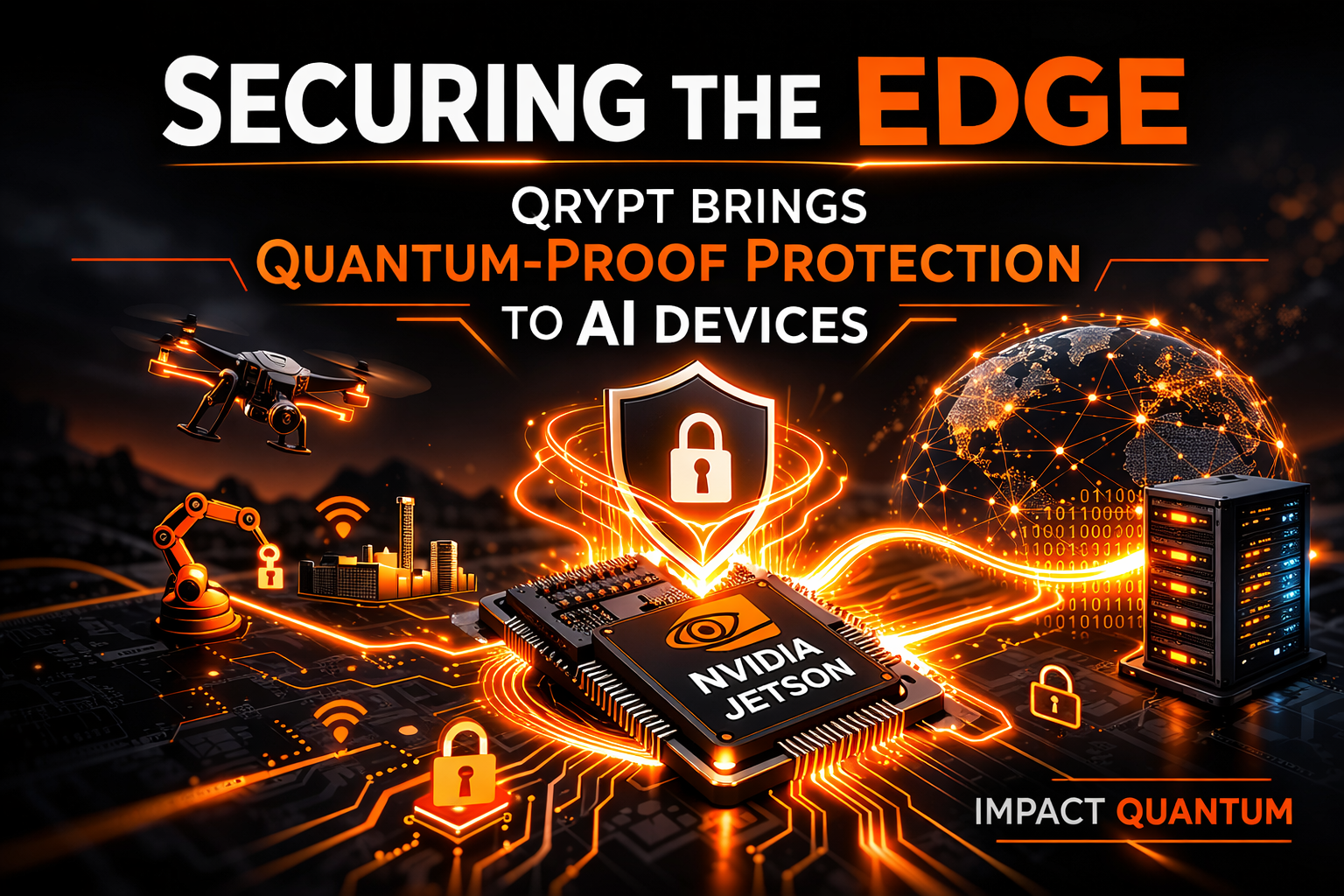
This week, Qrypt announced an integration with the NVIDIA Jetson platform, bringing quantum-secure encryption directly to the hardware powering modern edge AI devices.
At first glance, it might sound like a niche technical update.
But if you zoom out a bit, it signals something much bigger.
It means post-quantum security is starting to move out of centralized infrastructure and into the physical world where AI actually lives.
The Quiet Risk Living at the Edge
The term “edge computing” gets thrown around a lot, but the idea is simple.
Instead of sending every piece of data back to the cloud, some devices process information locally.
Think about:
• autonomous drones
• smart manufacturing sensors
• medical monitoring devices
• intelligent cameras in hospitals or cities
• robotics platforms
These devices need to react instantly. They can’t afford the delay of sending everything back to a remote server.
So they process data right where it’s created.
That speed is powerful.
But it also introduces a vulnerability.
Most of today’s encryption relies on mathematical problems that quantum computers will eventually be able to solve. Which leads to the growing concern security experts call “Harvest Now, Decrypt Later.”
An attacker could capture encrypted data today…
…and simply wait for future quantum computers to unlock it.
If that data comes from edge devices monitoring infrastructure, healthcare systems, or autonomous machines, the consequences could be enormous.
Qrypt’s Different Approach to Key Security
What makes Qrypt interesting is that they approach encryption from a different angle.
Traditional encryption relies on something called key exchange.
Two devices connect.
They perform a handshake.
They agree on a secret key used to encrypt and decrypt information.
The problem?
That handshake becomes a target.
Quantum algorithms are particularly powerful at breaking the types of mathematical problems used in these exchanges.
Qrypt eliminates that vulnerability entirely.
Instead of exchanging keys, their system uses Quantum Random Number Generation (QRNG) to independently generate identical symmetric encryption keys at two different locations.
The keys are never transmitted.
They simply appear simultaneously at both ends.
No exchange.
No interception point.
No handshake to attack.
It’s a clever shift that turns one of cryptography’s most vulnerable steps into something much harder to exploit.
Why the NVIDIA Jetson Platform Matters
If Qrypt’s technology stayed inside research labs, the story would end there.
But the integration with NVIDIA Jetson changes the picture dramatically.
Jetson is one of the most widely used platforms for edge AI development. It powers robotics, autonomous systems, computer vision applications, and industrial automation across thousands of companies.
In many ways, Jetson has become the brain of the edge AI ecosystem.
By bringing quantum-secure encryption directly onto this platform, Qrypt is making it dramatically easier for developers to build systems that are secure from the moment they are deployed.
A robotics startup building an autonomous inspection drone doesn’t need to invent its own quantum-safe security architecture.
It can build directly on top of a platform where that protection is already integrated.
That’s a powerful shift.
Security moves from something developers bolt on later…
…to something built directly into the hardware stack.
The Bigger Pattern Emerging
The more I watch the intersection of AI infrastructure and quantum technology, the more a clear pattern is starting to emerge.
Quantum computing will eventually change how we process information.
But long before that happens, it’s already changing how we protect information.
Post-quantum cryptography isn’t waiting for quantum computers to arrive.
It’s quietly being integrated into the systems we’re building today.
And increasingly, those systems aren’t centralized.
They’re distributed.
From data centers…
to networks…
to the edge devices that collect and generate the world’s data.
From the Edge to the Data Center
What Qrypt is ultimately working toward is something much bigger than device-level encryption.
The vision is end-to-end quantum-secure communication.
Data created at the edge—on a Jetson-powered device—remains protected as it moves across networks and into centralized infrastructure.
A continuous tunnel of quantum-safe security.
From sensor to cloud.
From robot to data center.
From AI devices to the broader digital ecosystem.
As AI systems become more deeply embedded in healthcare, infrastructure, transportation, and national security, the stakes around protecting that data are rising quickly.
Which means security itself has to evolve.
Not just in the cloud.
But everywhere computing happens.
And increasingly…
that means the edge.