If you were looking for a clear winner in quantum hardware this week, you probably walked away disappointed. And honestly, that is exactly the point.
Across the latest announcements, research papers, and roadmap updates, no single qubit modality made a decisive leap ahead of the pack. Instead, what we are seeing is something far more interesting and far more important for the industry’s long-term trajectory.
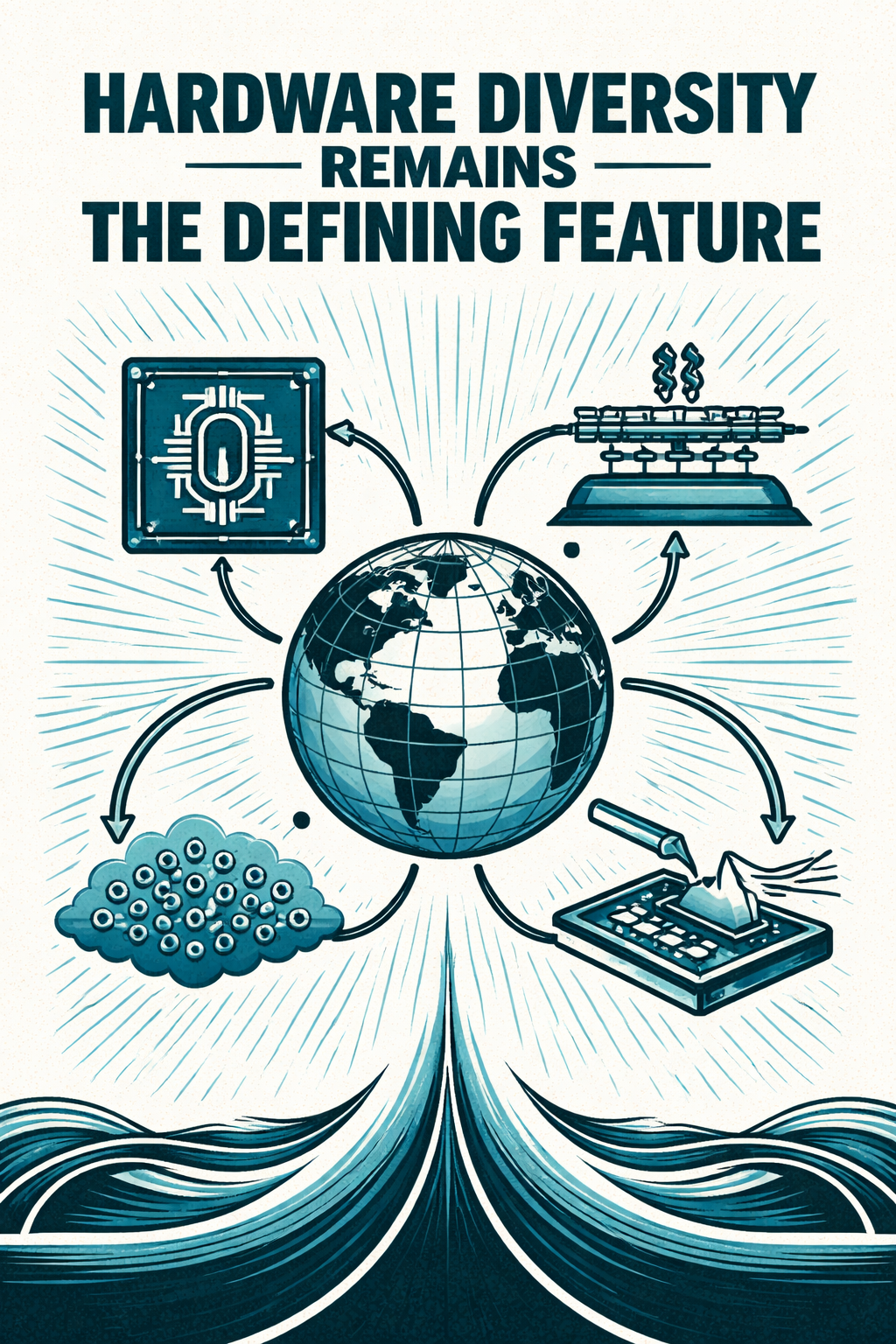
Quantum computing remains a multi-horse race.
And that is not a weakness. It is the defining feature of this era.
For anyone building, investing, or simply trying to understand where quantum is headed, the signal is clear. The field is still in its exploratory phase, where different hardware approaches are optimizing for different strengths. The idea that one modality would quickly dominate now looks increasingly unlikely.
Let’s unpack what actually moved this week and what it tells us about where the ecosystem is heading.
Superconducting Platforms Continue Their Steady March
Superconducting qubits continue to do what they have done consistently over the past several years: scale methodically.
We saw incremental improvements in device counts, packaging approaches, and control electronics. None of it was flashy. None of it was meant to be.
But in many ways, this quiet progress is exactly why superconducting systems remain so central to the current quantum landscape. The ecosystem around them is mature. Toolchains are relatively well understood. Fabrication pipelines are increasingly industrialized.
The story here is not sudden breakthroughs. It is an engineering discipline.
That matters because scaling remains one of the hardest problems in quantum computing. Superconducting teams are leaning hard into manufacturability, repeatability, and integration with classical control systems. The pace may look incremental from the outside, but underneath, the infrastructure is getting stronger.
Trapped Ions Keep Raising the Fidelity Bar
While superconducting platforms focus heavily on scaling, trapped ion systems continue to push the boundaries in what they have historically excelled at: gate fidelity and coherence.
Recent updates show continued progress in reducing error rates and improving operational stability. These gains may look subtle in headline form, but they compound in powerful ways when you start thinking about logical qubits and error correction overhead.
High-fidelity operations directly impact how quickly systems can move toward fault tolerance. Every fraction of improvement matters.
The tradeoff, of course, remains system complexity and scaling architecture. Ion systems still face real engineering challenges when building very large processors. But in the near to medium term, their precision continues to make them extremely attractive for specific workloads, especially in research-heavy and algorithm development contexts.
In other words, ions are not trying to win the same race as superconducting platforms. They are running a different leg of the marathon.
Neutral Atoms Show Quiet but Meaningful Progress
Neutral atom platforms may not always dominate the headlines, but the steady improvements in array control and system programmability are becoming harder to ignore.
This week’s updates reinforce a pattern we have been watching closely: better control over larger atom arrays, improved gate performance, and more flexible reconfiguration capabilities.
Neutral atoms sit in an interesting middle ground. They offer promising scaling pathways through large, reconfigurable arrays, while still maintaining respectable coherence properties. The technical hurdles are real, especially around uniformity and error management, but the architectural promise continues to draw serious attention.
If you are thinking in terms of long-term scalability combined with spatial flexibility, neutral atoms remain one of the most intriguing modalities in the race.
Photonics Keeps Advancing the Integration Narrative
Meanwhile, photonic quantum computing continues to lean into its core differentiator: integration and networking potential.
Recent progress in photonic chip integration, source development, and error mitigation strategies shows that this platform is playing a very long game. Photonics is not always about near-term gate model supremacy. It is about building systems that naturally align with communication networks, room-temperature operation, and modular scaling.
The bet here is architectural.
If photonic teams can continue to improve source quality, detection efficiency, and on-chip integration, they may unlock entirely different deployment models than those we see in cryogenic platforms today.
It is still early. But the narrative is clearly advancing.
Reality Check: We Are Still in the Multi-Horse Era
Step back and the pattern becomes obvious.
No single qubit modality pulled decisively ahead this week. In fact, the opposite happened. Each platform made progress within its own optimization lane.
Superconducting systems are strengthening their scaling story.
Trapped ions are sharpening their fidelity advantage.
Neutral atoms are improving array control and flexibility.
Photonics is doubling down on integration and networking potential.
This is exactly what a healthy, early-stage deep tech ecosystem looks like.
Your framing that different qubits will likely serve different tasks continues to age extremely well. The market is not converging yet. It is diversifying and specializing.
And that should change how we talk about the future.
Instead of asking which qubit modality will win, the more useful question may be:
Where will each modality win first?
Because the evidence keeps pointing in the same direction. Quantum computing is not heading toward a single hardware monoculture. It is evolving into a heterogeneous stack where different physical systems may dominate different application classes.
For builders, this means optionality still matters.
For investors, it means patience is required.
And for the broader ecosystem, it means the most important story right now is not consolidation.
It is coexistence.
The multi-horse race is not slowing down. If anything, it is just getting interesting.