If the quantum conversation sometimes feels dominated by technical breakthroughs and venture headlines, it is worth stepping back and looking at the steady, structural force reshaping the ecosystem: national quantum programs.
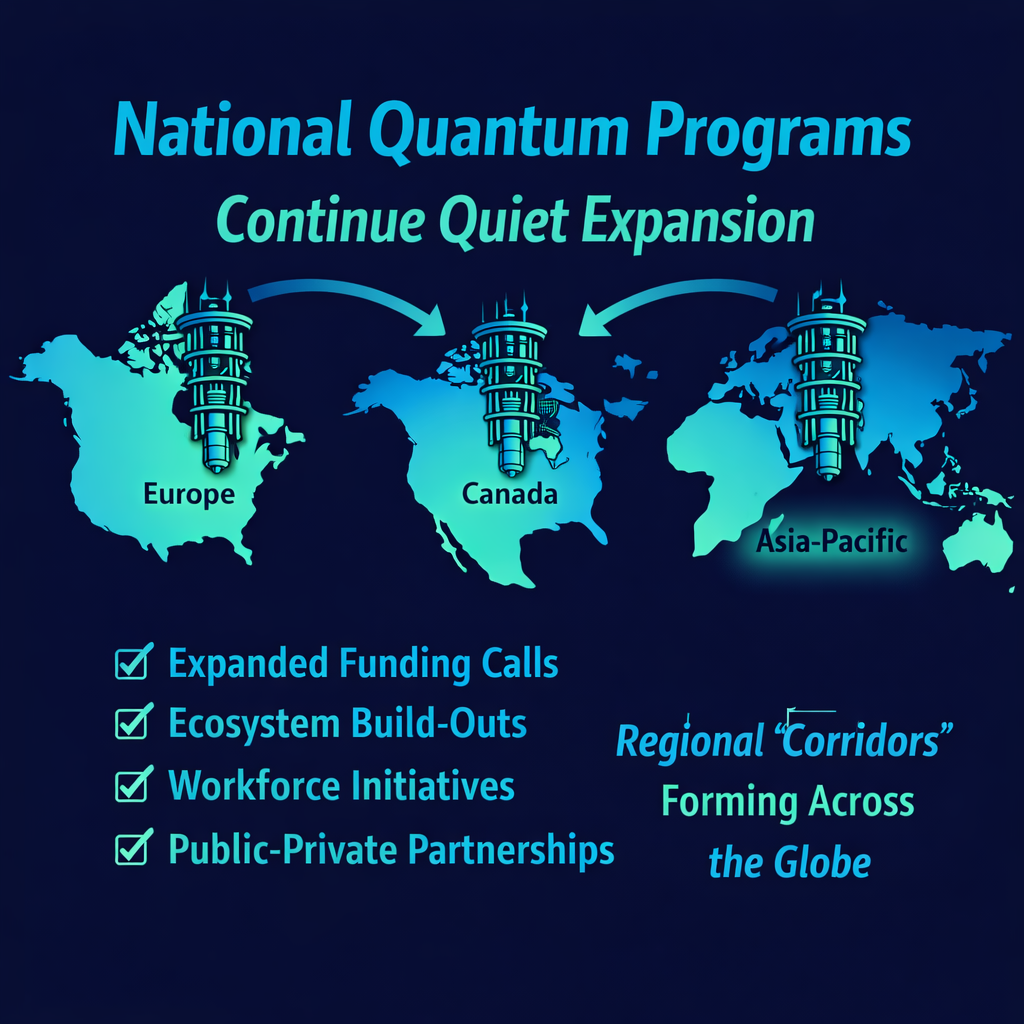
Around the world, government-backed quantum initiatives are not slowing down. If anything, they are quietly accelerating. Over the past several months, and especially in recent weeks, multiple signals have reinforced the same underlying trend. Public funding pipelines are expanding in Europe. Canada continues to deepen its ecosystem build-out. Regional workforce programs are multiplying. And public-private partnerships are becoming more tightly integrated.
None of this arrives with the drama of a new qubit record. But taken together, these moves point to something more durable: the global quantum landscape is entering what can best be described as the quantum corridors era.
This is not shaping up as a single global race with one winner.
It is evolving into a network of regional buildouts, each with its own strengths, priorities, and industrial strategy.
That distinction matters.
For years, the public narrative around quantum computing often borrowed language from the semiconductor race or the space race. The implication was that countries were competing toward a singular finish line. But the reality now emerging is far more nuanced. National strategies are diverging in ways that suggest long-term specialization rather than simple head-to-head competition.
In Europe, expanded funding calls continue to reinforce a strong research-to-industrial pipeline. Programs are increasingly focused not just on fundamental science but on translation layers: testbeds, pilot lines, and early commercial validation environments. The emphasis is on building a resilient, sovereign quantum stack that spans hardware, software, and applications.
In Canada, the ecosystem build-out remains particularly notable. The country has leaned heavily into cluster formation, fostering tight collaboration among universities, startups, and established technology players. Rather than attempting to dominate every modality, Canada’s approach has emphasized depth in key areas and strong talent development pipelines. The result is an ecosystem that punches above its weight in both research output and startup activity.
Meanwhile, new regional workforce programs are emerging across multiple jurisdictions. This is one of the clearest signs that governments are thinking beyond early-stage research. Workforce initiatives signal long-term intent. They acknowledge that quantum advantage, whenever it arrives, will depend not only on physics breakthroughs but also on the availability of engineers, technicians, software developers, and system integrators who can operationalize the technology.
Public-private partnerships are also becoming more structured and strategic. Early quantum programs often funded academic research in relative isolation. Today’s initiatives increasingly tie funding to commercialization pathways, industry collaboration, and infrastructure development. Governments are not just seeding science. They are attempting to shape full-stack ecosystems.
Taken together, these developments reinforce the emerging pattern: we are no longer watching a single global sprint. We are watching the formation of multiple quantum corridors.
Each corridor is developing its own specialization profile.
Some regions are doubling down on superconducting platforms. Others are investing heavily in photonics. Some are prioritizing quantum sensing and secure communications. Others are building national capabilities around quantum software and algorithms. Workforce strategies, supply chain investments, and regulatory approaches are also beginning to diverge.
This fragmentation will have real downstream consequences.
First, supply chains will become more regionally structured. Quantum hardware already depends on highly specialized components, from cryogenic systems to advanced photonics and control electronics. As national programs emphasize technological sovereignty, we should expect more localized supply networks and potentially less reliance on fully globalized sourcing models.
Second, talent flows will increasingly follow these corridors. Researchers and engineers tend to cluster where funding, infrastructure, and career pathways are strongest. As regional programs mature, we are likely to see more defined talent gravity wells forming around major quantum hubs. This will shape hiring dynamics for both startups and large technology firms.
Third, standards battles are likely to intensify over time. As different regions build out their own stacks and architectures, questions around interoperability, benchmarking, and technical standards will become more pressing. Early alignment is still possible, but the window for easy global convergence may narrow as national investments deepen.
Importantly, none of this fragmentation is inherently negative. In many ways, regional specialization can accelerate innovation by allowing ecosystems to move quickly in their areas of strength. The risk is not fragmentation itself, but fragmentation without coordination.
For industry observers, the key shift is conceptual. Quantum is no longer just a laboratory technology inching toward viability. It is becoming an element of national industrial policy.
And that means the map matters.
As funding expands, workforce programs multiply, and public-private partnerships deepen, the quiet expansion of national quantum initiatives may ultimately prove just as consequential as the next hardware breakthrough. The corridors are forming. The specialization is beginning. And the global quantum landscape is becoming more structured by the month.