Why Real-Time Monitoring May Be the Missing Link to Fault-Tolerant Quantum Computing
In the race toward practical quantum computing, one stubborn reality continues to haunt engineers and physicists alike: qubits are famously temperamental. Unlike classical bits, which behave predictably, qubits exist in a fragile quantum state that is extraordinarily sensitive to their environment. Even the most advanced superconducting processors—such as those pioneered by Google and IBM—must contend with a subtle but destructive phenomenon: microscopic material defects that quietly sap energy from qubits.
These defects act like what researchers sometimes call “quantum thieves.” They jump unpredictably through the device’s material structure, intermittently degrading qubit performance. The result is not a clean failure mode but something far more frustrating: fluctuation. A qubit may behave beautifully one moment and poorly the next.
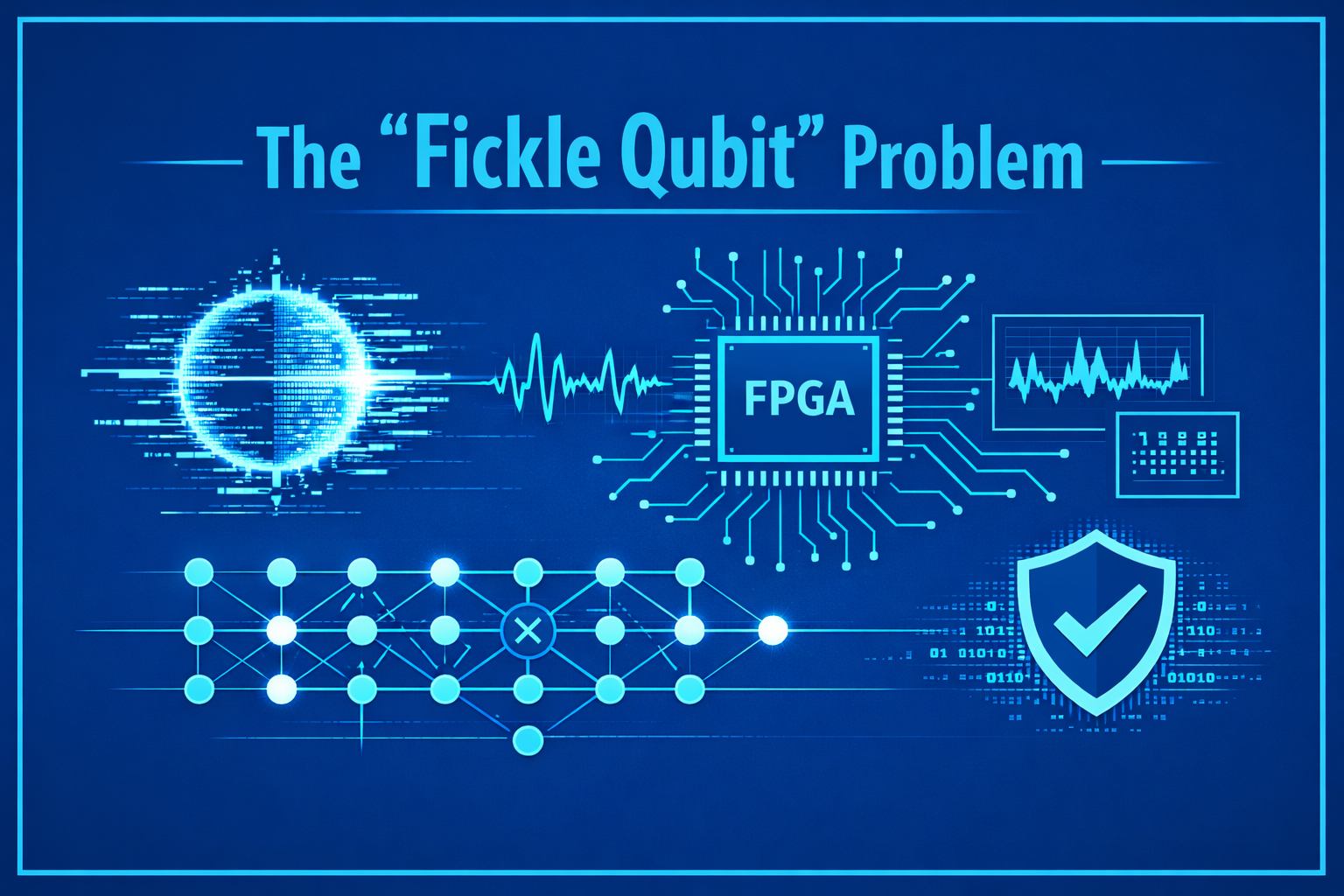
This is the heart of the Fickle Qubit Problem—and it has been a major obstacle on the road to scalable, fault-tolerant quantum machines.
The Old Way: Too Slow for a Fast Problem
Historically, measuring a qubit’s health—typically quantified through its relaxation rate (T1)—has been a relatively slow process. Traditional monitoring approaches could take up to one minute to produce a reliable estimate.
On paper, that sounds reasonable. In practice, it is painfully inadequate.
Why? Because qubits do not degrade on minute-long timescales. They can shift from “good” to “bad” in fractions of a second. When measurements take too long, they effectively blur together periods of good and poor performance.
The result is a time-averaged picture that looks deceptively stable.
It’s the difference between:
- Taking a long-exposure photo of a lightning storm
- Versus filming the lightning in real time
One gives you a smooth glow. The other reveals chaos.
For quantum processors, missing these rapid “storms” means missing the very events that cause computational errors.
The Breakthrough: 100× Faster Tracking
A major step forward has emerged from work led by postdoctoral researcher Dr. Fabrizio Berritta and collaborators. Their team developed a monitoring system capable of tracking qubit fluctuations in milliseconds—roughly 100 times faster than traditional methods.
The performance jump is striking:
| Feature | Traditional Monitoring | NBI Breakthrough |
|---|---|---|
| Detection Speed | ~1 minute | ~10 milliseconds |
| Data Fidelity | Time-averaged (blurry) | Real-time (sharp) |
| Hardware | Standard external PCs | FPGA-based controllers |
| Logic | Static testing | Adaptive Bayesian modeling |
This speed unlocks something researchers have long needed but couldn’t quite achieve: real-time visibility into qubit behavior.
Instead of seeing the average, scientists can now watch qubits flip quality moment by moment.
How It Works: The FPGA “Brain”
The true innovation here is not just better physics—it is smarter classical control.
At the center of the system sits a Field-Programmable Gate Array (FPGA), a specialized processor optimized for ultra-low-latency tasks. Unlike conventional computers that shuttle data back and forth between memory and CPU, an FPGA can execute highly customized logic directly in hardware.
Here’s the key shift:
Old approach
- Qubit measured
- Data sent to external computer
- Analysis performed
- Feedback applied (too late)
New approach
- Qubit measured
- Bayesian algorithm runs immediately on FPGA
- Health estimate updated after every pulse
- Feedback loop stays tightly synchronized
This creates, essentially, a real-time nervous system for the quantum processor.
The Bayesian model continuously updates a “best guess” of qubit health, refining its estimate with each new measurement. Because the computation happens on the FPGA itself, the controller can evolve at nearly the same speed as the qubit’s environment.
That timing alignment is the breakthrough.
Why This Matters for Fault Tolerance
Fault tolerance is the holy grail of quantum computing. The goal is a machine that can detect and correct its own errors faster than noise can accumulate.
But here’s the uncomfortable truth: you cannot correct what you cannot see.
The fickle nature of qubits has made error management far more difficult than early roadmaps suggested. The NBI team’s approach directly attacks this visibility gap.
1. Dynamic Calibration
Today’s quantum systems often require lengthy recalibration cycles. With millisecond-level monitoring, calibration can become continuous and adaptive.
Instead of stopping the machine, the system tunes itself in flight.
2. Sidelining the “Lemons”
In large-scale processors, some qubits will inevitably misbehave. Real-time health tracking enables intelligent routing:
- Detect a degrading qubit instantly
- Redirect operations to healthier qubits
- Maintain computational integrity
This is a major step toward graceful degradation, a hallmark of mature engineering systems.
3. True Scalability
Perhaps most importantly, this work reframes quantum computing from a fragile laboratory experiment into something closer to an engineered platform.
Think of the difference between:
- A car that only reports failure after the engine blows
- Versus a vehicle with real-time telemetry on every cylinder
The latter is how you build reliable infrastructure.
The Verdict
What surprised Dr. Berritta and the team was not merely that qubit quality fluctuates—it was how fast those fluctuations occur. A qubit trusted at 12:00:00.000 might degrade by 12:00:00.010.
That is the timescale quantum engineers are now confronting.
By keeping qubits “honest” in real time, the NBI team has delivered something the field has urgently needed: a practical pathway toward managing quantum hardware as a dynamic, living system rather than a static device.
It may not be the final step to fault tolerance—but it is a foundational one.
And in the long arc of quantum computing, better visibility often precedes every major leap forward.