Let me take you somewhere strange for a moment.
Imagine watching a beam of light strike a perfectly polished mirror. In the classical world, we know exactly what happens next. It reflects. Clean. Predictable. Deterministic.
Now imagine that same beam behaving like a ghost, brushing up against a barrier it should not be able to cross, and then quietly appearing on the other side.
That is photonic tunneling.
It is one of those phenomena that forces you to reconsider how solid the rules of physics really are. At the quantum scale, the boundaries we think are absolute begin to soften.
The “Forbidden” Zone That Isn’t
To understand photonic tunneling, we begin with something that feels completely classical: total internal reflection.
Picture yourself underwater, looking up at the surface. At certain angles, the water behaves like a mirror. Light trying to escape into the air reflects entirely back into the pool. No leakage. No transmission. A perfect optical boundary.
Classically, that is the end of the story.
But Maxwell’s equations, which govern electromagnetism, reveal something more subtle. When light reflects completely, it does not simply stop at the boundary. A tiny, invisible extension of electromagnetic energy reaches into the region beyond the surface.
This faint extension is called an evanescent wave.
Here is the key detail. It decays almost immediately. Its amplitude falls off exponentially, usually within a distance roughly equal to the wavelength of the light.
In most situations, that is where it ends.
Now introduce a second piece of glass placed extremely close to the reflective surface. Not millimeters away. Not microns. Nanometers.
Close enough that the decaying evanescent wave can still interact with it.
Suddenly, that fading energy has somewhere to go.
The light no longer reflects completely.
It tunnels.
Frustrated Total Internal Reflection
In laboratory settings, this effect is known as Frustrated Total Internal Reflection, or FTIR.
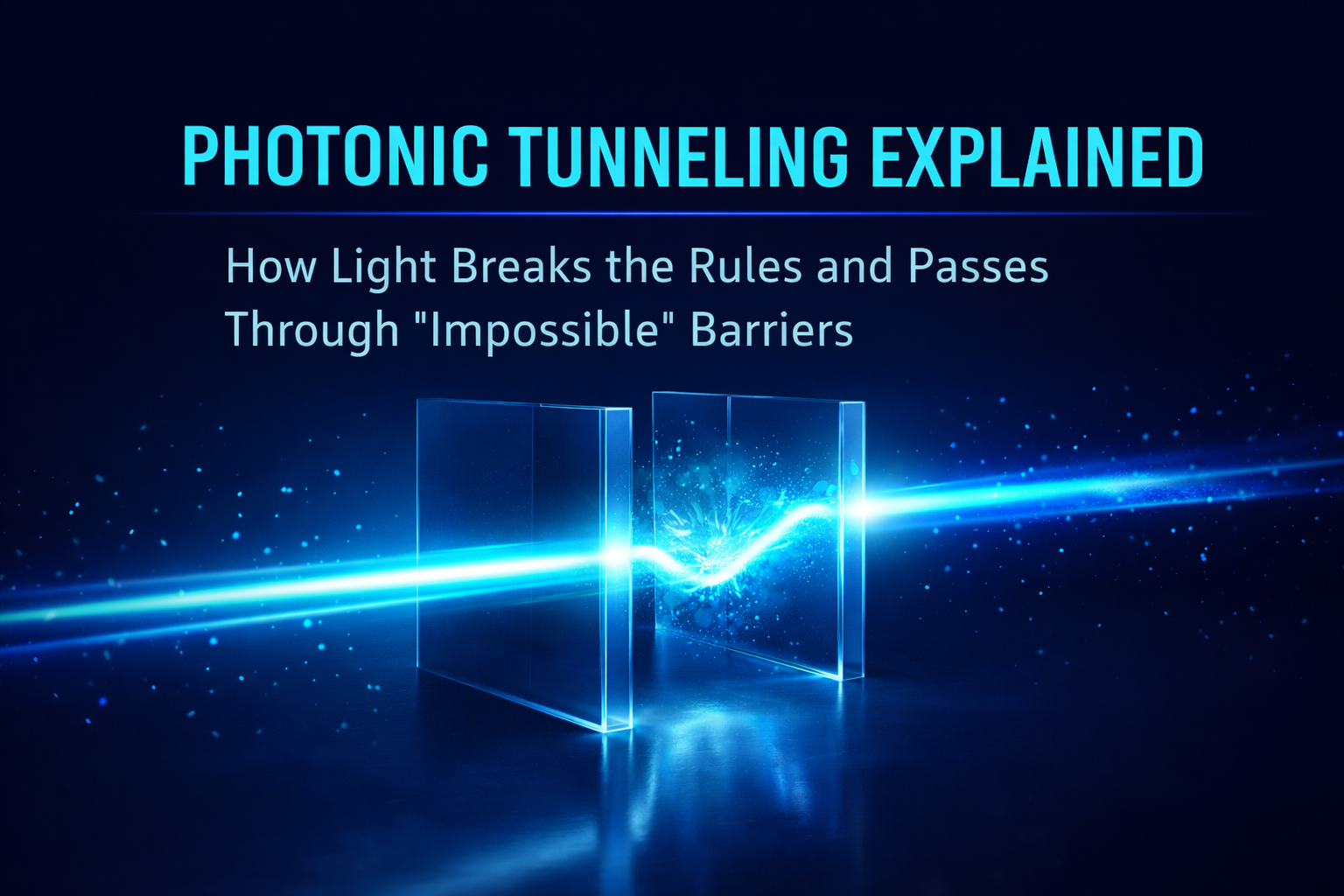
Imagine two glass prisms positioned nearly face-to-face, separated by a microscopic air gap.
Light enters the first prism and strikes the internal surface at an angle that should guarantee total reflection. If the air gap is wide, the reflection behaves exactly as classical optics predicts.
But shrink the gap to less than the wavelength of the light, and something remarkable happens.
The evanescent wave extending beyond the first surface couples to the second prism.
From our perspective, the light appears to jump across the gap.
It does not travel through the air in the traditional sense. It does not propagate as an ordinary beam. It vanishes from one side and reappears on the other, as if the barrier were never truly solid.
That is photonic tunneling in action.
Why It Is Called Tunneling
The term comes directly from quantum mechanics.
In the quantum world, particles are described by wavefunctions. These are mathematical expressions of probability rather than solid trajectories.
When a photon encounters a barrier that it does not have enough classical energy to cross, classical physics would predict that its probability drops instantly to zero.
Quantum mechanics says otherwise.
Instead of stopping abruptly, the wavefunction tapers off exponentially into the barrier. If the barrier is thin enough, there remains a small but nonzero probability that the photon exists on the other side.
When the photon is detected beyond the forbidden region, we say it has tunneled.
Thin barriers open the door.
And light passes through.
Real-World Applications
This phenomenon is not confined to theoretical discussions. Photonic tunneling plays a foundational role in modern technology.
Near-Field Microscopy
Conventional microscopes are limited by the diffraction limit. They cannot resolve features smaller than roughly half the wavelength of light being used.
However, evanescent waves exist in the near-field region just beyond a surface. By placing a nanoscale probe close enough to capture these tunneling photons, scientists can resolve structures far smaller than conventional optics allows.
Atoms and molecules become visible in ways that classical lenses could never achieve.
Photonic tunneling enables imaging beyond traditional limits.
Fiber Optic Couplers
The global internet quietly relies on this principle.
When engineers need to split or combine optical signals, they bring two fibers extremely close together. A portion of the light’s evanescent field tunnels from one fiber into the other.
There is no need to break the glass or redirect the beam into open air. Proximity alone allows controlled signal sharing.
Quantum behavior supports digital infrastructure.
Optical Touch Interfaces
Some optical touchscreens use FTIR principles. Light reflects internally across a glass surface. When a finger touches the surface, it disrupts the internal reflection.
Light tunnels into the skin.
Sensors detect where the reflection is interrupted and calculate the touch position with precision.
Your fingertip becomes part of the optical system.
The Faster Than Light Question
One of the more debated aspects of photonic tunneling involves what is known as Hartman’s Effect. Some experiments suggest that the time required for a photon to tunnel through a barrier becomes independent of the barrier’s thickness once it is sufficiently thick.
At first glance, this can make it appear as though the photon crossed the barrier faster than light would travel the same distance.
This has raised questions about superluminal behavior.
However, most physicists agree that this effect results from wave reshaping rather than true faster-than-light information transfer. The leading edge of the wave packet emerges, but no new information travels faster than the speed of light.
Einstein’s theory of relativity remains intact.
Still, the discussion highlights how deeply quantum mechanics challenges classical intuition.
The Deeper Meaning
Photonic tunneling bridges classical optics and quantum mechanics. It demonstrates that barriers are not always absolute. They can be regions where probability decays rather than walls that enforce strict separation.
At the macroscopic level, boundaries feel solid and final.
At the quantum scale, they become permeable.
The universe does not treat edges as fixed lines. It treats them as gradients of possibility.
In the world of the very small, impassable walls are often just suggestions. And sometimes, when the gap is thin enough, light moves through them as quietly as a ghost passing through stone.