
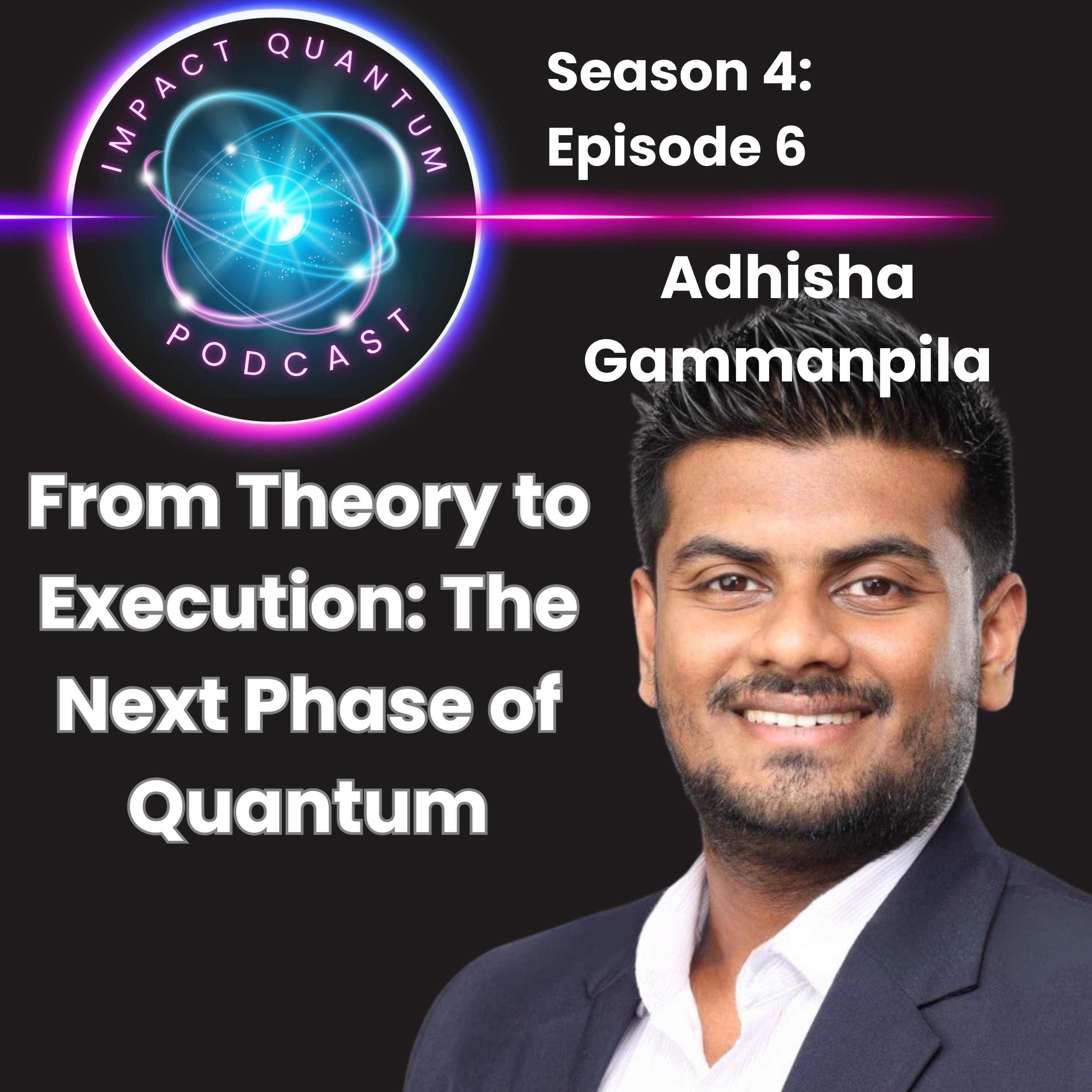
In this episode, hosts Frank La Vigne and Candace Gillhoolley sit down with Adhisha Gammanpila, founder and CEO of Feynman—an innovative company making quantum computing accessible for everyone, no PhD required. Together, they dive into the rapidly evolving quantum landscape, discussing how AI-driven copilots are transforming protein simulation, climate modeling, and drug discovery—tasks that used to take months and now can be accomplished in minutes.
Adhisha Gammanpila shares his journey from university research to launching a platform that abstracts away the complexities of quantum gates, letting scientists focus on their real-world problems instead of getting caught up in the technical details. The conversation explores the intersection of quantum and climate innovation, how AI and quantum are powering new solutions, and what it really takes to build meaningful climate tech in today’s world. They also examine misconceptions about quantum’s role in climate change, advice for students and entrepreneurs, and look ahead to the breakthroughs that lie just around the corner.
Whether you’re deeply invested in quantum or just curious about its impact, this episode is full of insights into how quantum and AI, working together, are poised to solve some of our biggest challenges.
Links
- Adhisha Gammanpila on LinkedIn – https://www.linkedin.com/in/adhisha-gammanpila/
Time Stamps
00:00 “Quantum Computing for Everyone”
04:40 “Building a Quantum Ecosystem”
08:24 “AI-Driven Quantum Computing Copilot”
11:51 “Quantum Chemistry Driving Innovation”
15:10 “Versatile Quantum Coding Platform”
18:17 “Quantum Algorithms for Optimization”
22:49 Emulating Nature for Energy Efficiency
26:03 “Quantum Energy Teleportation Vision”
29:56 “Quantum Computers Misconceptions Explained”
32:01 “Climate Action Starts Locally”
38:06 Sri Lanka’s Growing Innovation Ecosystem
39:15 Global Expansion and Collaboration Opportunities
44:15 “Hype, Skepticism, and Innovation”
46:14 “Moving the World Forward”
51:12 “Think Big, Start Small”
52:44 “Gratitude for Today’s Discussion”
Transcript
So that the copilot will take the entire protein sequence, map
Speaker:it to a quantum circuit and then run and give you back the results.
Speaker:So this, we did it within six
Speaker:minutes. You can do a protein simulation on
Speaker:a quantum computer or a quantum simulator under six minutes. When
Speaker:breakthroughs move that fast, the future stops being theoretical and
Speaker:starts getting impactful. This is Impact Quantum
Speaker:podcast. Turn it up fast, Kenneth. Blowing my
Speaker:mind at last. Hello and welcome
Speaker:back to Impact Quantum the podcast. We explore the emerging field
Speaker:and industry that is quantum computing. We don't need to have a PhD, be
Speaker:a quantum physicist or really know anything at
Speaker:all. You just need to be a little bit curious and a little bit self
Speaker:driven. And again, the most quantum curious and self driven
Speaker:person I know is Candace Gooley. How's it going, Candace? It's great. Thank
Speaker:you, Frank. I have to say though, today is exceptionally cold. Everyone's going
Speaker:through this like Arctic, this like Arctic temperatures. And even
Speaker:us here in Montreal, Quebec, we are shivering. It is
Speaker:really crazy cold. It's not much warmer
Speaker:down here in Maryland. It's very cold.
Speaker:This is usually January, February weather,
Speaker:not pre Christmas weather. That's right. I
Speaker:guess the Arctic blasts are going to do their thing.
Speaker:Yes, yes. So today we're going to be speaking with
Speaker:Adhisha Gamanpila and
Speaker:he is the CEO and founder of
Speaker:Feynman and we're really excited to talk to him today.
Speaker:He's a lot of good things. He's a lot of really interesting talents and
Speaker:I can't wait to dig in a little farther. Awesome. Now is it Feynman or
Speaker:is it Feynman? I thought it was like named after Richard Feynman. It's Feynman.
Speaker:Right? Okay, cool. Just check, just check it out.
Speaker:That's okay. So he's checking on me, making sure. No worries. I
Speaker:got your back, Candace. There we go. There we go.
Speaker:Welcome to the show. So obviously you named your company, your company's named
Speaker:after Richard Feynman. So I'm going to go out on the limb here and say
Speaker:it has something to do with physics.
Speaker:So who are you and what do you do? Absolutely. So I can
Speaker:decide. Frank, it's so good to be here. And I think the climate
Speaker:is changing a lot and that could also be a good
Speaker:topic for us to speak about today. So I'm
Speaker:Adisha, founder and CEO of Feynman, starting from Richard
Speaker:Feynman, just like Frank mentioned. So pretty much
Speaker:what we do is we help
Speaker:anyone, even without zero quantum knowledge to use quantum
Speaker:computers. So you don't have to have a Ph.D. you don't have to go through
Speaker:the deep mathematics to to experience the power of quantum.
Speaker:So make we make quantum easy to use. So
Speaker:that's what we do at Feynman and we want to
Speaker:put our tooling in front of every quantum computer that's out there
Speaker:so that anyone could easily make use of quantum. So that's what we
Speaker:are doing. Frank and Candice love to have a deeper discussion around
Speaker:it and super excited. Well, let's just
Speaker:go ahead Candice. Sorry. Before we dig deep I wanted to
Speaker:take a little step back because I really like to understand where
Speaker:people like they come to the information. So when you were
Speaker:back and you were back at university, were you already into
Speaker:physics? Were you computer science? Were you something else? What brought
Speaker:you Tell us a little bit about your path. Absolutely,
Speaker:absolutely. So I studied computer science along
Speaker:with physics, the classical side of physics
Speaker:as well as quantum side of physics. And
Speaker:I wanted to pursue my higher studies in theoretical physics
Speaker:study quantum physics. So while studying computer
Speaker:science I wanted to do a practical application
Speaker:with computer science and theoretical physics. That is somewhere around
Speaker:2017 that's when IBM
Speaker:also started giving out cloud access to quantum computers.
Speaker:Then I wanted to run a
Speaker:tion on a Quantum computer in:Speaker:So I did not realize how difficult it was back then. So I
Speaker:hich was written somewhere on:Speaker:early:Speaker:to run it on IBM quantum computer. The running part was around
Speaker:few hours but preparing to run it was like six months of work.
Speaker:The transformation of transformation of the
Speaker:classical models to quantum and then the learning curve mapping the
Speaker:data set to the quantum circuits and
Speaker:it was, it was really hard and it practically did not
Speaker:run the larger use case but for a smaller use case
Speaker:of a similar fashion was possible.
Speaker:That gave me the understanding how difficult it is in a first hand
Speaker:experience. And then I was also doing courses at MIT
Speaker:via online. Then Covid came and I published my paper
Speaker:and then a lot of reviews came across from the student community, research community.
Speaker:How did you do it? So
Speaker:that was a moment of realization to understand, okay, there
Speaker:are people who need quantum who want to run quantum but they're
Speaker:struggling and they give up on the idea of going quantum. And
Speaker:there are engineers who wants to try quantum but they're interested in
Speaker:results so they need quick access they not to go through all the science
Speaker:behind it. So I started seeing all these variations
Speaker:and last year we brought out our platform
Speaker:with the APIs, the copilot where we have the learning
Speaker:modules to build out this entire quantum
Speaker:ecosystem. So that's how we got it into play.
Speaker:Candice and Frank. Interesting.
Speaker:That's a good point because there is that moment of my personal
Speaker:first exposure to quantum computing was I was at a Microsoft
Speaker:conference and I was so excited about this. I went
Speaker:back to the hotel that night and I installed Q Sharp. And then I
Speaker:realized what now I felt like I had
Speaker:got a glimpse of this wonderful world, but then
Speaker:I had, I suppose the tools. But like I felt like a caveman
Speaker:banging, you know, banging with rocks, you know, like I held
Speaker:this massive wall of like, okay, now what? Right? And I think ever since
Speaker:then I've always been like, okay, now what? You know,
Speaker:and I'm curious to see how your tools kind of address that. Right. Because
Speaker:you know, I would imagine that I'm not the only
Speaker:one that's going to, you know, has already. Has already had that experience or will
Speaker:in the near future.
Speaker:Absolutely. So that feeling is
Speaker:feeling of, okay, you run your first single
Speaker:qubit or one or two qubit. Okay, you run
Speaker:it on a simulator or a quantum computer and you get the results.
Speaker:You get 100 shots and you put these gates and okay, you
Speaker:really come to a moment, okay, now what, what does
Speaker:this really mean? What can I do with it?
Speaker:So that is where the practicality of using quantum comes in.
Speaker:Because if you really look at it, we are using gates,
Speaker:we call it Hadamard gate and different other gates. In a classical
Speaker:world we have similar gates like the N gate, the not gate.
Speaker:You can't write a software platform with these gates combined.
Speaker:You can't bring all these gates together and write it. That's
Speaker:impossible. Theoretically you could, but no one will do it.
Speaker:But theoretically possible. But when I talk
Speaker:to folks about kind of these new gates and you know,
Speaker:the I guess and an OR logic you do deal with in
Speaker:programming on a regular basis, but the exclusive or like the X
Speaker:naught like these are not things you normally normal day to day
Speaker:enterprise or people in career would do. It's usually like you
Speaker:learn it in your first semester of computer science and you never
Speaker:hear of it again unless you do some kind of weird research.
Speaker:Exactly. But those become the fundamental building
Speaker:blocks. But there's so much of abstraction built
Speaker:on top of it
Speaker:over the years in the classical world where the programming frameworks like as
Speaker:we don't have to talk about these gates anymore now what
Speaker:we do is we build that abstraction through our
Speaker:copilot
Speaker:with the world with AI transformations coming in co Pilots coming in to
Speaker:every avenue of things we do, from research to web development
Speaker:to application. So we build this quantum computing
Speaker:copilot where you as a scientist could put
Speaker:your requirements in natural language. Let's say I'm a climate
Speaker:scientist, I insert my data set
Speaker:and I tell, hey, I want to run this, I want
Speaker:to do this prediction. You click
Speaker:enter, that's it. So the Agentix system takes out the requirement,
Speaker:splits the requirement, looks at the data set, creates
Speaker:the quantum circuit, runs it or creates a code,
Speaker:creates the circuit, run it on a quantum computer or a
Speaker:simulator, gives you back the results and then you can tell, hey,
Speaker:okay, can we adjust this space and run back and
Speaker:say and see how the results are going to change so
Speaker:that, that, that is how we are solving this. We have created
Speaker:this environment where you could tell your requirement and the agent system
Speaker:will generate the code, run it on a simulator quantum computer and
Speaker:give you back the results. So here you don't have to worry about
Speaker:how quantum computers work. What is the architecture of the quantum computer, what is
Speaker:the language, whether it's going to be Q Shop,
Speaker:Qiskit or Open
Speaker:Chasm. So you don't have to worry about it. You just need to pick the
Speaker:infrastructure and just run it and get your results. You need to
Speaker:know your subject matter only if you're into finance, no problem. You know your
Speaker:finances, you, if you're into climate, you
Speaker:have your subject matter around that. A great example,
Speaker:a great example is that we integrated our platform
Speaker:with Google with AlphaFold.
Speaker:AlphaFold is a global database of proteins
Speaker:and you just have to call
Speaker:out which protein you need and then tell the requirements so that the
Speaker:copilot will take the entire protein sequence, map it to
Speaker:a quantum circuit and then run and give you back the results.
Speaker:So this, we did it within six
Speaker:minutes. You can do a protein simulation on
Speaker:a quantum computer or a quantum simulator under six minutes
Speaker:without tooling, without it, it's just months of work. I actually
Speaker:did it by, in a airport during a transit. That is how we released this
Speaker:feature to the platform. I was testing it with my team while I was
Speaker:traveling and it worked and we pushed it. And it's
Speaker:imagine you trying to map out a protein to a quantum circuit. It's
Speaker:unimaginable. So this just six minutes.
Speaker:I understand that most of you, your focus seems to be on
Speaker:climate modeling. And so what
Speaker:do you see as the strongest near term opportunity
Speaker:that we're going to see in quantum and climate
Speaker:modeling? Absolutely, absolutely.
Speaker:Now, right now, if you look at the market,
Speaker:probably let's say the European market, for example, we see a lot
Speaker:of pharmaceutical companies are doing a lot of
Speaker:research or research around quantum chemistry,
Speaker:how molecules interact and in terms
Speaker:of drug discovery, likewise. So fundamentally it's
Speaker:around chemistry, I would say. So there are a lot of chemistry use
Speaker:cases and these chemistry use cases also spans
Speaker:into material discovery, sustainability, sustainable
Speaker:materials, fertilizer research, which will impact on,
Speaker:let's say ammonia production for climate,
Speaker:likewise. But fundamentally chemistry has become a major use case for
Speaker:R and D which will impact on
Speaker:climate as well as other similar avenues like drug discovery,
Speaker:likewise. And even like sustainable paints,
Speaker:sustainable material for flights. So these are like very popular
Speaker:use cases that are being industrially research,
Speaker:not academically industrially researched.
Speaker:And even recently I have seen content coming out
Speaker:from World Economic Forum, Bloomberg, how these enterprises
Speaker:have actually have
Speaker:experience to a certain degree of
Speaker:quantum advantage, like the signals of that. So
Speaker:those are the real world use cases that are happening at the moment.
Speaker:On the flip side, when it comes to
Speaker:cyber security, that is on the quantum safety side,
Speaker:the entire world is preparing when the hardware maturity comes in,
Speaker:how our infrastructure will be secured. So the, the quantum
Speaker:cryptography part is already there.
Speaker:Nationwide, the preparations are taking place. Enterprise wide it's
Speaker:taking place, but it's on another avenue of
Speaker:quantum. But on the quantum computing field, quantum chemistry, climate
Speaker:modeling, drug discovery, those are very, very popular use
Speaker:cases that's happening out there. Yeah,
Speaker:no, I mean that's a good way to put it. Right. Um, there's a
Speaker:lot chemistry is going to obviously kind of the, the quantum
Speaker:encryption aspect is, is top of mind for a lot of people
Speaker:for good reason. But also the whole notion of the chemistry,
Speaker:how this is going to revolutionize chemistry, medicine, material
Speaker:science, better sustainable
Speaker:products. Yeah. So
Speaker:would it be fair to like give an elevator pitch if I had to give
Speaker:an elevator pitch for your product that this is kind of like quantum Vibe co.
Speaker:Or is that. You can say that. You can say that. Okay,
Speaker:interesting. In a very, very generalized sense. So
Speaker:when it comes to white coding, the thing is like for a
Speaker:Vibe code, like if we have around 100 plus
Speaker:scientists on our platform right now, pretty
Speaker:much in the Europe, UK and US and they're
Speaker:pretty much PhD students of
Speaker:postdoctoral candidates, researchers. Right. So
Speaker:it's very hard to imagine it's Vibe coding
Speaker:because the experience that we see on the platform is they actually know
Speaker:quantum to a great extent. It's a matter of saving time for
Speaker:them and even picking hardware because the platform does it.
Speaker:But in a very, very general sense, it's more of like a wide coding platform,
Speaker:but it's,
Speaker:we see different behaviors coming in with our different
Speaker:user groups. It sometimes operates as a research assistant for them to
Speaker:prototype certain research ideas faster before going and using it on
Speaker:a supercomputer. We see that behavior coming and from
Speaker:industrial users we see it more of like, just like you said, a wide coding
Speaker:platform. They don't care about how the nitty gritty is bug. They need
Speaker:results. So they want to prototype and see so
Speaker:different sides of it. But yeah.
Speaker:But I also like the fact that it abstracts away a lot of the harder
Speaker:aspects of the quantum gates
Speaker:and the quantum software creation. Right. I think
Speaker:subject matter experts are still going to be important. Obviously your
Speaker:company is probably filled with physicists, people who are experts in how these gates
Speaker:go. So it's not just like your average vibe coding tool
Speaker:that everybody and their cousin and their cousin's dog has out now, right?
Speaker:Yeah, no, that's fascinating. I think, I think that'll, that'll help ease
Speaker:the transition for a lot of folks into quantum kind of
Speaker:the quantum space. Absolutely. And just to add to it,
Speaker:Frank, we recently published a paper
Speaker:where we compared our agentic system against
Speaker:popular LLMs from Claude to Gemini to
Speaker:OpenAI and we compared how the code was
Speaker:generated, the quality of the code, like when our system
Speaker:was completely outperforming the classical or the traditional
Speaker:models. And Even with
Speaker:Qiskit V2, most of these platforms are
Speaker:popularly available. LLMs are not generating the latest code
Speaker:or sometimes the code is wrong. So the
Speaker:agentic system we have built with our fine tuned models or the
Speaker:optimized model for quantum is directly outperforming
Speaker:those cases. So that's where our value proposition really
Speaker:comes in. Because existing models out there are not serving the community,
Speaker:they have to keep on trying. Sometimes it does not work and sometimes it takes
Speaker:the requirement in a wrong way. And then
Speaker:these are like very
Speaker:scientifically intensive things. Right. So the,
Speaker:the, the model should be very much fine
Speaker:tuned for that subject matter. So that is how
Speaker:we have handled it as a separate proprietary
Speaker:model of ours. So how do
Speaker:you evaluate whether a problem is quantum ready
Speaker:versus still better solve classically or even with
Speaker:hybrid meth? Absolutely, absolutely. So
Speaker:that's, that's actually where most of our scientists are engaged
Speaker:with us in terms of breaking it. And there are different frameworks
Speaker:to it, but in a, in a theoretical
Speaker:point of view we have the NP hard problems, the ones that we can be
Speaker:classical solvable, the ones that are difficult to
Speaker:solve likewise. So
Speaker:now if you look at the it actually goes to the
Speaker:point of how we map this optimization problem
Speaker:to like, for example, how we map this optimization problem,
Speaker:whether it's classically solvable or it's. It's not. So
Speaker:there are certain theoretical frameworks that are used in math and
Speaker:likewise. So we try to map it to, against that
Speaker:and then take out the ones that should go onto quantum and then
Speaker:we take that part and then figure out which
Speaker:quantum algorithm will best serve for this. It could
Speaker:be like a variational quantum algorithm or
Speaker:likewise. So that splitting takes place and that is where
Speaker:more and more effort is. We also put with our scientific teams,
Speaker:the advisors to better architect
Speaker:splitting this. Now, in an industrial standpoint,
Speaker:we call this quantum centric supercomputing, where 95
Speaker:of the load is run on CPUs and GPUs and
Speaker:the last 5% is run on a quantum computer. So I think
Speaker:this word was even coined like one year ago, I suppose. So
Speaker:it's a very, very novel area. So even cracking that, how to
Speaker:which to go to quantum, it's not to go to quantum or classical. So it's
Speaker:heavily scientific. But getting the agents to do it is
Speaker:much more difficult. So that's, that's how we are trying to crack it.
Speaker:Candice. I mean
Speaker:earlier you mentioned ammonia production and
Speaker:carbon capture. I believe so.
Speaker:Do you think that quantum
Speaker:simulations for catalysts like ammonia production or
Speaker:carbon capture are closer to
Speaker:feasibility than pharmaceutical modeling?
Speaker:Okay,
Speaker:it's, it's a little bit difficult for me to say which is closer. It
Speaker:depends on how the scientists are doing it. Likewise.
Speaker:But if you look at fundamentally why we
Speaker:use quantum. Just quoting from Richard Feynman, that is
Speaker:to simulate nature. And.
Speaker:I, I even read this article on McKinsey, like how they have mentioned this.
Speaker:If you look at nature, ammonia is produced through
Speaker:microorganisms, through enzymes, without a very
Speaker:complicated Haber Bosch process that's completed through chemical
Speaker:reactions. How does that chemical reaction happens?
Speaker:Still, it's not computable. And for
Speaker:that only quantum is coming in to simulate nature. That's what Richard
Speaker:Feynman said. So
Speaker:the purpose of existence of quantum is to simulate nature.
Speaker:A really great way to put it. Sorry, I
Speaker:really liked how you put it that way. I'm sorry, go ahead. No, so,
Speaker:so I think when it comes to medical
Speaker:research, pharmaceuticals, it's fundamentally, it's again chemistry, right?
Speaker:How the biological systems are operating.
Speaker:So fundamentally it's just, it's, it's again the chemistry, right?
Speaker:It's how, how the electrons are reacting, how the protons are the
Speaker:the, the, the elements are reacting at a fundamental level.
Speaker:So that's why I was looking at chemistry at a root level rather
Speaker:than the application lay.
Speaker:I think
Speaker:this is my gut feel. I'm not sure. I think
Speaker:there would be more
Speaker:medical use cases coming in
Speaker:compared to fertilizer research,
Speaker:I think because of the commercialization and the intensive research funding
Speaker:that's happening on that side. But it's
Speaker:just a point of view. Yeah.
Speaker:Yeah. I mean that's a big part of energy
Speaker:production today is that it is creating fertilizer
Speaker:for. Through the Haber process, which is named after some
Speaker:German guy who figured out how to make
Speaker:ammonia, which is crucial for basically any,
Speaker:for a lot of industrial processes, but namely fertilizer.
Speaker:But to your point, microbes can do it, right? Microbes don't
Speaker:need an entire, don't need a lot of energy, yet they're
Speaker:able to do it right. And there's just a lot that
Speaker:we can emulate nature, but there's a lot we don't understand
Speaker:in terms of how it just does it so efficiently. And this goes even to
Speaker:our brains, right? In the virtual green room. We're talking about AI and my quote
Speaker:unquote day job in AI. Right. And I was joking about
Speaker:how I like to keep my office warm with this.
Speaker:But all of our, the human brain consumes something like 25 watts
Speaker:of power and it's able to do
Speaker:what, you know, as of today, we'll
Speaker:see the Deep Sea papers tend to come out around this time of
Speaker:year. So we'll see. But what conventional hardware
Speaker:and conventional AI researchers have not yet been able to duplicate,
Speaker:which would be effectively AGI. Right, but
Speaker:with data centers and data centers and nuclear power plants. Right. Yet we're
Speaker:able to do it with a monster energy drink
Speaker:and
Speaker:a candy bar. And even then that's not really
Speaker:good for you, Right? Exactly, exactly.
Speaker:So when you're evaluating other climate tech
Speaker:startups in the ecosystem, what signals
Speaker:tell you that they're building something real.
Speaker:When it comes to.
Speaker:No, the climate climate
Speaker:tech space is
Speaker:huge. Like let's say data from platforms which
Speaker:tracks, let's say
Speaker:ESG metrics to where
Speaker:they do very research
Speaker:oriented products as well. So it's a, it's a,
Speaker:it's a very broad spectrum. Now if you
Speaker:ask me, when you ask me the question, how do you assess whether they are
Speaker:doing something real? So
Speaker:they do it because they believe it. Right, so and they do it
Speaker:because they believe it. And even if it does not sound
Speaker:realistic and
Speaker:it's not my call to make whether it's, it's going to be real because, because
Speaker:of the people who thought it's going to be real. Only certain things happen in
Speaker:world. Even, even from the
Speaker:computing to every other technology or the scientific discoveries that
Speaker:we see out there in the world. Right? So it's. So when I
Speaker:see a company who is doing something
Speaker:like extremely challenging, I tend to get excited
Speaker:and I put my whole heart and soul to wish them good luck
Speaker:to make it happen. Because personally, deep down, like for example,
Speaker:quantum for me, quantum computing or the co pilot that we do is it.
Speaker:It's actually the starting point. So we have a big vision with what
Speaker:we want to do in terms of energy to energy
Speaker:teleportation with computing over the next 20, 30 years. Like let's say there are
Speaker:concepts called energy, quantum energy teleportation,
Speaker:which is actually done on a very, very nano level where you could
Speaker:transmit energy from one
Speaker:place to another at a quantum mechanical way. Now
Speaker:imagine that you can do this at a atmospheric wave, like let's see, on the
Speaker:space you can get sunlight and quantum energy
Speaker:teleport to the ground station without
Speaker:any loss. And that energy intensity would be extremely
Speaker:high. So those kind of things
Speaker:are like extremely theoretical, but which
Speaker:we tend to do. So a person like me, when I see something
Speaker:extremely rare to occur, I really
Speaker:get excited. So I always
Speaker:wish them good luck to make it happen.
Speaker:Now when it comes to quantum and climate in our topic, which
Speaker:we speak about today, how
Speaker:I see it is
Speaker:I always want it to happen right now rather than waiting.
Speaker:That's my nature. But if you
Speaker:look at all these reports and how the progression is taking place
Speaker:in the next three to five years is more of like the roadmap for Quantum
Speaker:provided by McKinsey to IBM. So if you look at a company doing
Speaker:quantum and climate, how I would perceive it is okay. They're working on
Speaker:the fundamental elements to make it possible
Speaker:so that their maturity will come in that three to five years
Speaker:or maybe later. And that is also something we also
Speaker:experienced when we were trying to build our platform around
Speaker:quantum and climate. But then we realized
Speaker:what we're doing is it's actually a general purpose thing. It's not just
Speaker:climate. You can do it from climate to chemistry to finance to everything.
Speaker:So the last one year we opened up the platform to every user
Speaker:and that actually democratized our platform into
Speaker:quantum as well. Like democratizing quantum. So
Speaker:I think to give a short answer,
Speaker:how do I assess, I think it's based
Speaker:on the probability of not happening is
Speaker:Very high. I always just get
Speaker:excited. That's how I would assess it.
Speaker:Well, there's a lot to be exciting about. Right. Like, you know, we
Speaker:missed out because of, you know, we were, you know,
Speaker:born too late to be there when the transistor
Speaker:kind of exploded in the PC revolution.
Speaker:And this is an opportunity, I think, for, for people who are
Speaker:in industry now or, you know, in university today to like
Speaker:participate in kind of something that's going to be at least as impactful as
Speaker:that on society and everything.
Speaker:Sorry, sidetrack. But you know,
Speaker:what do you think is the biggest misconception that
Speaker:you're facing in quantum computing? With climate
Speaker:in the climate ecosystem? Yeah. So
Speaker:when it comes to the basis misconception is that
Speaker:quantum will replace normal computers or classical
Speaker:computers, I think that is the biggest misconception
Speaker:we hear about and whether we will have quantum computers in our
Speaker:household. So I
Speaker:was having a meeting like few hours ago
Speaker:prior to this event. It was a European
Speaker:university I was working with and one of the students asked me whether we are
Speaker:going to have computers, quantum computers in our household.
Speaker:So I, I think it's,
Speaker:it's, it's just the unawareness of quantum because it
Speaker:has become a buzzword and if there's a lot of unawareness.
Speaker:Right. So when it comes to quantum and climate, I think it's a
Speaker:very, very niche audience who would
Speaker:look quantum and climate together with that.
Speaker:I think one of the biggest. Huh. I
Speaker:think the biggest
Speaker:misconception is
Speaker:quantum alone could solve climate. Right?
Speaker:Okay. Yeah. Because it's, it's
Speaker:not quantum who will go and solve climate. It's, it's, it.
Speaker:Quantum to classical to all this computing should
Speaker:facilitate the scientists to come and make the discoveries.
Speaker:Even though quantum is a reality, it will not come and do that magic. It
Speaker:should be a conjunctive effort of CPUs to
Speaker:GPUs to quantum, all working together with the scientists to make those
Speaker:discoveries. It's not the technology that will come and solve. I think that would
Speaker:be a point of view I would have. Yeah.
Speaker:Interesting.
Speaker:What advice would you give someone who is
Speaker:building the community or content around all this climate
Speaker:innovation?
Speaker:Yeah, I, I think for this I would like to quote
Speaker:Bill Gates. He said in his book
Speaker:how to avoid a Climate Disaster. So in that
Speaker:he referred that if it's not outside your
Speaker:house, you will not know it. So only when things are
Speaker:outside of your house, like let's say if there is a big flood outside your
Speaker:house or in your neighborhood, then only you will know. Okay. There is some Big
Speaker:issue is out there in the. But when it comes to a climate
Speaker:aspect, it's those little, little things that happens in the
Speaker:environmental ecosystem that will create this
Speaker:big things. So I think for content
Speaker:creators who are in climate who speaks about it, I
Speaker:think they should
Speaker:tell what like everybody
Speaker:knows about climate global warming for the last few decades.
Speaker:I think they don't know the current, the.
Speaker:The probability of having a catastrophe. For example, in my
Speaker:team I, I speak a lot about this planetary systems model
Speaker:where there are nine systems and out of nine how many have gone into
Speaker:the. To the red zone. Likewise. So
Speaker:these things actually not largely spoken. Only few, few people
Speaker:are speaking it out there. I think largely the content creator should speak about
Speaker:okay, out of nine systems, seven the red
Speaker:zone. And there is a high probability that we will have these kind of issues.
Speaker:So this is what you should do as individuals
Speaker:to make that change. Example, if you're a software development
Speaker:company, go to green hosting.
Speaker:How could you make your application green? So that is a very
Speaker:segment oriented content creation but that will create impact.
Speaker:Likewise and if you're using chat GPT okay, don't say hi because I
Speaker:will just create another.
Speaker:It's just even how to prompting is a good area to create
Speaker:content around climate because those will actually create
Speaker:tangible results out there in the market or in the world.
Speaker:I just everybody knows, okay, you need to use recyclable
Speaker:things. From the school days you have been taught to do that. But now
Speaker:the systems are different because the world is different. You need
Speaker:more day to day generation specific
Speaker:content around climate, around awareness as well as how to adapt or
Speaker:change. Okay,
Speaker:interesting.
Speaker:Do you think the climate innovation in quantum that's going to happen
Speaker:is going to be paired with AI?
Speaker:Absolutely, absolutely. Because all the. Because
Speaker:if you look at how, if you look at how innovations
Speaker:have evolved or how real breakthroughs happen in the world, it's just not one
Speaker:technology. It's a combination of all these
Speaker:technologies working harmoniously and
Speaker:driving real change. So it's not just the
Speaker:semiconductor that created the Mac. It's
Speaker:the hardware, the wiring, the semiconductor, the, the.
Speaker:The. The glass technology or the, the how the screen
Speaker:technology all together created the map or the iPhone. The
Speaker:revolutionary breakthroughs. So it's not just
Speaker:quantum or any other technique. It's
Speaker:most likely be all CPUs, GPUs, AI,
Speaker:the mathematical models, everything. All working harmoniously
Speaker:will bring solutions. And
Speaker:I think AI will be a great catalyst
Speaker:to speed things up. Okay, for
Speaker:example this not yet built but it's in our roadmap.
Speaker:Which will be released early next year. We are building
Speaker:quantum research agents who will work or research
Speaker:247 uncertain given projects run on
Speaker:quantum simulations and give results. So this we actually.
Speaker:So there is a new way of knowledge creation which was not
Speaker:there before without AI. So
Speaker:AI will be infused with everything.
Speaker:But, but how will human
Speaker:intuition or that wisdom
Speaker:side of things will play out is
Speaker:I think that will be the most
Speaker:important part I guess in this whole transformation. Like
Speaker:I don't think what Einstein found will be
Speaker:discovered by an agent. By an agent or an AI.
Speaker:I see what you mean. Yeah. But the next
Speaker:Einstein will probably be helped by an agent or some kind of
Speaker:agent. Exactly. Exactly.
Speaker:Interesting. How can the
Speaker:government. I mean Sri Lanka just suffered a devastating
Speaker:cyclone. I
Speaker:saw that on the news this, this past week.
Speaker:How can the government better support the adoption of these complex
Speaker:climate technologies without slowing down
Speaker:innovation at the same time?
Speaker:Absolutely. Great question. So. So
Speaker:in. In Sri Lanka. Okay, I. I'll
Speaker:take it in Sri Lanka the and the
Speaker:global landscape. So in, in Sri Lanka
Speaker:we got out of a certain crisis situation
Speaker:and now we were back back on track and then the floods came in.
Speaker:So in Sri Lanka innovation is
Speaker:so we. We have a huge deep tech community in Sri Lanka
Speaker:starting from biotech to like people
Speaker:like us who are doing quantum and so much
Speaker:more around and EVs likewise.
Speaker:So the, the universities, the government.
Speaker:So there's a massive amount of initiatives that's
Speaker:going out there. I think it's more of like taking to a global stage
Speaker:to
Speaker:get the right investments to to let's say
Speaker:having part global partners is more of like a current
Speaker:initiative that is happening to make sure these technologies
Speaker:scale because there's a lot of things that's happening
Speaker:within the country that's not out there.
Speaker:So the government's support is now
Speaker:being put a lot to those kind of innovation. So this includes
Speaker:climate solutions as well. Climate tech to different sustainable
Speaker:solutions many others. Because
Speaker:sometimes it's not just within Sri Lanka. These enterprises should also
Speaker:go out to outside the world and then only these models will also
Speaker:be better and better and become
Speaker:much more production ready.
Speaker:So there is on one end but if you look at the the
Speaker:Europe or the US I'm sorry especially around Europe the European
Speaker:Union is having a lot of CL up
Speaker:modeling related fund related funding to grants games
Speaker:like us. I think those collaboration is something
Speaker:that is being encouraged at the moment.
Speaker:Yeah, that's my take around
Speaker:it. It's an exciting time to be in. This industry, isn't it?
Speaker:Right. It is exciting yeah. And like I think
Speaker:2025 was like, we'll look back at that
Speaker:as a particularly
Speaker:interesting year. Right. I don't know,
Speaker:maybe next year will be more exciting and we won't even remember this year. Who
Speaker:knows? Absolutely. Hopefully.
Speaker:I believe that:Speaker:2027 are going to be extremely,
Speaker:very interesting years because even in the quantum space there's
Speaker:going to be a lot of hardware maturity coming
Speaker:in. There's a lot of topics being spoken around industrial
Speaker:applications, around quantum. So this will cover a lot of climate use
Speaker:cases, practicalities and maybe
Speaker:,:Speaker:have more quantum advantage achieved use cases
Speaker:terprise level, hopefully. So:Speaker:are going to be very, very interesting years
Speaker:to look out for and
Speaker:we too look forward for some breakthroughs.
Speaker:Yeah,
Speaker:interesting.
Speaker:Where do you see. I'm just awash in possibilities. I'm so sorry, I'm
Speaker:just awash in possibilities. Possibilities. Where do you see the biggest
Speaker:gaps between what energy companies need
Speaker:and what the deep tech researchers are building right now?
Speaker:Okay. When it comes to deep tech it's again,
Speaker:it's a very broad spectrum. But I'll fixate into
Speaker:quantum. I think
Speaker:one, I think there are two areas. One is.
Speaker:How exactly will quantum create
Speaker:value for me is a
Speaker:question that is asked by industry from quantum companies.
Speaker:That is an awareness problem. And,
Speaker:and then secondly, when you get past that state,
Speaker:can it create value now?
Speaker:Still the answer is no, unless you are preparing for research.
Speaker:So that is what I've
Speaker:seen publicly and as well as the certain interactions
Speaker:I've had together with certain companies.
Speaker:So mostly it's at a POC level, not at a production grade
Speaker:limitation being the hardware maturity, the instability of
Speaker:the, the quantum error correction likewise.
Speaker:But at a POC level there are many, many use cases coming in.
Speaker:Right. But internally, which is because all
Speaker:these are R D. Right. These are research topics, you don't put it out there.
Speaker:So internally there can be a lot of things that energy
Speaker:companies are investing in quantum to keep themselves ready. Which is
Speaker:not out there in the public or open out loud. Spoken out
Speaker:loud. But those are probably a lot of. Secret projects
Speaker:going on. Exactly. That they're not gonna particularly like. You don't know
Speaker:what they're working on until it's a massive success and even then. Exactly. There's
Speaker:no one unless there's some regulatory reason, they're not really incentivized
Speaker:to help their competition. This is popular across
Speaker:energy to pharma because it's all R and D. Right. You use it
Speaker:for your next usp. But what I said
Speaker:is something that we all mostly face, not only us, but
Speaker:mostly many other companies when we do PoCs with
Speaker:companies.
Speaker:Did we lose him? No, no, we haven't. No, he's
Speaker:here. We're just, we're coming up with our next. My mind is just like, I
Speaker:know, same here. So many ways. It's so wonderful. Yeah, yeah.
Speaker:It's an exciting field. And I think a lot of people are
Speaker:skeptical of all the promises AI has made.
Speaker:Rightfully so, because some ridiculous promises have been made.
Speaker:I do worry that
Speaker:Quantum can also eventually part of the hype
Speaker:cycle, I guess, is ridiculous promises, right? But
Speaker:when kind of the hype wave crashes,
Speaker:there are still new possibilities. I mean, look at the dot com boom, right? Like,
Speaker:you know, pets.com, right, is, you know, I don't know if you're, you may not
Speaker:be old enough to remember tets.com but pets.com was like this. There were a
Speaker:lot of crazy startups that were started in the 90s that
Speaker:were way ahead of their time. Right
Speaker:now it's fair to say Amazon kind of owns that space. Right.
Speaker:You know, in most countries. Right. The world we live
Speaker:in today with the, you know, the smartphone and things like that, these were all
Speaker:things that were, I would say, promised in the
Speaker:dot com era, but the underlying technology wasn't quite there to
Speaker:make it practical. I
Speaker:wonder what that will look like for, you know, the Quantum hype wave.
Speaker:Could be similar. Yeah, could be, could be similar.
Speaker:But when it comes to Quantum, it can be slightly different
Speaker:because it's, it's mostly
Speaker:with the scientific community. It's not like a dot com boom
Speaker:where it's mostly accessible or spoken out loud. I mean, I
Speaker:mean, like, because it goes with a lot of math and physics.
Speaker:So I, it's not a general, am I? But what I was trying to say
Speaker:was it's not a general purpose kind of general public kind of a thing.
Speaker:You have to go with science and likewise. But when it comes to AI, of
Speaker:course there can be similar patterns coming in and likewise.
Speaker:But.
Speaker:I think it's, it's, it's so
Speaker:this. How do I put it?
Speaker:You can. I believe that.
Speaker:I, I actually don't believe
Speaker:about that wave personally
Speaker:because, because
Speaker:deep down what we believe is to move the world forward.
Speaker:So that's our underlying philosophy and that's
Speaker:at an early stage that what I wanted to do,
Speaker:what can I do to move the world forward? So that has been my
Speaker:personal motto. And when I started off in
Speaker:2014, we developed software that with that inspiration we actually did a
Speaker:lot of things, did a lot of movement around
Speaker:in our community with our customers likewise.
Speaker:And what we believe with Feynman is
Speaker:that over the years a lot
Speaker:of studies have been there where
Speaker:potentially how quant, how the branches of
Speaker:theoretical physics could bring value to
Speaker:people or to, for us.
Speaker:And if we can take one part of theoretical
Speaker:physics like quantum computing back in the days and now practically apply,
Speaker:just forgetting about this hype curve and really make a breakthrough,
Speaker:that's what we are heading towards. So personally
Speaker:I really don't worry much about hype
Speaker:curves, whether I just believe in the science and what we
Speaker:can do, which is controllable for us.
Speaker:And if things are not working, yes, we
Speaker:pivot, but I think deep down
Speaker:we look for that moment,
Speaker:what we do right now, can we really move the world
Speaker:forward? I think that's, that's our driving force. When
Speaker:we have that framework in our mind, that hype
Speaker:and those things becomes noise in a way. Right,
Speaker:Interesting. It's, it's how I govern myself.
Speaker:No, I mean that's a great way to look at it. I don't think. I
Speaker:think it's a healthy way to look at it. Right. And it is
Speaker:very easy to get caught up in the hype cycle and the hype wave. But
Speaker:at the end of the day, I think I like your approaches, you know,
Speaker:self governance. Right. Because
Speaker:then you're not chasing what's coming next. It's something that you
Speaker:intuitively say your gut feel everything all together.
Speaker:It's not just a very logical thing or a market
Speaker:reaction you are chasing. It's something that you envision
Speaker:and that brings much more confidence, stability
Speaker:in what you do, even in the most darkest
Speaker:times, because it's a belief that you're chasing
Speaker:and it becomes a reality.
Speaker:That's a good way to put it. Is there any other advice that you would
Speaker:give, let's say students who are in university now,
Speaker:you know, let's say who are in computer science and they're trying to figure out
Speaker:a potential path. Like what, what advice would you give them
Speaker:considering where you are now? Absolutely. So
Speaker:I think it's not at all related
Speaker:to quantum or climate. So it's, it's, it's, it's, it's
Speaker:purely about self
Speaker:discovery.
Speaker:It's, it's purely about self discovery.
Speaker:Example, this book called Ikigai, where you
Speaker:have this beautiful Venn diagram. But you love to do what the world needs,
Speaker:what you can do likewise. And it's just one
Speaker:model. But even if you just really explore yourself
Speaker:and see what you are deeply, deeply passionate about,
Speaker:deeply, that gets you into the flow state
Speaker:that you can keep on doing. I think
Speaker:being honest with yourself and figuring that out at the early,
Speaker:early stage will definitely give you answers to all
Speaker:the decisions that you want to take in life.
Speaker:Because it's your journey. The decisions you take will not
Speaker:you. It doesn't have to justify other people's frameworks
Speaker:or what their thought processes are. So. And
Speaker:you will have your own compass inside when you have yourself
Speaker:cleared out. That's what Bruce said. That's what Steve Jobs Jobs said. That's what
Speaker:any,
Speaker:Any of these philosophers have said. So for me, I think early on
Speaker:I met mentors and coaches who
Speaker:actually helped me carve that picture out. For me, I think that is
Speaker:the most important thing for you to understand yourself, self
Speaker:discover and final remarks,
Speaker:whatever you do, student, entrepreneur,
Speaker:career employed, I think
Speaker:whatever you do, it's all about you. Think big,
Speaker:start small and work fast. So think big, start small
Speaker:and work fast. Work fast. Yes. Okay, where can
Speaker:folks find out more about you, about Feynman and
Speaker:anything else you'd like to share? Yeah, so
Speaker:I think you can of course have the web links and
Speaker:all, but you can always catch me on LinkedIn x
Speaker:any social media platform as Adisha or Disha Government pillar and
Speaker:website is feynmanhq.com and
Speaker:everything is pretty much connected so you will see the content. But I think you
Speaker:can also share the reference links in your captions and
Speaker:all. Fantastic. Excellent. Thank you so much
Speaker:for today. I, you know, climate affects everybody and this
Speaker:was really fantastic. I really appreciated your time on
Speaker:this. And we'll play the outro music the.
Speaker:Universe dances it snug as a
Speaker:rotten podcast Turn it up
Speaker:fast Kenneth and Frank blowing my mind at last
Speaker:Quantum podcast.






Leave a Reply