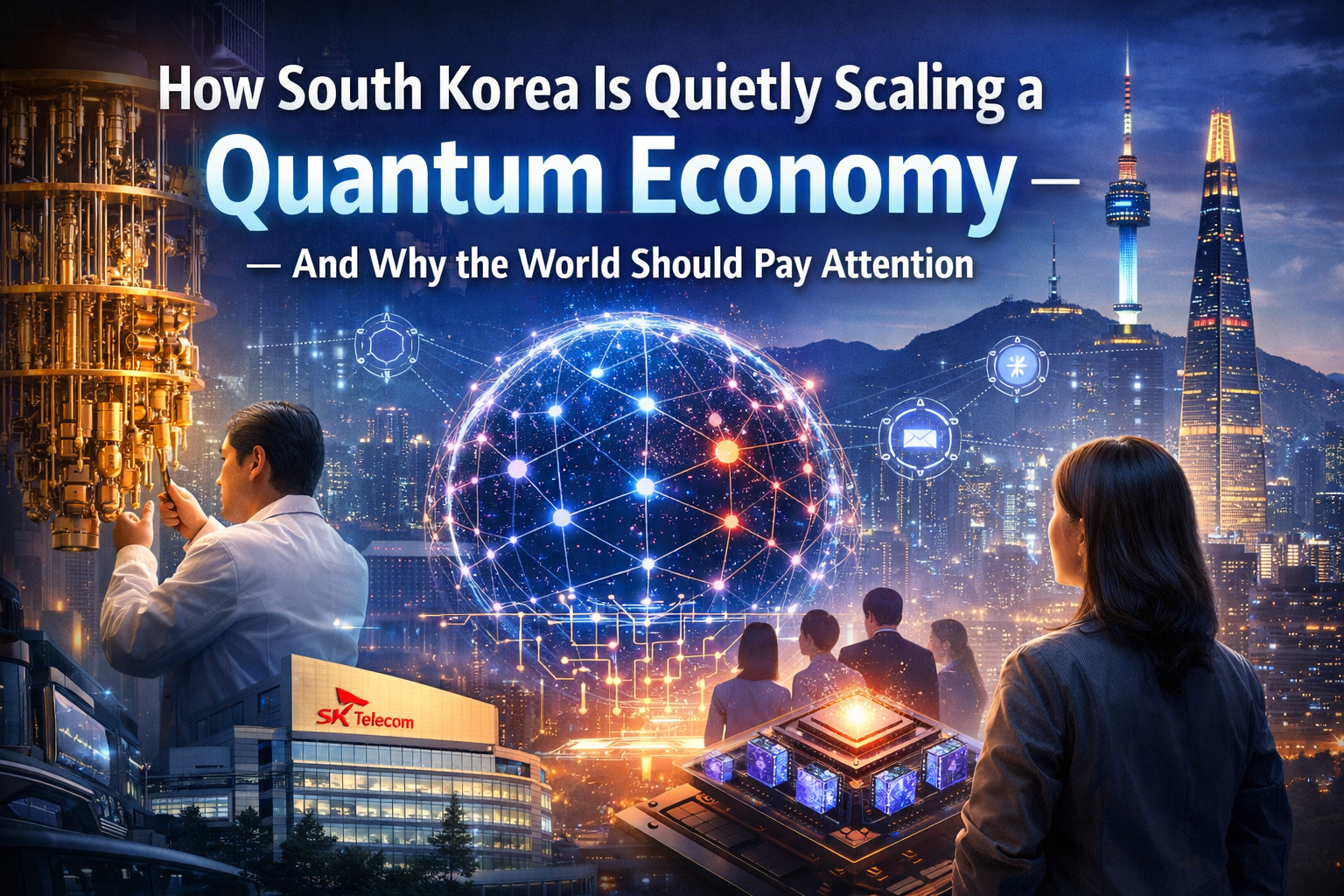
South Korea isn’t just investing in quantum computing. It’s building a scalable quantum economy from the ground up. And it’s doing so with a kind of intentionality that others are still dreaming about.
One of the things I’ve come to appreciate in covering global quantum development is how uniquely each nation approaches the challenge. Some lead with aggressive startup funding. Others double down on academia. A few bet on moonshot prototypes. South Korea? It’s weaving it all together, policy, research, and commercialization in a way that turns deep tech ambition into a national strategy.
This isn’t about hype cycles or speculative unicorns. It’s about infrastructure. It’s about talent. And most of all, it’s about alignment.
A National Strategy, Not a Patchwork
South Korea’s quantum journey isn’t built on isolated research labs or flashy demos. It’s built on a coordinated, long-term plan, led by the Ministry of Science and ICT (MSIT), with a 3-trillion-won public-private roadmap targeting global leadership by 2035. That roadmap identifies quantum as a “NEXT” technology—a pillar of future national competitiveness alongside AI and semiconductors.
This is what makes Korea stand out. While other countries chase short-term wins, Korea is thinking in decades. And the results are starting to show.
Institutions That Make It Real
Let’s talk infrastructure. Three institutions form the backbone of Korea’s quantum ecosystem:
- KRISS (Korea Research Institute of Standards and Science) leads in quantum metrology and measurement standards—essential building blocks for scalable systems.
- ETRI (Electronics and Telecommunications Research Institute) is pushing the boundaries in quantum communication and integration with telecom networks.
- KAIST (Korea Advanced Institute of Science and Technology) is investing in talent to create the next generation of quantum scientists and engineers.
These aren’t siloed efforts. They’re deeply interconnected, feeding into a pipeline that moves seamlessly from lab to market.
Commercialization That Matters
But the real magic happens when that pipeline delivers actual companies—ones that don’t just prototype but deploy.
- SDT Inc. is building hybrid quantum-AI computing centers blending classical infrastructure with quantum acceleration.
- Qunova is developing practical software for the NISQ (Noisy Intermediate-Scale Quantum) era, solving real-world problems with imperfect hardware.
- Genesis Quantum is focusing on secure quantum hardware and advanced sensing systems.
These aren’t moonshots; they’re market-ready. They represent a new phase in quantum: not just exploration, but execution.
Industry That Leads, Not Lags
South Korea also benefits from something most countries don’t have: a deep-tech industry that’s not afraid to integrate early.
Take SK Telecom, for example. It’s already commercializing quantum key distribution (QKD) and quantum random number generators (QRNGs) within its national telecom infrastructure. While others are still debating the feasibility, Korea is deploying.
That’s a big deal. Quantum security isn’t just a niche concern; it’s core to national digital sovereignty. And Korea is treating it that way.
Global Implications
So why should the world care?
South Korea is quietly offering a living blueprint for how to build a quantum economy. Not just isolated wins. Not just academic excellence. But the full stack: from policy and research to products and deployment.
This makes Korea one of the few countries actually scaling quantum in 2026. It’s not the loudest player in the room, but it may end up being one of the most consequential.
If you’re serious about the future of quantum, not just as a science, but as infrastructure—this is where your attention should go.
The Moment
On January 28, from 07:00 to 09:00 CET, the Quantum World Tour offers a rare window into this ecosystem. Hosted online and free to attend, it brings together leaders from across Korea’s quantum landscape: startups, researchers, telecom giants, and policymakers, all sharing how they’re turning ambition into architecture.
This isn’t just a webinar. It’s a case study in how to do quantum right.
South Korea’s story is one of alignment, strategy, and long-term thinking. And in the often chaotic world of deep tech, that kind of clarity is rare.
So tune in. Not just to learn what Korea is doing—but to see what’s possible when quantum becomes more than a buzzword and starts becoming reality.