At Photonics West 2026 (January 20–22 in San Francisco), one thing was unmistakably clear: photonics is no longer a supporting character. It’s infrastructure.
MKS Instruments, operating through its core brands Newport, Ophir, and Spectra-Physics, used the show to make a strong statement about where advanced computing is headed—and who’s quietly making it possible.
Under its “Surround the Workpiece®” strategy, MKS isn’t just shipping components. It’s building full, end-to-end photonics ecosystems that scale cleanly from research labs to high-volume semiconductor manufacturing. And that matters, because the demands coming from AI, quantum, and life sciences don’t leave room for fragile tools or disconnected workflows.
AI Infrastructure & Data Centers
AI doesn’t just need better models. It needs better hardware, fabricated with nanometer-level precision and moved at speed.
MKS highlighted motion and laser systems designed to reduce vibration, increase throughput, and support advanced packaging, exactly the bottlenecks AI chipmakers are wrestling with right now. There was also a clear emphasis on photonics inside the data center itself, especially around optical transceivers that improve bandwidth while keeping power consumption in check. This is the less glamorous side of AI scaling, but it’s the side that actually determines whether infrastructure can keep up.
Quantum Science & Research
Quantum hardware is unforgiving. Magnetic noise, vibration, thermal drift—any of it can destroy experimental fidelity.
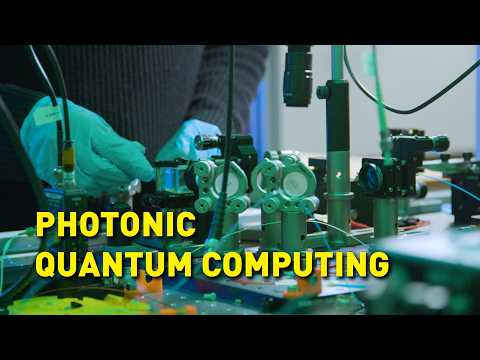
Here, MKS leaned into ultra-stable continuous-wave lasers and non-magnetic vibration-isolation systems designed specifically for quantum environments. These aren’t incremental upgrades; they’re the kind of tools that allow researchers to move from “Can we demonstrate this?” to “Can we repeat this reliably?” That shift is what turns quantum science into quantum engineering.
Biophotonics & Life Sciences
In biophotonics, the story is speed, depth, and clarity.
MKS showcased tunable femtosecond lasers optimized for deep-tissue imaging and fluorescence systems engineered to maximize signal-to-noise. The takeaway wasn’t just better images; it was faster discovery cycles in neuroscience, oncology, and cellular research. When imaging gets cleaner and faster, science moves faster too.
Industrial & Security Applications
From battery manufacturing to long-range infrared surveillance, MKS also demonstrated how high-power, ultra-short-pulse lasers and rugged IR optics are advancing industrial and defense applications. These systems are built for extremes, high throughput, high power, and long distances, and they signal where photonics is becoming mission-critical outside the lab.
Why This Moment Matters
This showcase lands at an interesting point for MKS. As of January 2026, the company is trading near its 52-week high (roughly $186–$200), and the strategy feels deliberate.
MKS is repositioning itself, not as a generic semiconductor supplier, but as a foundational infrastructure partner for the AI era. The kind that sits underneath model training, quantum experimentation, advanced manufacturing, and biomedical discovery.
Most people won’t see these tools. They won’t trend on social media. But without them, the AI rewire everyone talks about simply doesn’t happen.
And that, honestly, is where the most interesting technology stories usually live.