Quantum computing has long promised breakthroughs across drug discovery, materials science, logistics, climate modeling, finance, and cryptography. But for nearly a decade, superconducting quantum processors have hit a stubborn ceiling: systems rarely scale beyond ~100 qubits without running into crippling physical and engineering constraints.
The root cause is structural. In 2D superconducting chip designs, up to 90% of the chip area is consumed by wiring, not qubits. Routing thousands of high-fidelity control lines across a flat surface becomes exponentially harder—and introduces crosstalk, heat load, and layout complexity that degrade performance as qubits scale.
This is the bottleneck that froze progress across much of the industry.
QuantWare just broke it.
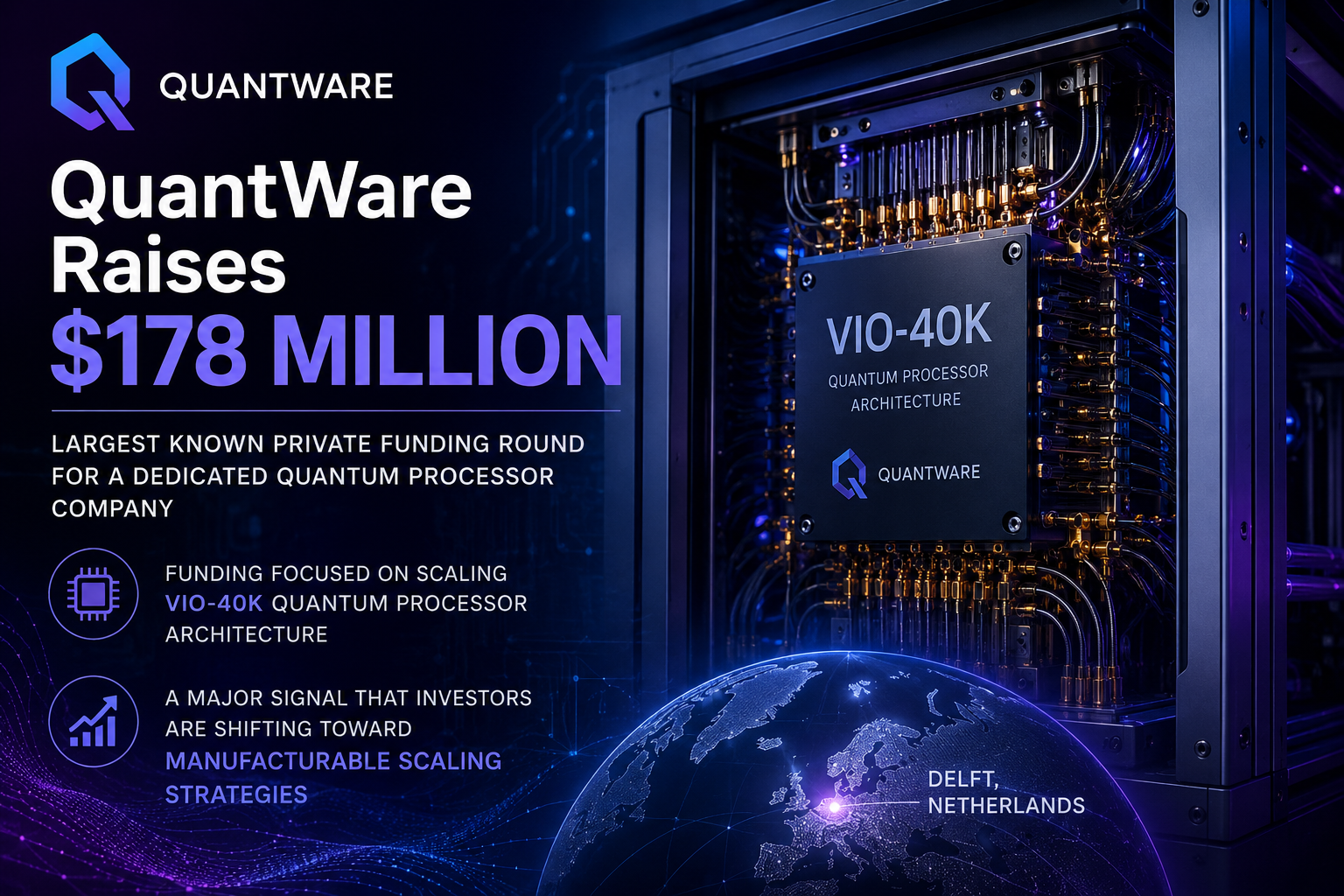
With the launch of its VIO-40K™ architecture, the Delft-based company has unveiled a 3D-integrated, chiplet-style quantum processor design that supports up to 10,000 superconducting qubits—a 100× leap over the practical limits of current devices.
This isn’t a step forward in scaling. It’s a jailbreak.
The Architecture: A 3D Leap Beyond the 2D Scaling Wall
At the heart of VIO-40K is QuantWare’s newest generation of VIO™ 3D wiring technology, enabling a shift from planar layouts to vertical integration.
Chiplet Modules
Instead of one oversized, crowded 2D chip, the processor is built from tiled chiplets—such as dense 64-qubit modules—that snap together into a unified qubit plane.
40,000 Vertical I/O Lines
The breakthrough: VIO-40K routes all required microwave and flux-control signals vertically rather than laterally.
This eliminates exponential fan-out and frees chip area almost entirely for qubits.
Ultra-High-Fidelity Interconnects
Chiplets connect through low-loss, chip-to-chip links with >99.9% fidelity across boundaries. Instead of stitching multiple QPUs together via slow optical or cryogenic links, VIO-40K forms a single monolithic processor that behaves as a single coherent device.
The result:
A 10,000-qubit superconducting QPU that is physically smaller than today’s 100-qubit chips—and dramatically cheaper and more power efficient than multi-QPU networking approaches.
Why This Matters: Economic and Industrial Implications
From Academic Toys to Utility-Scale Machines
Jumping from 100 to 10,000 qubits is not a linear improvement—it’s a structural shift. It opens pathways to applications that were previously decades away:
- VQE on ~1,000-qubit Hamiltonians for chemistry and materials
- Complex optimization workloads
- More realistic quantum machine learning models
- Cryptographic challenges that require large, coherent qubit spaces
This is the first architecture that makes “quantum advantage” feel like a near-term engineering problem—not a speculative dream.
Open Standard for a Global Ecosystem
QuantWare is positioning VIO-40K under its Quantum Open Architecture (QOA) initiative.
That means any company in the superconducting ecosystem can adopt the standard, accelerating compatibility and innovation much like open GPU standards helped drive the AI hardware explosion.
Seamless Classical–Quantum Integration
VIO-40K already works with NVIDIA’s NVQLink and CUDA-Q, meaning future quantum workloads can run in tight orchestration with AI supercomputers.
Quantum + AI isn’t hand-wavy anymore. The pipes are being built.
KiloFab: Scaling Up the Supply Chain
To support global demand for kiloqubit-class processors, QuantWare is building KiloFab, the world’s first fabrication facility dedicated exclusively to QOA-compliant quantum chips.
- Opening: 2026
- Location: Delft, The Netherlands
- Production impact: 20× increase over current capacity
This gives Europe a powerful foothold in the quantum hardware supply chain—an area currently dominated by the U.S. and China.
The Path Ahead
Reservations for VIO-40K devices are open now, and first customer deliveries are expected in 2028, aligning with the maturation of:
- large-format dilution refrigerators,
- advanced cryogenic control electronics,
- and integrated quantum-AI workflows.
QuantWare’s announcement is more than a hardware update; it signals the beginning of the KiloQubit Era. If the company delivers on its promises, VIO-40K may reset the industry’s trajectory and establish the architectural foundation for the first economically meaningful quantum machines.
The decade-long scaling stagnation may finally be over.