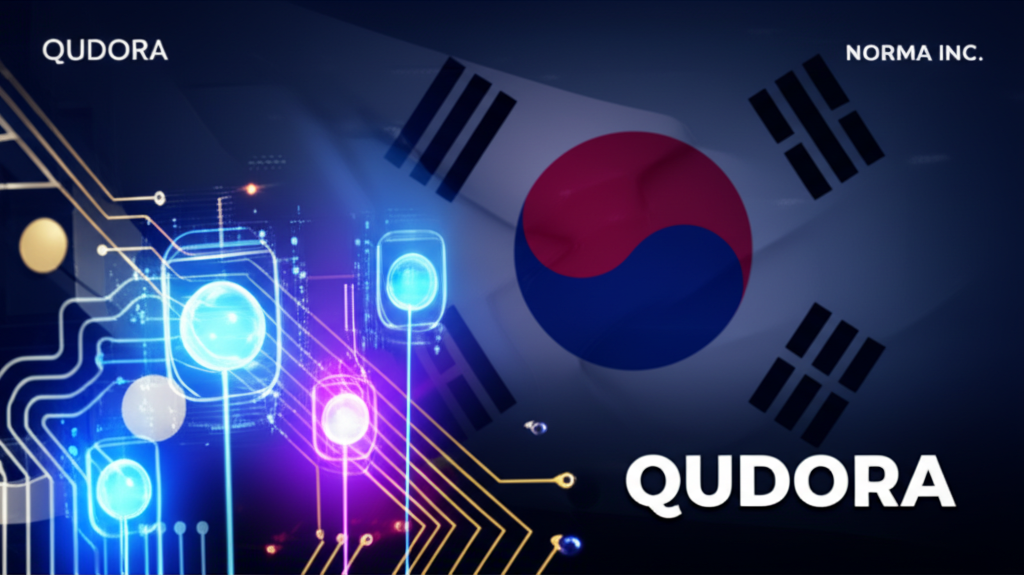
Quantum computing doesn’t always announce itself with sparks. Sometimes it enters a room quietly, purposeful, as if it’s been there all along. That’s the kind of presence we’re seeing in South Korea right now, as QUDORA, a European leader in trapped-ion quantum computing, partners with Seoul-based Norma Inc. It’s a move that feels less like expansion and more like alignment, two organizations meeting at the intersection of deep tech and local understanding.
QUDORA brings the hardware: long-coherence trapped-ion systems that are gaining attention for their accuracy, scalability, and subtle strength. These aren’t machines built to impress with noise or speed. They’re built to last, to hold coherence in the chaos, and to operate with fidelity where other platforms drift. Norma, on the other hand, brings its grounded expertise in South Korea’s quantum landscape. Their Q Platform cloud service is just the surface layer. Beneath it lies a dense network of academic ties, government relationships, and industrial partnerships, the kind of connective tissue that global players often lack when stepping into new territory.
Together, they’re not just selling access. They’re building it.
Rather than chasing headlines, QUDORA and Norma are rolling out a series of seminars, technical workshops, exhibitions, and education-focused initiatives. It’s a strategy rooted in generosity and long-term thinking. They’re not pushing people into quantum. They’re inviting them to explore it. And for a country like South Korea, where innovation already moves with quiet confidence, this approach lands with the right tone.
At the same time, the partnership is designed to dovetail with national research priorities and public procurement pathways. That’s a significant detail. It signals that this isn’t just about tech for tech’s sake. It’s about embedding quantum technology into Korea’s existing systems of trust and authority, ensuring that researchers, students, and businesses alike can gain hands-on experience without needing to go through foreign gatekeepers.
For QUDORA, this partnership isn’t a one-off. It follows a similar agreement in Taiwan with Kensho, suggesting a deliberate regional strategy is unfolding. Not flashy. Not rushed. Just precise. Taiwan and Korea are both countries that offer strong semiconductor ecosystems, rising government interest in quantum, and the kind of infrastructure that can support emerging technologies without being overwhelmed by novelty. QUDORA appears to be establishing a network, not of customers, but of collaborators.
Trapped-ion quantum computing is often overlooked in mainstream tech conversations, mainly because it doesn’t rely on spectacle. It doesn’t shout. But that’s also why it matters. This technology offers longer coherence times and higher operational fidelity than many of its competitors. That makes it not just viable but powerful. Strategic. And when embedded into Korea’s already ambitious innovation pipeline, it could shape a new generation of thinkers, developers, and engineers who don’t have to leave their country to become global contenders.
Zooming out, the significance becomes even clearer. This partnership is not just about moving hardware across borders. It’s about moving understanding. QUDORA represents the European R&D discipline and deep technological heritage. Norma represents Korean agility and local knowledge. Together, they form a bridge, not just a geographic one, but also a conceptual one. It’s a model for how the quantum world could grow: not through domination, but through dialogue.
If it works, as expected, South Korea may not just join the quantum age. It could become one of its most dynamic, grounded, and future-facing testbeds. And maybe the real legacy of this partnership won’t be a single machine or contract. Perhaps it will be a quiet shift in how quantum becomes part of everyday innovation. Not loud. Not rushed. Just inevitable.
The announcement can be found here.
Stay Connected
Follow our journey and be part of the conversation:
🔗 Find us on LinkedIn
📬 Join our mailing list
📺 Subscribe to our YouTube channel