
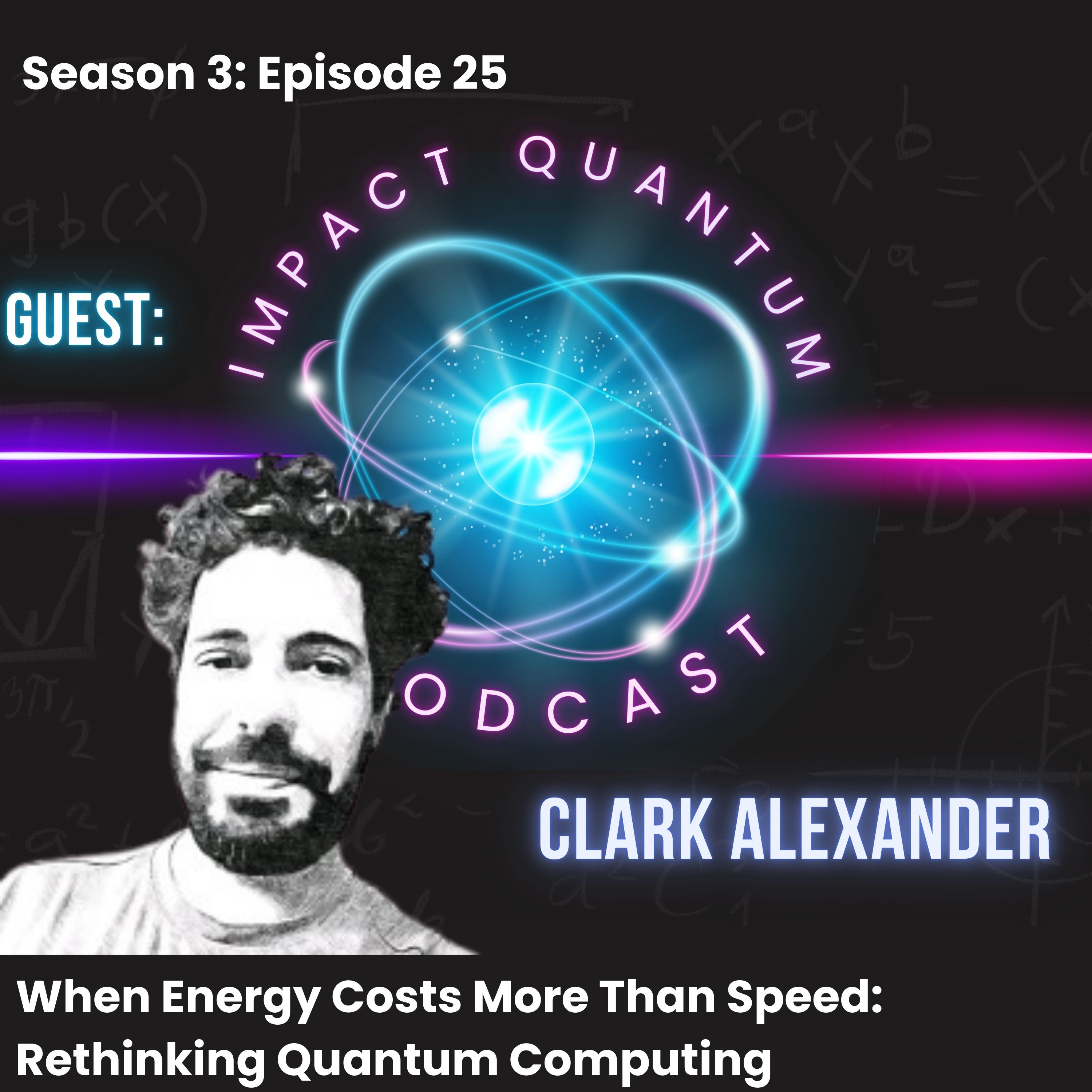
Welcome to Impact Quantum, the podcast where curiosity meets cutting-edge technology and quantum concepts get untangled for everyone—no physics PhD required. In this episode, hosts Frank La Vigne and Candace Gillhoolley sit down with Clark Alexander, mathematician, quantum thinker, co-founder of Enerjuice, and self-proclaimed flaneur. Together, they dive into the unexpected intersections of quantum computing, artificial intelligence, and the energy markets.
Clark shares insights from his recent experience as a juror at Egypt’s first national quantum hackathon, unpacks the real-world energy demands of quantum hardware, and challenges some industry assumptions about quantum advantage and supremacy. From the complexity of electricity markets and the astonishing mathematics behind power grids to the philosophical depths of algorithmic breakthroughs and cyber security, you’ll get a front-row seat to some spirited debate, practical analogies, and a few SAT-worthy vocabulary words.
Whether you’re fascinated by the future of quantum tech, curious about the energy powering your electric bill, or just want to learn why you can’t build a Lego tower to the moon, this episode delivers sharp opinions, relatable explanations, and just the right amount of existential crisis—perfect for anyone eager to explore where quantum theory meets real-world impact. Grab your coffee and get ready for an illuminating journey across the quantum landscape!
Time Stamps
00:00 “Quantum Computing: Beyond Algorithms”
03:40 Egypt’s First National Quantum Hackathon
08:25 Quantum Computing: Efficiency vs. Precision
10:13 Key Measures in Modern Computing
16:44 Quantum Hardware for Specialized Problem Solving
17:28 Google’s Willow Chip & F1 Insights
23:16 “Quantum Annealing vs. Gate Computing”
24:19 Quantum Annealing and D-Wave’s Specialty
29:46 “Infinite Algorithmic Possibilities”
31:43 “Brilliant Inverse Square Root Trick”
36:43 Clueless: Science Program in Mexico
40:07 Transition to Industrial Mathematics
43:14 MISO: Energy Flow and Pricing
45:59 Electricity Pricing Optimization Challenge
50:24 Understanding Electricity Markets
51:46 Impact Quantum Wrap-Up: Math & Qubits
Transcript
Welcome back to Impact Quantum, the only podcast where we explore
Speaker:the frontier of quantum computing and ask the real
Speaker:questions, like how many SAT words can we fit into a single
Speaker:episode? I'm your host, Frank Lavine,
Speaker:joined as always by the indomitable quantum curious,
Speaker:Candice Gilhooly. Today's guest is Clark Alexander,
Speaker:a mathematician, quantum thinker, co founder of
Speaker:Energuice. No, it's not. A startup selling
Speaker:kombucha and self professed flania. If you've ever
Speaker:wondered how quantum computing, AI and energy
Speaker:markets intersect or how to irritate IBM with a single
Speaker:slide, this episode is for you. We'll dive into quantum
Speaker:advantage, energy efficiency, and why you can't just
Speaker:build a Lego tower to the moon. Expect some strong
Speaker:opinions, academic wanderlust, and at least
Speaker:three existential crises about your electric bill. Let's
Speaker:get into it.
Speaker:Hello and welcome back to Impact Quantum, the podcast where we explore the emerging
Speaker:industry and field of quantum computing and where you don't need
Speaker:to be a physicist, but it does help if you're curious.
Speaker:And with me, as always, is the most quantum curious person I
Speaker:know, Candace Gooley. How's it going, Candace? It's great. I'm
Speaker:really excited to be here today. We are going,
Speaker:we're going, it's all good. We're going today to speak with
Speaker:Clark Alexander, who is a mathematician and
Speaker:he is co founder of Energuice. And it actually sounds
Speaker:really exciting, his company. So we're definitely going to be asking him some
Speaker:questions about that. Yeah. So welcome to show Clark and tell
Speaker:us, tell us all the good things you're up to with Energuice,
Speaker:which is a portmanteau of energy and juice.
Speaker:And in the virtual green room, we were, we were busting out with the
Speaker:SAT vocabulary words. So.
Speaker:Right. I like, I like Portmanteau. I once got
Speaker:an improv comedy show and they're like, give us some words that were SAT words.
Speaker:I was like. Well, we've had two so
Speaker:far. There was Flenore, which I was like, the
Speaker:only person I've ever heard use that word in public was Nicholas
Speaker:Nassim Taleb. And turns out you're familiar with his works.
Speaker:And then we had Portmanteau immediately followed. So this is going to be the
Speaker:SAT vocabulary word show. So not only we learn about energy
Speaker:and quantum computing, but also maybe pick up a new vocabulary word or
Speaker:two. But not like in the way when I'm stuck in traffic and my kids
Speaker:learn new vocabulary words. Those are different types of vocabulary.
Speaker:Well, thank you very much for having me. This
Speaker:is exciting. I like to talk about what I'm working on and I like
Speaker:talking about quantum computing and how it's affecting industry. And so I think we've landed
Speaker:the right place for today. Awesome. So that's a good, that's a
Speaker:good segue. Like where are we with industry? Right,
Speaker:because we had a guest recently kind of talk about
Speaker:how it's going to be an industry by industry type of
Speaker:takeover. Not takeover, but it was like it's going to grow industry by industry.
Speaker:And he's like, you know, will the airline CEOs care about quantum computing?
Speaker:Well, probably not for another 10, 15 years, but if you're in the defense or
Speaker:mathematics or even chemistry,
Speaker:you're going to care about that in a much shorter time frame.
Speaker:Sounds reasonable to me. But what's your take on that?
Speaker:Yeah. So I want to pitch back to just one
Speaker:week ago I was in Egypt for the first ever national
Speaker:hackathon of Egypt. And it was co sponsored by
Speaker:Open Quantum Institute, IBM Quantum Quantum,
Speaker:the Bibliotheca Alexandrina was there, ICAFE out of
Speaker:Netherlands. So Saleem, who you may have talked to, and then
Speaker:Yusuf Eldakar were some of the organizers. They had
Speaker:invited me to one be a juror on that at that
Speaker:hackathon, which was amazing to see the, the progress being made by the
Speaker:university students in the, the wider MENA region. And then also
Speaker:they had me give a talk. And you know,
Speaker:my thing is I follow energy. I was an energy trader a few years ago
Speaker:and you know, I work in AI and I work in quantum computing. And right
Speaker:now I'm looking at what are the energy limitations of
Speaker:quantum computing. So this was, this was my talk. It ruffled a few feathers, but
Speaker:it got people actually really thinking about it. So
Speaker:sort of to put our listeners in the right mindset, those
Speaker:viewing, I love to start with this question. This gets us sort of in the
Speaker:right mindset. And the question is this. How tall
Speaker:a tower can you build out of Legos? You know,
Speaker:like just, just the bricks. Just take a bunch of two by fours. How tall
Speaker:can you build that tower? Okay. And if you think about
Speaker:this for a few minutes, well, there's, there's kind of two
Speaker:obvious answers. There's the math answer which is just keep sticking the bricks together
Speaker:for infinity. And then there's the physics answer and you
Speaker:start asking, well, can I build this to the
Speaker:moon? What happens to gravity? Can I build this
Speaker:past geosynchronous orbit? How tall can you actually Build this thing,
Speaker:right? Plus wind and like birds flying into it and stuff like that. Like,
Speaker:so the, the analogy that we're trying to get here is that there's a math
Speaker:answer and there's a physics answer, and in the world, live in this
Speaker:sort of mesoscopic world. Here's a good SAT word for you. So
Speaker:in the mitoscopic world, this middle thing, the math and physics really agree
Speaker:really, really closely. Extremely closely. But
Speaker:when we're talking about like galactic style stuff,
Speaker:right? How do you measure how far away a star is,
Speaker:right? You're not measuring the centimeter. You're
Speaker:not measuring, you're measuring this to the nearest like astronomical unit. But you also
Speaker:have to consider like how gravity is bending light, right? I mean
Speaker:this, this is a very different realm of physics. The mathematics
Speaker:is the same, but the physics has actually changed. Now the same
Speaker:exact phenomenon happens at the quantum level, right?
Speaker:Quantum mechanics has its own set of rules. There's physical rules that are not in
Speaker:this world that we live in, right? They're mostly counterintuitive.
Speaker:So we have things like the uncertainty principle, right?
Speaker:In the, in the, the mat. The big world we live in, we don't
Speaker:have to worry about this. And there's, you know, I'll give you a joke, right?
Speaker:A friend of mine once said, I got pulled over for speeding.
Speaker:And the cop said, do
Speaker:you know how fast you were going? And my friend said, no, but I know
Speaker:exactly where I was.
Speaker:I mean, he was a physicist. And like, that was a really nerdy joke. But
Speaker:people who have studied quantum mechanics are like,
Speaker:actually that's, that's a good point. But you know, in this world we can know
Speaker:how fast we're going and where we are kind of simultaneously, right? There's
Speaker:some, some error there. But we're not concerned at 10 to the -35
Speaker:electron volt seconds. That's not a, that's not in our
Speaker:consciousness, Right, Right. So I mean, the,
Speaker:this, this ends up being the point, right? At quantum computing,
Speaker:there's this energy scale that we have to consider. There's actually a
Speaker:large energy scale and there's a small energy scale.
Speaker:And so to, to start with the large energy scale, let's start with the one.
Speaker:We kind of understand this, right? How much build, how much energy does it take
Speaker:to build a house? How much energy does it take to build a skyscraper? We
Speaker:can actually measure that pretty closely, right? So
Speaker:I'm looking at, say, these superconducting qubit technologies.
Speaker:IBM is maybe the most forward and out there
Speaker:according to their Blog. They use a 25 kilowatt
Speaker:refrigerator, which they have to run for 96 hours to get
Speaker:their qubits cold enough. Now, I gave this talk last
Speaker:week and one of the guys from IBM who I
Speaker:actually really quite like, he said, I think it's a 50 kilowatt refrigerator.
Speaker:Like, okay, that's a lot of energy, right? So let's, let's say 25
Speaker:give IBM the benefit of the doubt. Their scientists have figured out some
Speaker:extremely awesome refrigeration technology.
Speaker:But it's good to be an H. Vac tech, isn't it?
Speaker:Sorry, I didn't mean to cut you off. Yeah, yeah, but
Speaker:you do the math. It's 2.4 megawatt hours
Speaker:of electricity to get to that computation.
Speaker:And in this world, we can't ignore that overhead, we can't
Speaker:ignore that time overhead, and we can't ignore that energy overhead. And so
Speaker:you ask this second question. How much can you get done in four days
Speaker:using 25 kilowatt hours of electricity? That's like 400
Speaker:laptops running at full tilt, right? For four days.
Speaker:Like, can you get a pretty good approximation of
Speaker:literally anything running that fast? It's like
Speaker:not everything, but an extremely large set of problems you can
Speaker:get a good approximation for, right? And so
Speaker:I was in a business meeting a few months ago with the
Speaker:former head of Renaissance Technologies, and I pitched this question to him,
Speaker:right? I can find you an approximate portfolio of stocks
Speaker:that you want to trade which will give you, let's say,
Speaker:28.1% return. Or I could run for
Speaker:four days and I could get you
Speaker:.:Speaker:return. And he's like, well, I'll take the first one all day, right? By the
Speaker:time the, the stock market's already changed in that four days, so
Speaker:.:Speaker:negative, right? Because you're paying for that in time and volatility,
Speaker:right? So what this, this does, this puts us in
Speaker:what quantum computers can and cannot do and where they actually are going to be
Speaker:advantageous, right? So for me, I like to, I like
Speaker:to sort of say exactly what is advantage and what is
Speaker:supremacy in the world of quantum computing? I think these words get used a
Speaker:lot without like really defining them. So
Speaker:I'm going to dig deep into my mathematical self and I'm going to give you
Speaker:the definitions and your listeners and viewers can disagree with me all
Speaker:they want, and that's totally fine. But from my
Speaker:perspective, there's three things that we measure in modern
Speaker:computing. There's speed, there's memory.
Speaker:And the kids who have studied the beginning computer science algorithms will realize
Speaker:you can trade off speed and memory. You can sort a list really, really,
Speaker:really fast if you can memorize all of it. Right? So there's a trade off
Speaker:there. Okay. But the third one now is really energy,
Speaker:right? You look at the large language models
Speaker:opening, reopening nuclear facilities, data centers, how much water
Speaker:they're like Tulsa, Oklahoma had to go on water restriction a couple of days last
Speaker:year to like cool these data centers down. So this is no longer
Speaker:this sort of thing we think about at an industrial scale. This is
Speaker:the main metric. There's energy, then there's speed,
Speaker:then there's memory, right. Or energy and then time and then
Speaker:storage. If you want to think of it this way, for me, energy
Speaker:is like the prime metric now in quantum
Speaker:computing space. I think advantage means that some
Speaker:quantum computer chip system
Speaker:has outperformed a supercomputer in at least one of these three things,
Speaker:even on a specialized task. Okay. And
Speaker:Supremacy would mean that a quantum computer is outperforming a
Speaker:large, large, large set of problems in all three of these tasks.
Speaker:Okay. So advance. We've probably seen
Speaker:Willow, probably this Marco Pistoia when he was at
Speaker:JP Morgan before, before he joined Ion Ionq.
Speaker:They did this certified randomness. I
Speaker:think that's advantage. I think that is advantage. They have built a very
Speaker:specific chip to outperform in speed.
Speaker:Building randomness on a classical computer.
Speaker:I'll give them this, right. I think, I think that actually happened
Speaker:for Supremacy.
Speaker:I think because we have, at the moment, we have
Speaker:this huge time and energy overhead, I don't think
Speaker:we're actually going to be able to get ahead on time based problems.
Speaker:Right. So I've worked in supply chain optimization and I don't have four days
Speaker:to cool down a computer. So I can make a decision. I have to make
Speaker:the decision 12 hours from now, right? If we have this
Speaker:overhead that can't be discounted. And so there's no way a quantum computer can
Speaker:actually beat that in time because they have
Speaker:this overhead that you can't get around, right. There are physical rules to it. It's
Speaker:not like, oh yeah, I have a quantum computer that's just always on, right?
Speaker:With that amount of energy, if would. You throw energy into the mix, then yeah,
Speaker:that becomes an issue, right? And I was thinking like, well, what if you rotated
Speaker:it, right? Like you have one on one cooling? And I was like, well, you're
Speaker:still spending. You still have. Absorbing.
Speaker:Not absorbing. Yeah. You're still running a lot of energy. Yeah, that's
Speaker:right. You know, and a few years ago I was talking, I
Speaker:interviewed at Oak Ridge National Lab for their quantum machine learning group and
Speaker:they were, they were installing Frontier at that time, which was
Speaker:at that time the world's fastest and largest supercomputer. It's now moved to
Speaker:second, but when it came online was the most energy efficient per
Speaker:computation that had ever been built. And the guy directing
Speaker:the building of this computer said, you know why we didn't build it twice as
Speaker:big? It's because we couldn't afford the electricity bill. I'm thinking you guys work for
Speaker:the doe, right? Right. Seriously, if anyone could, you
Speaker:know, sign off on new nuclear reactors and whatnot, like, it'd be them.
Speaker:I mean, this is them telling me they couldn't afford the
Speaker:electricity bill. So there's some, like this metric has
Speaker:like catapulted into like, this is the thing we actually really need to care about.
Speaker:Right. At an industrial scale. And, you know, he worked out the math for me.
Speaker:Roughly as you square the number of operations, you cube the amount of electricity
Speaker:necessary. This is a serious,
Speaker:this is a serious problem. It's funny because now you, you pointed something out
Speaker:that, so I live between Data Center Alley in Northern
Speaker:Virginia, which is Loudoun County, Virginia, which is
Speaker:near Dulles Airport. So if you ever fly in a Dulles airport, all those
Speaker:buildings are probably data centers and Three
Speaker:Mile Island. Right. So one of the big
Speaker:controversies here is they want to plow through a lot of farmland and
Speaker:like remove, put in a new power line.
Speaker:It goes basically straight from the Pennsylvania grid to Virginia.
Speaker:And there's going to be, there's a lot of political drama, NIMBY
Speaker:type stuff going on. NIMBY meeting, not in my backyard. It's not another
Speaker:SAT word really. But.
Speaker:But I mean, like, it's like it's serious and it's just like basically
Speaker:the way the, there's a lot of shady deals going on where Maryland
Speaker:customers are going to have to pay a surcharge for this reliability product project,
Speaker:which is the electricity is basically going to go straight over our heads into the
Speaker:next state. So I mean, this is a very real problem. Right. And you
Speaker:can look, you can look online about, you know, kind
Speaker:of stories about, you know, communities
Speaker:that have had data centers put in and it wasn't exactly the wonderful
Speaker:thing that they were told it was going to be. Right. So like, it's, it's,
Speaker:it's interesting to see that. Now this is an issue. Right.
Speaker:I long sometimes for the days when nobody cared about computers but other
Speaker:computer nerds. Yeah, yeah. I mean I'm
Speaker:in, in some ways I make computing great again. Right, right, right,
Speaker:right, right. Mpga. That's what we want to do. Make it obscure
Speaker:again. Again. I like that.
Speaker:Yeah, we got the acronyms going today too. So
Speaker:anyway, this, this is where I, where I am about how quantum computing
Speaker:is going. I don't think supremacy is in the cards because there's a large
Speaker:set of problems that we
Speaker:can't either outperform on memory or time. Right. One,
Speaker:energy or time memory is not even in the discussion yet. Right.
Speaker:Story. Quantum storage is not even in discussion. I know there's a patent on
Speaker:qram and I took to Mohammed Zadin who has that patent. I talked to him
Speaker:last week and even he's not really a believer in
Speaker:quantum memory over performing classical memory ever.
Speaker:And he has the patent. Right. So it's not like
Speaker:it's not some rando on YouTube. Right, right. This, this is the
Speaker:folder I saw the patent itself actually, which was pretty cool. So
Speaker:any case, he's, he's not necessarily a believer in this,
Speaker:this third one, the memory piece. So
Speaker:I think going way back to the earlier point,
Speaker:what we're going to have to have is quantum hardware built for
Speaker:specialized problem sets in which they can perform an advantage and
Speaker:maybe two or three, two of the, two of the metrics that probably be able
Speaker:to over forum. I, I see this happening. Right. And
Speaker:to give yet another analogy, I was speaking with
Speaker:the IEEE subgroup yesterday. We were working on our, our final paper for
Speaker:quantum cyber security. And I told them this, that we're, we're discussing
Speaker:Google's Willow chip. I'm a big Formula One fan. I've
Speaker:been a big Formula One fan for a long time, since 92 actually, Nigel Mansel,
Speaker:but you can look that one. Nigel Mansel, my man.
Speaker:Weird dude, but good driver in, in modern
Speaker:Formula one, they take the cars apart after every race and they
Speaker:rebuild them and they sort of rebuild
Speaker:them to be advantage, advantageous to the track they're about to race on.
Speaker:Right? So this, this is some like really, really, really specialized race car. At each
Speaker:track, it looks roughly the same, but they can tilt the front wheel a little
Speaker:bit and they can, they can balance the tires a little bit. So if they're
Speaker:going to be turning right a lot more than turning left, if there's banked turns
Speaker:right. If there's a very, very long straightaway, they'll they'll let
Speaker:the, the back wing come down, you know, a tenth of a degree more.
Speaker:It's built specifically for the track. Right. They're not
Speaker:allowed to memorize the track. That calls the disqualification. A couple years ago with Renault,
Speaker:they had memorized the tracking in the brakes
Speaker:that caused a disqualification. But they, they build
Speaker:the car to, to the specifics of the track for the week. That's legal
Speaker:right, to within, to within rules.
Speaker:That's the kind of thing I think we're going to see in quantum computing. People
Speaker:are going to be building specialized systems to solve specialized problems
Speaker:and kick ass at doing this. Right, right now the,
Speaker:this where, where we're actually going to see some advantage. You know, again, I
Speaker:was sort of jostling back and forth with IBM about this.
Speaker:This is. Well, I can solve something that will take 3 million years in 5
Speaker:minutes. Okay. If that thing is worth 3 million years of
Speaker:advantage, then I give you 4 days, I'll give you 8 days to cool your
Speaker:computer down. It doesn't matter. Right, right. But stock trading
Speaker:doesn't fall on this thing. But if you're talking about
Speaker:improving, we end up speaking about the
Speaker:Habermach process for making ammonium. Right. If you're
Speaker:improving that by a fraction of a percent, the
Speaker:payback is so, so, so enormous over, over just
Speaker:a year that that energy usage is going to be wiped out.
Speaker:Right. If you're doing something that's like a long term massive energy
Speaker:reduction problem and you can solve this faster, that's
Speaker:advantage. That's really a thing that has happened. But stock
Speaker:trading, supply chain optimization, it just can't. Right? You
Speaker:can't, there's, there are like physical barriers which you can't do that.
Speaker:Right. So it really has to be for now
Speaker:forget nisq. This is like specialized quantum hardware to solve specialized
Speaker:problems. And I think, and, and I'm, I'm okay with that. I think that's a,
Speaker:that's a really interesting scientific and
Speaker:engineering problem to go into like solving. I want to solve this thing
Speaker:better than it has ever been solved in history. Right.
Speaker:That's, that's a, it's a worthwhile, at least scientific endeavor.
Speaker:Well, so I'm the curious one, so I get to ask questions that sometimes seem
Speaker:silly. But when you're saying the
Speaker:quantum hardware that's able to do this kind of precision,
Speaker:why would that not be different kinds of software?
Speaker:Like I'm trying to understand the difference as to, as to
Speaker:what would allow you to do this
Speaker:kind of computation. And I thought that was more of a software thing
Speaker:than a hardware thing.
Speaker:Well, at this level, at present, they're not really separated.
Speaker:Right. Because I think, I think where we are in the world of quantum
Speaker:computing is we haven't even decided what a qubit really is.
Speaker:Okay. There, there are nine known types
Speaker:of. Geez. And,
Speaker:and what I'm hearing this is, this is from the IEEE discussions are saying, well,
Speaker:each one has its own advantages and disadvantages.
Speaker:I mean, so have we decided what a Qubit is? Well, IBM
Speaker:has decided what they think a Qubit is, but IonQ has decided something else.
Speaker:Right. Because there's, there can be used for different sectors to solve
Speaker:different types of problems. Like you have the ion capture and then you have
Speaker:the super. You know, when we started learning about qubits and learned there
Speaker:were nine different kinds and you know, every time we feel like we've
Speaker:got our handle on the information, there's just a little bit more that's
Speaker:released that we're like, no, we don't know anything. Two,
Speaker:like mathematically there's two types, right? Annealing has these, like these
Speaker:wires. Right. So if we're going to talk about topology a little bit,
Speaker:the annealing is just like, it's a one dimensional qubit. It has, it's just
Speaker:spin, positive or negative spin. And the,
Speaker:the neutral atom or
Speaker:the trapped ion or the superconducting cubits, they're like
Speaker:full electron spin. So the, the annealing 1D wave
Speaker:is like an S1. Oh, the circle. And then on the, the
Speaker:gate side you have like S3. So a sphere sitting in four
Speaker:dimensions. Right. This an S3. Right. So
Speaker:even even that technology is like mathematically they're super
Speaker:far apart. Even how you program them is different. Right. So it's just like
Speaker:the analogy of a punch card computer to
Speaker:modern digital computer. Just even that technology is different. So they're going to do
Speaker:different things. Although punch cards are not so useful at this
Speaker:time. No, I know what you mean. You mean like what's the type of architecture
Speaker:we have now? Not von Neumann, but I know what you mean.
Speaker:Like the typical. It'll come to
Speaker:me later. But speaking of sat. Yeah.
Speaker:Computer science, AP terms. But yeah, I know what you mean. Like a traditional,
Speaker:what you would call a conventional or classical computer, that type of thing. Punch
Speaker:card computer is a little harsh. But, but I know where you're going with
Speaker:that. Two types of quantum
Speaker:computers are not, it's not that far apart. But you know, I just want to
Speaker:make the analogy so that the listener understands that
Speaker:annealing and gate computing are really separate technologies and they
Speaker:require a separate set of mathematics and a separate set of programming. Right. A
Speaker:digital computer is like, or to be reductive, it's a little bit of
Speaker:light switches. It's just a whole bunch of light switches, zeros and ones on and
Speaker:off. A quantum computer has a fundamentally different set of physics
Speaker:and so it needs a fundamentally different set of rules to program. Well,
Speaker:annealing and gate computers are also fundamentally different. Like
Speaker:topologically, they're a distinguishable type of things.
Speaker:So it's not just a new species, it's like a new
Speaker:category of species. Right. Like just program
Speaker:a gate computer to do an annealing task. They're not the same.
Speaker:Okay, so is that why companies like D Wave, they're, they're
Speaker:heavy on the annealing side of things and they're, they're more
Speaker:commercially around longer and maybe that's an
Speaker:easier problem to solve? Well, annealing is,
Speaker:you know, kneeling's been around for several thousand years. Right. And so I think
Speaker:it right itself In I guess 99 when D wave
Speaker:started to say like, yeah, actually we could probably do this quantum
Speaker:annealing thing and make, make a specialized thing, right?
Speaker:D Wave, D Wave has a specialized solver. It's, it's kind of a one trick
Speaker:pony. And I don't say that in a dismissive way like it's an
Speaker:amazing trick that it does, but it does a thing it's not going to
Speaker:be doing. It's not, you're not going to have a D Wave GPT,
Speaker:Right. That's the kind of thing it's going to solve. You're going to have these
Speaker:really hard optimization problems which you can pitch as
Speaker:binary optimization problems. So special purpose
Speaker:computing. Yeah, yeah. And it can solve a
Speaker:lot of really, really hard problems or solve or
Speaker:approximate very closely a lot of hard problems.
Speaker:But it's in a specialized realm, not just a general computer.
Speaker:Right. So where do you think
Speaker:the first breakthrough is going to happen? True
Speaker:breakthrough? Like, is it going to be in precision? Is it going to be in
Speaker:pharma with precision medicine? Is it going to
Speaker:be in energy with EV batteries? You
Speaker:know, is it going to be in finance
Speaker:for, you know, what was that? The random number generator?
Speaker:Like, what do you think will be the first true
Speaker:breakthrough?
Speaker:I don't, I don't want to maybe guess because
Speaker:what prediction is hard, especially about the future.
Speaker:Go more quotes. But I'll say this,
Speaker:what I see, you know, I, part of my talk is I, I talked about
Speaker:how cyber security is safe from quantum Computers forever and ever and
Speaker:ver and ever. It just is. RSA:Speaker:quantum computers because of this. There's an energy limit on the bottom. We can talk
Speaker:about that later if we want. But they're only
Speaker:safe from this particular style of attack.
Speaker:Right. This quantum Fourier transform source algorithm is going to top out because
Speaker:you have to do this. You have to rotate these
Speaker:electrons so little, right. So the
Speaker:readout becomes random. It's just noise. Right. You can't, you can't say,
Speaker:I'm going to rotate this 10 to the
Speaker:-:Speaker:that's zero rotation that the rent. The readout will just be random. Okay.
Speaker:There's no, there's no way you can produce so little energy to actually make that
Speaker:rotation physically meaningful.
Speaker:Right. Mathematically, it's fine. Rotate as little as you want. It'll
Speaker:work. We've proved Shor's algorithm works mathematically in the 90s.
Speaker:Physically, it can't. Right. There's, there's an uncertainty limit there. But
Speaker:what, what, what all that does is that tells us
Speaker:that the, the path that we're going is going to have some sort of limitation
Speaker:when you're trying to get some so specificity, right.
Speaker:You're. You're going to run into a limit the way we're doing it
Speaker:now. This does not, however, preclude some totally
Speaker:other algorithm and totally other way of doing
Speaker:things from coming up. Right. Going back to Nassim Taleb, we'll go to
Speaker:the Black Swan. Right. Earlier this year,
Speaker:Ken Ono, who's an amazing mathematician, he's a number theorist, actually, I
Speaker:think was working with Katie Ledecky, the swimmer. They were, they were doing some.
Speaker:So he helped her with like, cracking the statistics. But anyway,
Speaker:he's, he's a number theorist and he and two of his students,
Speaker:Greg and I think Vaughn Iterson, they put a paper this
Speaker:year redefining what prime numbers are.
Speaker:Hmm. And they said, actually
Speaker:we found out that if you take this polynomial and this partition function, partition
Speaker:is just the number of ways you can add up a number to get there.
Speaker:So five can be added up as four and one. It could add up as
Speaker:three and one and one or three and two or two and two and one.
Speaker:Right. These are partitions of five. How many partitions of the
Speaker:integers there are this polynomial times this partition
Speaker:function plus another polynomial times another partition function.
Speaker:It works only on primes. It's just this sort of like, magical thing.
Speaker:We've been thinking about primes. The Same way since Aristhenes, right.
Speaker:2600 years ago. Right. We've been thinking about primes this
Speaker:ime. And now, just this year,:Speaker:actually there are infinitely many more definitions of primes.
Speaker:This is the black swan, right? And so, you know, let's. Let's go, let's. I
Speaker:uote is from The Zero Effect,:Speaker:Bill Pullman's character says this thing, and even though it's a
Speaker:comedy movie, it's so, like, philosophically deep. I kept. It says, if
Speaker:you're looking for something, something specific, your chances of finding it are
Speaker:very bad because of all the things in the world. But if you're looking for
Speaker:anything, anything at all, your chances of finding it are very good
Speaker:because of all the things in the world. And I think,
Speaker:like, this is. This is where we are in quantum computing right now.
Speaker:For. For specifically for Internet security.
Speaker:Right. Somehow there's. There's a magical way in
Speaker:which most technologies have two different sets of competing
Speaker:technologies, but Internet security has never been that. It's just been key exchanges.
Speaker:Okay? And so factoring large numbers has basically been
Speaker:what Internet security is. Well, now you just need one
Speaker:algorithm to break any one of infinitely many definitions.
Speaker:I'm looking for anyone at all in any way, shape or form.
Speaker:I'm not precluding this possibility at all. In fact, the
Speaker:chances of this not happening are one in infinity, right? It's going to
Speaker:happen, right? This thing is going to happen.
Speaker:By whom? I don't know Where. I don't know by what type
Speaker:of algorithm, I don't know. But the fact that there are so many
Speaker:possibilities now, it opens it up in a way that we haven't
Speaker:been thinking about, right? And this, this is brand new. This is four months
Speaker:ago that this paper came out, right? So we're. We're
Speaker:not there yet. So Internet security,
Speaker:maybe at least the. The integer factorization part,
Speaker:what I see actually happening, and
Speaker:maybe I'll ruffle some feathers here. A good friend of mine I
Speaker:went to undergrad with is now at Flatiron Institute. And if you follow Flatiron
Speaker:Institute, these are four guys who, they take all
Speaker:these claims about, oh, quantum breakthrough happens. Chinese researchers
Speaker:have done XY thing that supercomputer could
Speaker:never do. And about six months later, they say, actually, we did it on a
Speaker:laptop. They've done this like four or five times.
Speaker:Flatiron Institute, they do awesome stuff. And
Speaker:for me, talking about quantum impact, being on this, like,
Speaker:particular podcast is important that the real
Speaker:measurable economic impact of quantum computing is
Speaker:it is causing these guys like Flatiron Institute and guys like me who work in
Speaker:evolutionary programming to rethink what our classical algorithms are
Speaker:doing. We are getting better and faster and smarter
Speaker:classical algorithms which are costing less energy and less memory
Speaker:to do better things, to sort of push quantum advantage back.
Speaker:This is a quantum inspired algorithms at the.
Speaker:Generally the. Okay, some of them are, and some of them are just like,
Speaker:oh, you know what, there's this randomization scheme we just weren't looking at,
Speaker:right? Some of them are just pure randomized algorithms with
Speaker:like a really clever way to do stuff,
Speaker:right? Now I give this example, like someone showed me this is the
Speaker:slickest line of code I've ever seen. And it was,
Speaker:it was for a video game where when you're looking around in a video game,
Speaker:what they want to do is make the, you know, all the
Speaker:vectors are normal. So like when you're looking at the spot, you
Speaker:turn around and you look. And what this looks like mathematically is you have to
Speaker:take this ray of vision and you normalize it to
Speaker:length one. Alright? So going way back to vector analysis,
Speaker:you take the vector, you divide it by its length,
Speaker:right? So square root of it. And so this guy found this way to
Speaker:just take an inverse square root really, really, really fast.
Speaker:And the way he did this is basically he got a really good first guess
Speaker:and one linear approximation. And that's
Speaker:absolutely brilliant. That's what he did. He took a really, really, really good first
Speaker:guess. And so this thing can sort of run and it causes much less lag.
Speaker:And you can, you can, you can see this happen in like, you know,
Speaker:area game. So you, he's reduced the lag across the entire network of
Speaker:all video gamers worldwide by just this clever,
Speaker:right? That's pure, pure classical algorithm. But it was like a really awesome
Speaker:randomized first guess. He figured out how to do that,
Speaker:right? No quantum nothing. It was just like, oh, if you start
Speaker:near the solution, you only have to do a little bit of computation to get
Speaker:to the real solution. So some of it is quantum inspired
Speaker:algorithms. Absolutely 100%. I work in that sort of area.
Speaker:Genetic algorithms, Monte Carlo simulations. I think there's this like
Speaker:biased field diagonal cross.
Speaker:Optimize something. It's a, it's a terrible acronym that has
Speaker:no word to it. But this to me
Speaker:e quantumized version of this:Speaker:algorithm called MCMCMC. There's three
Speaker:MCs which for the listeners will be
Speaker:Metropolis coupled Markov Chain Monte Carlo algorithms,
Speaker:in case you're wondering. So it's not a rap group from the early 90s, though
Speaker:it's unfortunate. Not. No, it's not in the native tongue school. Right.
Speaker:I know Latifah and De La Soul would have put out the album of the
Speaker:three MCs, but that'd be awesome. And
Speaker:it got into like, philology in. In biological
Speaker:classifications. But I use this actually for supply chain optimization
Speaker:because the point is that instead of just guessing this one spot like
Speaker:Monte Carlo algorithms do, it allows you to guess
Speaker:many different Monte Carlo algorithms. And so it allows you to
Speaker:find multimodal probability distributions a lot
Speaker:faster. It converges so much faster. Right. It's just
Speaker:pure probability. And I think, I think that actually inspired the quantum
Speaker:algorithm for the biased field diagonalization,
Speaker:at least to my reading. That's how it looks. Right. So the
Speaker:quantum algorithm is classically inspired, not the other way around this time.
Speaker:Gotcha. It goes both ways. Right.
Speaker:This is a. So you wouldn't have thought of that kind
Speaker:of. Naturally, you would not have thought that the classical
Speaker:inspired algorithms would. I don't know if the. The authors
Speaker:of that algorithm were thinking of it that way, but, you know, having. Having
Speaker:used the other. The classical algorithm myself multiple times and,
Speaker:and having read their paper, at least to me, it was just like,
Speaker:you know, my neurons were lighting up, my neural network was saying, oh, these are
Speaker:the same algorithm. These are the same algorithm. That's how it
Speaker:rang to me. They might not have been thinking about that. And that's cool that
Speaker:they have like a totally unique algorithm. But, you know, I,
Speaker:I've, I've seen this algorithm before as a classical thing,
Speaker:but even, even if they didn't know about it, you know, this same
Speaker:sort of technique landed. Right. It's like,
Speaker:it's like the name Soren. Soren is a Persian name, but it's also a Swedish
Speaker:name. They just sort of landed on the same letters. Right.
Speaker:Interesting. That's my take. Could be wrong,
Speaker:but that's just how I read it.
Speaker:I'd love to just take a little step back if I could. I mean, what
Speaker:you do sounds legitimately
Speaker:fascinating. And you know, what you're uncovering and
Speaker:you're. You're at the, the frontier of
Speaker:innovation, you know, I'm going to ask you, like,
Speaker:walk me through a little bit of your career journey.
Speaker:That got you. That got you to where you are
Speaker:right now. Okay.
Speaker:I hope you guys like random walks because. Oh,
Speaker:that's all the type of walking I do. Fantastic. Okay.
Speaker:You'll appreciate this. I've, I've done a couple
Speaker:of, I've been to support
Speaker:this program in Mexico a few times called Clueless. And one of my
Speaker:former students from Northwestern is one of the founders of this. So he invited me,
Speaker:said come talk. And, and one of my favorite events at this,
Speaker:this week, it's like a one week intensive where instructors from Mexico and United
Speaker:States come and teach like one week intense course on some sort of
Speaker:science to high school seniors, college freshmen, college sophomores in
Speaker:Mexico. Right. Because there's a lot of talent coming and they just don't have the
Speaker:resource that was the point. But Wednesday night of this week,
Speaker:whenever they do it, they have like the, the Science Cafe and they have the
Speaker:instructors, me and some professors from University of
Speaker:Chicago, from Harvard, they come and they ask us questions
Speaker:and someone asked me about how do I
Speaker:think about work, life balance, something like this. And I said
Speaker:whatever you're expecting in the future is wrong.
Speaker:That's it. But I don't mean start there. Yeah, but
Speaker:what that means is that some things are going to far exceed
Speaker:your expectations and some of your expectations will never
Speaker:even get close. Right. Okay. Right.
Speaker:So that's, that's kind of, and that's, that's kind of how my life has worked.
Speaker:So I'll give you like just the really top down overview.
Speaker:I finished my PhD in:Speaker:geometry and mathematical physics. What I have
Speaker:learned, reading a lot the last two years is that historiography is a chaotic
Speaker:system. If you start the story one year earlier, it changes the whole story.
Speaker:So:Speaker:commutative geometers and mathematical physics. And this was spurred on by Alan
Speaker:Cohen's idea that he may have solved Riemann hypothesis using these mathematical
Speaker:physics techniques. There's like this glut of non commutative
Speaker:ing in postdoc positions. The:Speaker:around and I, I didn't get one of those postdoc positions. I got a teaching
Speaker:job at Temple University. Go Owls. It was
Speaker:awesome. But I was going to say at. Least you didn't work for a mortgage
Speaker:company. So. Right. Well, almost, almost happened.
Speaker:You know, think, think all it didn't. Right. You'll go randomness all the way.
Speaker:2008, you may have remembered there was like a massive financial crisis.
Speaker:So there were a lot of postdocs of three postdocs for three years got
Speaker:shortened to two postdocs of two years. So I got double
Speaker:caught up in that. And Then I basically came what
Speaker:they would call in the sports world the journeyman. I went to southeast India to
Speaker:Institute of Mathematical Sciences for a year. And then I came back.
Speaker:A professor had died days before semester was supposed to start, and I
Speaker:just ended up getting a job at the University of Wisconsin Parkside to fill that.
Speaker:That was completely random only because I had known someone here in Evanston who was
Speaker:doing this. I taught there for two years. Then I
Speaker:landed at DePaul lecturing one year. One year. One year. I was at DePaul
Speaker:for six years. And then I moved to UIC for a half a semester. And
Speaker:I never was going to make tenure. Right. That those days had
Speaker:kind of passed for me in some sense.
Speaker:And so a friend of mine who I'd gone to Northwestern with had started a
Speaker:company, and he. He called me and said, clark, I'm doing this
Speaker:thing in data science, but it's not. It's not traditional data
Speaker:science. I need some real mathematical firepower, and I don't have it. You want to
Speaker:come work with me? And he went
Speaker:to my wife and said, you need to convince Clark to come work with me.
Speaker:And so my wife said, clark, you need to go work with him.
Speaker:My friend Rami pulled me out of academia and started me into industrial
Speaker:mathematics. And I didn't know how to program a computer, and so I learned
Speaker:there. Rami, unfortunately got sick and he. He died
Speaker:a few years ago. And so I kind of have made my way
Speaker:from there. He got sick and then. Then Covid
Speaker:happened and I left that company and I joined an
Speaker:electricity trading company through another roundabout connection that I knew from India.
Speaker:Completely random. A mathematician was like, I want a mathematician to help me trade
Speaker:electricity. Okay. So I did that. There was a
Speaker:electrical storm in Texas, you may remember, like, there was an ice storm.
Speaker:Everyone lost all the money. So my company went under. I lost a job again.
Speaker:Fantastic. Started just applying
Speaker:everywhere. That was when I was applying at Oak Ridge. And then I ultimately took
Speaker:a job at a credit card company that didn't work out
Speaker:for whatever reasons. And then I joined a logistics
Speaker:company where aforementioned, my friend Rami was
Speaker:supposed to be the head of AI, and when he was. When he was
Speaker:really sick, he had called the CEO and said, hey, you need to take Clark.
Speaker:And so that's how I landed there. Interesting.
Speaker:Mentioned a couple of times. Energy trading.
Speaker:What's the dollar store description of what
Speaker:energy trading is? I'm not quite sure because I know it comes up a lot.
Speaker:Usually when there's a crisis, people are suddenly experts on energy
Speaker:trading, but like the Texas crisis, plus there was some
Speaker:drama in the early:Speaker:the most infamous energy trading company in the world is still. Enron,
Speaker:many orders of magnitude. So. Yeah,
Speaker:well, if you're going to blow up something, blow it up big.
Speaker:But what, what is energy
Speaker:trading? I don't quite get it, right. Because like, and this has come up, you
Speaker:know, I'll tie it back to the issue with Maryland and
Speaker:Virginia and Pennsylvania, right. Like they're talking about they buy
Speaker:energy from here and they do that I don't quite understand.
Speaker:I can understand how the math would work in terms of optimization and
Speaker:probably what you do, but I don't understand the industry. And I realize this is
Speaker:the Quantum podcast, not energy trading, but what,
Speaker:what's like a good two dollar description of. Okay,
Speaker:fantastic. I'll give you two really easy problems and then I'll tell you why quantum
Speaker:computing is important. Okay, so good, you're tying it back in.
Speaker:That actually just happened recently. It'll tie all back in. Great.
Speaker:So there's, there's two ways the energy trading sort of works, right. The easiest
Speaker:one is you go to a city, let's say Madison, Wisconsin.
Speaker:Right. Wisconsin goes to the regional transmission
Speaker:operator or independent system operator, depends on how they're named. So you've heard maybe
Speaker:of Caiso, that's California ISO. And then
Speaker:you've maybe heard of miso, which is where I am, Mid
Speaker:Continent Independent system operator. So the ISO or the
Speaker:RTO controls like all the energy flow and it controls the
Speaker:pricing. So the city of Madison, Wisconsin will say, okay, I want
Speaker:to buy, is basically a futures contract. I want to
Speaker:buy this many gigawatt hours of electricity
Speaker:that you give me from January 1st to December 31st
Speaker:of this year. And I want to pay this much per
Speaker:kilowatt hour for it ahead of time. And in this way Madison,
Speaker:Wisconsin can now sell to their residents at
Speaker:whatever marginally marked up price. Right. So we want to buy it
Speaker:for 12 cents a kilowatt hour for the entirety of the year. And we're going
Speaker:to make a deal for, let's say 500 gigawatt hours,
Speaker:whatever they make, I don't know how much Madison uses. And then so they sell
Speaker:it to all the, the, the independent
Speaker:households and the schools and the businesses for 15 cents a kilowatt hour. And that's
Speaker:just the price of electricity for the whole year. Right. That's one way to do
Speaker:it. That's a, that's a four year contract. Okay. They make the deal
Speaker:the one in trading. So you could do that if you're, if you're a
Speaker:municipality, you trade this way. If you're an individual little brokerage
Speaker:house, you will say, okay. The ISOs and the
Speaker:RTOs actually set the price of electricity. And what they do is they say,
Speaker:okay, 9:00am today, so this is just a few hours ago.
Speaker:They set the price for tomorrow's electricity
Speaker:pricing. They set it at 5 or 15 minute increments, depending on where you are.
Speaker:So say every 15 minutes we're going to charge this much for electricity.
Speaker:Okay. This is called the day ahead price. Okay.
Speaker:And so what, what happens is these little traders can come in and say,
Speaker:okay, actually I think it's going to be less than that.
Speaker:Okay. It, the real time price is going to be less
Speaker:than that. So what I'm going to do is buy the real time price now
Speaker:and sell it at the, the actual. I'm gonna
Speaker:buy it, buy the day ahead price and sell it at the real time price.
Speaker:Right. So they make some money. Or you can sell it as like short
Speaker:selling. Basically you can sell it, you think it's going to be too expensive, you
Speaker:sell it and then you buy it back at the, the real time price.
Speaker:Literally. I think this is called day ahead real time. So in, in trading they
Speaker:call that the DART model D A, R, T. Right? That's,
Speaker:that's the simplified version. And then there are options, all
Speaker:sorts of exotic options and, and hedging and
Speaker:all kinds of stuff. You know, they run it like a hedge fund, except that
Speaker:the commodity they're trading is time based. Very, very, very strictly time
Speaker:based. That's how it works. Okay. So you know, Con
Speaker:Ed is kind of like the supermarket. And then whatever the
Speaker:supermarket buys their food and their groceries and distributors is
Speaker:kind of like that, the back office to all of that. Right. And so
Speaker:the RTOs and ISOs have this question like how do you set the price?
Speaker:And so what you want to do in. So this is a massive, massive
Speaker:optimization problem. This is probably the most important, most
Speaker:worthwhile optimization problem you've never heard of, called the AC opf.
Speaker:This alternating current, optimal power flow. So
Speaker:what you want to do if you're making the electricity, if you're a generating plant,
Speaker:you don't want to just distribute more than you've made and you
Speaker:don't want to have shortages. So you want to balance best you can
Speaker:in real time the supply and demand of electricity.
Speaker:Okay. And this takes into account
Speaker:congestion. Where there's construction, there are voltage angles, there's
Speaker:like you know, there's all, all sorts of things, pricing. So if,
Speaker:if you're a mathematician, this is the most exciting problem because it's non
Speaker:convex, non linear, time dependent, directed graph,
Speaker:acyclic graph, cyclic, whatever, whatever non thing you
Speaker:can think of. This is the problem for you.
Speaker:Like a 0.1 percentage in improvement. I think I did the, the math on
Speaker:this. If you improve the efficiency of this solution by 1% and
Speaker:are actually able to successfully trade on it, it's like a billion dollar a day
Speaker:benefit. Oh wow. So no wonder why it's
Speaker:run like a hedge fund. Yes, but like bigger than that. Way, way,
Speaker:way, way, way. Right. Because the electricity market is
Speaker:so much bigger than the stock market because everyone uses electricity
Speaker:all day, every day. Right, right. And it's, it trades on
Speaker:companies and trades on everything. And there are, there are options and there are municipalities,
Speaker:there are big players, there are little players. This is a big market. We're talking
Speaker:like size of 4x. I mean massive, massive market.
Speaker:So wow. The AC OPF extremely
Speaker:difficult. The way that people make money is that the, the
Speaker:optimization is called the D.C. oPF and D.C. oPF is direct
Speaker:current, optimal power flow and that has a convex solution. So you
Speaker:can simulate this and solve it very quickly on a digital computer.
Speaker:You need a supercomputer, but you can solve it quickly. Right. Minutes.
Speaker:Right. It's a minute solution, not a, not a
Speaker:millions of years solution. So one of
Speaker:the main problems, the ACOPF has sort of sub branches. One is about
Speaker:pricing and one is about actual energy delivery. It looks like
Speaker:IonQ has recently worked on the unit
Speaker:delivery problem. So given a particular
Speaker:power plant, where does it deliver its units of energy? I guess they're
Speaker:doing them, they're probably scaling them in kilowatt hours. Where does it
Speaker:deliver kilowatt hours at 15 minute intervals? That is an
Speaker:extremely difficult problem. And it looks like IONQ has tried to
Speaker:tackle this at least at a small scale. Right.
Speaker:So this might be one of the major breakthroughs. Just the problem is the amount
Speaker:of memory needed. I think it will
Speaker:overwhelm any quantum computer that currently exists.
Speaker:But this might be one of the major things. But
Speaker:ACOPF is like worth not a little bit of money,
Speaker:is worth a lot of money, extreme amounts of money.
Speaker:So wow, this has been interesting and I like the fact that
Speaker:this is literally every time you flip the switch, like this is a
Speaker:mathematical problem. So kids, if kids are listening,
Speaker:math is super important and
Speaker:that cannot be said enough. Seriously, Seriously.
Speaker:But look at the exciting things. He's doing because
Speaker:he started with math. I mean, this is just
Speaker:outstanding. Interesting. Like, this
Speaker:would captivate any, you know, any Gen Z
Speaker:kid out there. Like, you know, you can tell she's Canadian, she lives in Canada.
Speaker:She's not. Right? Because I say I born New York,
Speaker:born New Yorker, born and bred. But now I say Zed because I'm in Canada.
Speaker:Still on Mid continent ISO.
Speaker:Honestly, Clark, you've been absolutely fascinating. I've
Speaker:loved every second of this and I absolutely want to have you back on
Speaker:because I have so many more questions to ask that, that we didn't get to.
Speaker:So I, I just, I'm blown away right now. I've learned. I've learned a lot.
Speaker:I've learned a lot. And I have to like, digest, you. Know,
Speaker:to just the explanation of the electricity
Speaker:markets and how they function is worth it because I just. All I remember
Speaker:is, oh my God, Enron did all this
Speaker:fraud and then you didn't, you didn't hear about it for years
Speaker:until everything went sideways in,
Speaker:in Texas. It's like, oh, well, the energy companies blame the energy
Speaker:traders and blah, blah, blah, blah. These people do this. And I'm like,
Speaker:oh, these people again.
Speaker:Yeah, yeah. So that was, that was a totally different issue.
Speaker:Maybe we can get into that if we, if we go again. Yeah, another time.
Speaker:Yeah, yeah, yeah. But where can folks find out more about you and
Speaker:what you're up to? Basically, I'm
Speaker:mostly on LinkedIn these days, starting another
Speaker:venture called Argentum AI, which we're trying to do energy efficiency in.
Speaker:In AI training. Right. And we distributed
Speaker:training. So Argentum AI is one of my things introduce.
Speaker:We're trying to do some projects with the DOE,
Speaker:but mostly LinkedIn. I'm. I'm kind of just
Speaker:mostly there most of the time. Yeah. And.
Speaker:And if you're into soccer, I'm the local soccer commissioner in Evanston, so come out
Speaker:and see me on Sunday. Cool. Awesome. That's
Speaker:awesome. And we'll let our AI finish the show. And that's a
Speaker:wrap on another episode of Impact Quantum, where the topics are dense,
Speaker:the qubits are entangled, and the guests are occasionally
Speaker:flaneurs. Huge thanks to Clark Alexander for joining
Speaker:us today and proving that mathematics isn't just useful,
Speaker:it's a passport to energy markets, quantum
Speaker:hardware and mildly unsettling jokes about the uncertainty
Speaker:principle. If you enjoyed this episode, be sure to, like,
Speaker:subscribe or entangle yourself with our past
Speaker:interviews. You can find Clark on LinkedIn,
Speaker:energuce on the cutting edge of renewable innovation and
Speaker:candice trying to remember which qubit type is currently
Speaker:trendy. Until next time. Remember, classical
Speaker:computing may be fast, but quantum computing has
Speaker:better party tricks.






Leave a Reply