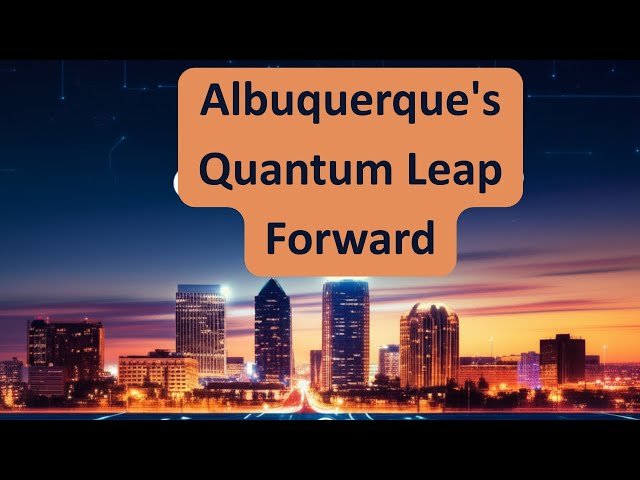
Imagine a small, often overlooked city taking a giant leap towards becoming a central player on the world tech stage. That’s exactly what’s happening in Albuquerque, New Mexico, thanks to a transformative $25 million state grant aimed at establishing a quantum technology innovation district. As we unwrap this story, Albuquerque’s journey reflects a fascinating interplay of local initiative and strategic global competition, an intriguing marriage of federal muscle and entrepreneurial spirit that charts a blueprint for future tech ecosystems.
This video is from ImpactQuantum.
The heart of this initiative, the Roadrunner Venture Studios, is set to create a bustling hub primarily focused on quantum computing and semiconductor development. This venture isn’t merely building a complex of high-tech labs; it’s about turning Albuquerque into a gravitational center that attracts the brightest minds in science, particularly those seasoned in quantum technologies.
What intrigues me the most is the backbone of this initiative – its deep connections with national security. Albuquerque isn’t starting from scratch. The city boasts of close affiliations with national laboratories like Sandia and Los Alamos, institutions renowned for their pioneering advanced research and national defense contributions. This existing synergy between groundbreaking research and critical national security objectives provides a dual benefit: driving commercial innovation while strengthening the U.S.’ muscle in both economic and security dimensions.
This strategy is particularly astute given the quantum landscape’s importance; quantum technologies are poised to revolutionize fields such as computing, cryptography, and material science. With nations like China and several European countries aggressively investing in quantum research, the stakes couldn’t be higher. Albuquerque’s initiative is a direct counteraction, enhancing the U.S.’ standing in a fiercely competitive international arena. It’s a strategic play that acknowledges a critical reality: in the race toward quantum supremacy, complacency could mean ceding control over a potentially trillion-dollar industry and crucial national security advantages.
The economic implications are monumental. This new district aims to transform raw scientific acumen into market-ready innovations, potentially reaping economic benefits not just regionally but nationally. The blend of foundational scientific expertise with potent fiscal investment and a focus on commercial viability offers a template that other regions could emulate. It’s about creating ecosystems where advanced knowledge meets entrepreneurial energy, catalyzing growth, and positioning the U.S. as a leader in the next great tech frontier.
Moreover, the inherent advantage Albuquerque holds due to its rich repository of scientific talent, nurtured through decades of critical research work at these national labs, positions it uniquely in the quantum race. Not every city has such a ready-made workforce of highly skilled physicists and engineers who are not just seeking a job but are driven by missions of national and global importance.
Reflecting on this development, it’s clear that the creation of such innovation districts is not merely about building new infrastructures or funding new startups. It’s about knitting together an ecosystem where advanced research can transition smoothly into commercial success, where securing a nation’s economic future is tightly linked with bolstering its national security, and where the local becomes pivotal in the global narrative.
This approach—where state-level investment meets decades-long federal research expertise—could very well be the blueprint for future quantum districts, not just in the U.S. but globally. Other nations watching this unfold might be prompted to reevaluate their strategies, possibly sparking a global movement towards establishing similar quantum hubs.
In closing, Albuquerque’s venture into a quantum technology district isn’t just a local or national event; it’s a significant node in the wider mesh of global technological progress. It’s a story of transformation, of how strategic investment and solid research frameworks can position a city as a leader in the high stakes world of quantum technology.
It’s a reminder for us all: the next big tech revolution could be incubating in the most unexpected places. Let’s keep our minds, and our eyes, wide open.