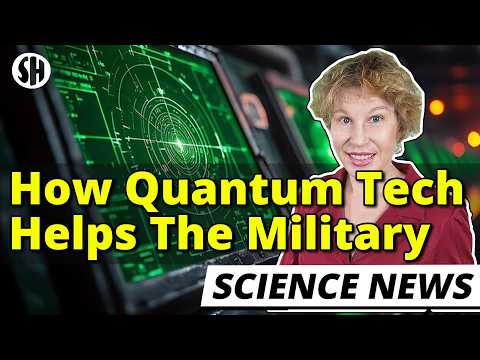
Recently, intriguing reports emerged about the U.S. military’s use of quantum technology in the successful rescue of a missing soldier in Iran. The New York Post alleged that a “long-range quantum magnetometer,” capable of detecting the electromagnetic signature of a human heartbeat, played a critical role in this operation. Dubbed “ghost murmur,” this supposed technology has sparked much speculation. But does it represent reality or just a fascinating myth? Let’s dive into the details.
On the weekend of Easter, April 3rd, 2026, a U.S. Air Force fighter jet was shot down over southwestern Iran. While the pilot was quickly rescued, the weapons systems officer remained missing, even after activating a signaling beacon that only narrowed down his location to a broad area. By Easter Sunday, he was rescued during a daring nighttime operation involving numerous aircraft. It was an operation hailed by then-President Trump as an “Easter miracle.”
Based on content from Sabine Hossenfelder
The excitement surrounding this rescue operation was intensified by the New York Post article that claimed an anonymous source hinted, “If your heart is beating, we will find you.” It’s an exhilarating declaration, but is it a reflection of current capabilities?
In the world of quantum technology, there exists a field known as quantum magnetometry, a branch of quantum metrology that utilizes quantum effects to measure minuscule magnetic fields with high precision. While it is possible to detect minor changes in magnetic fields—like those produced by a beating heart—this is typically effective only over very short distances, such as a few centimeters. The challenge lies in the sheer sensitivity gap: it would require a nearly miraculous leap in technology to detect such weak signals from kilometers away.
Another concept that gets tossed around is quantum ghost imaging. This technique uses entangled photon pairs to identify an object’s characteristics. However, similar limitations apply as it operates optimally over a few centimeters in controlled laboratory settings. Scenarios involving long-range use in battlefield conditions stretch the limits of current capabilities.
Given the constraints of quantum technologies at scale and distance, what might have been used instead? A more plausible explanation involves advanced infrared sensors, which can detect heat signatures from considerable distances. These technologies, like type two superlattice detectors, leverage quantum mechanics to capture minute heat variations, a technique that could feasibly locate a person over kilometers away in specific conditions.
So, what about detecting a heartbeat? While AI-driven analysis of infrared images can reveal subtle temperature fluctuations linked to blood flow, current techniques work best within a range of several meters, not the kilometers described in the narrative. The truth might be that the U.S. military uses classified technologies that eclipse what’s publicly known but perhaps not by orders of magnitude.
In conclusion, while quantum technology enthrallingly pushes the boundaries of what’s possible, it’s crucial to maintain a realistic understanding of its applications—particularly in such high-stakes operations. The “ghost murmur” could be more about narrative than reality, but it certainly highlights growing technological frontiers.
This discourse also underscores the value of credible, timely, and visually appealing representation of such science and technology stories. Supporting this, the video from Sabine Hossenfelder’s channel, sponsored by Storyblocks, emphasizes how effective visual aids enhance content delivery.
If you are curious about the intersection of media and technology, Storyblocks offers robust resources for creators seeking quality visual and audio content. For those eager to explore this exciting realm, their special offer enables access to professional-grade materials that can enrich narratives and work sessions significantly.
In this ever-evolving field, we continue to push boundaries and explore new possibilities—sometimes those that seem pulled directly from the realm of science fiction.
Thank you for engaging with this exploration of future technologies. Stay curious and see you next time!