
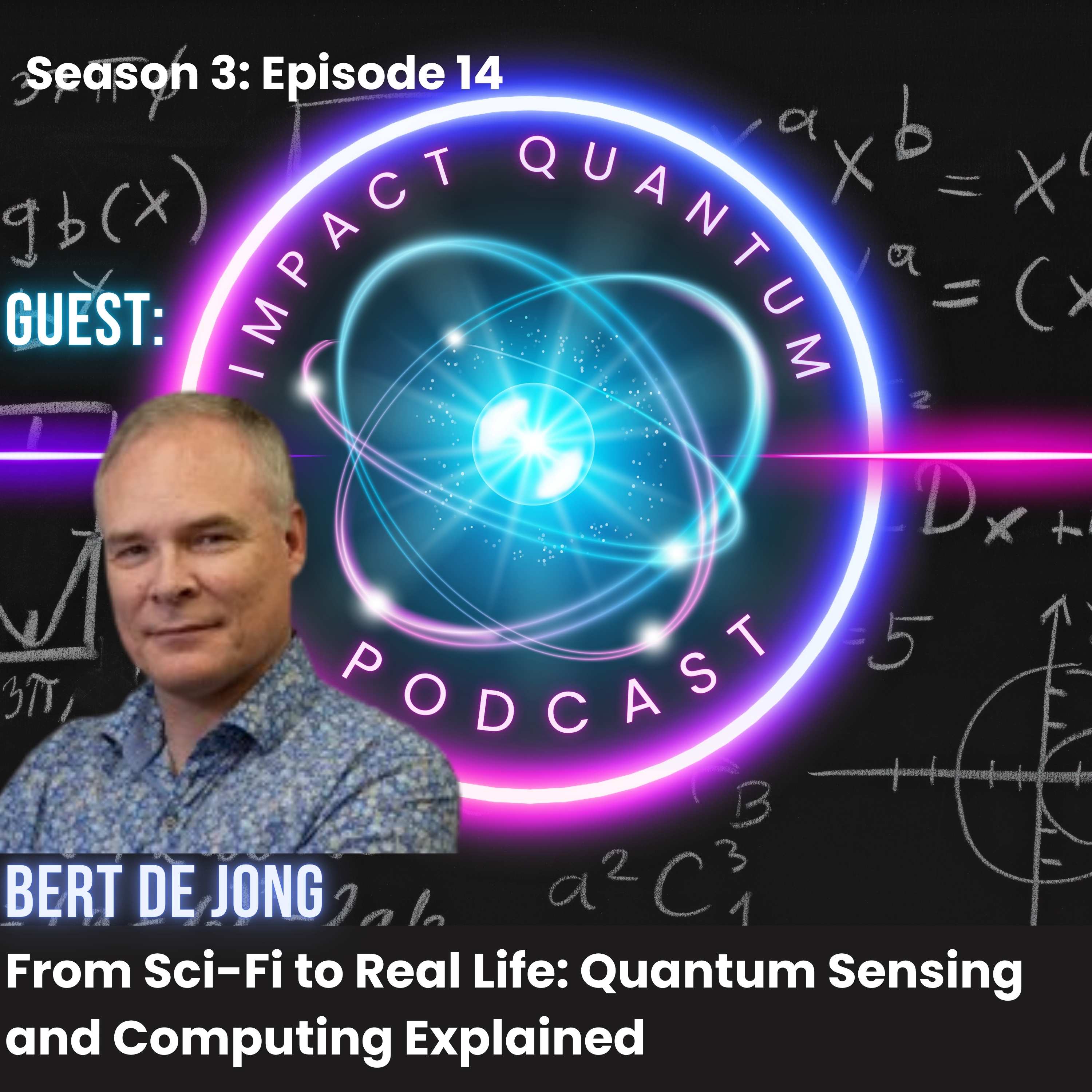
oday, we dive headfirst into the frontier of quantum technology with a special guest: Bert De Jong, senior scientist at Berkeley Lab and director of the Quantum Systems Accelerator, part of the U.S. Department of Energy’s National Quantum Initiative. Join hosts Frank La Vigne and Candice Gillhooly—and our ever-charming, semi-sentient MC, Bailey—as we explore how Bert and his team are pushing the boundaries of quantum computing and sensing.
From gravitational sensing with entangled atoms to real-time power grid monitoring, Bert explains how quantum sensing is already reshaping fields from resource discovery to national security, and even medical technology. We break down what quantum sensing actually is, how it could lead to miniaturization of sophisticated sensors, and why quantum’s impact is happening sooner than you might think.
Whether you’re quantum-curious or quantum-confused, tune in for an engaging conversation that bridges the gap between cutting-edge research, real-world applications, and the evolving ecosystem of quantum information science. By the end of this episode, you’ll see that the quantum revolution isn’t some distant future—it’s knocking at our door, bringing opportunities (and challenges) for industries and individuals alike.
Timestamps
00:00 Quantum Systems Leadership at Berkeley
04:19 Revolutionizing Sensing with Quantum Information
09:53 Harnessing Quantum Entanglement Sensors
13:27 Miniaturization and Quantum Advancements
17:06 Advancing Medical Technology’s Impact
19:12 Quantum Progress Happening Now
23:09 Bridging Academic and Commercial Gaps
25:44 Specialized Technologies Over Universal Solutions
28:26 Understanding Quantum Information Sciences
34:03 Qubit Stability and Challenges
36:53 Repetition Codes in Computing
39:29 Balancing Hype and Reality
42:48 Quantum Systems: From Theory to Application
44:58 Preparing for Quantum Computing’s Future
48:16 Explore Quantum System Accelerator Opportunities
Transcript
Greetings, fellow travelers in the quantum continuum.
Speaker:I'm Bailey, your disembodied yet charmingly British master
Speaker:of ceremonies here at Impact Quantum, the podcast where
Speaker:qubits aren't just theoretical, an entanglement isn't a
Speaker:relationship status. Today we have an absolute
Speaker:corker of a guest, Bert De Jong. He's not only a
Speaker:senior scientist at Barclay Lab. Yes, that
Speaker:Barclay. But also the director of the Quantum Systems
Speaker:Accelerator, part of the U.S. department of
Speaker:Energy's National Quantum Initiative. Translation.
Speaker:He's the bloke helping push the boundaries of quantum computing
Speaker:and sensing, while the rest of us are still trying to figure out how to
Speaker:update our WI fi Reuters. From gravitational sensing
Speaker:with atoms to real time power grid monitoring, Bert's
Speaker:work is less science fiction and more science faster than you think.
Speaker:So whether you're quantum curious or just quantum confused, you're
Speaker:in for a treat. Now, without further ado, let's
Speaker:beam into the conversation already in progress with hosts Frank La
Speaker:vine and Candace Gilhooly. And the man who makes qubits
Speaker:quiver, Bert De Jong.
Speaker:All right. Hello and welcome back to Impact Quantum, the podcast
Speaker:where we explore the emergent ecosystem and field of quantum
Speaker:computing, where it's not just for physicists anymore, it's
Speaker:also for the quantum curious. And with me, as always, is
Speaker:the most quantum curious person I know, Candace Kahooly. How's it going, Candace?
Speaker:It's great, Frank. Thank you again. I'm very excited about today.
Speaker:Yes, we have an amazing guest here
Speaker:and I'm just looking at his.
Speaker:His LinkedIn about page and it's. It's a lot,
Speaker:so I should ask
Speaker:AI to summarize it, but.
Speaker:But. Welcome to the show. We have Bert De Jong,
Speaker:which hopefully I pronounced that right. He is a driven, strategically thinking
Speaker:leader and team builder, leading with Impact and
Speaker:building next generation leaders. He's a senior scientist at
Speaker:Berkeley Lab and is currently serving as department Head for Computational
Speaker:Sciences and the interim lead for the Applied Computing for
Speaker:Scientific Discovery Group, acsd.
Speaker:ACSD advances scientific computing by developing and enhancing
Speaker:applications in key disciplines, as well as developing
Speaker:tools and libraries for addressing
Speaker:general problems in computational science. Wow. There's a. There's a lot there.
Speaker:So let's. But one of the things here is that you're part of the National
Speaker:Quantum Initiative. Yes.
Speaker:And you're at Berkeley University. The Berkeley University. So
Speaker:that's pretty cool. Continue. Tell
Speaker:us. Tell us what you're up to these days. Yeah,
Speaker:thanks, Frank. Thanks, Candice, for having me. So,
Speaker:yes, to give it a short on the Quantum Side. So I
Speaker:lead large number of programs on the quantum on in quantum
Speaker:at Lawrence Berkeley National Lab. So
Speaker:I'm the director of the Quantum System Accelerator, which is one
Speaker:of the five national Quantum initiative centers funded out of the
Speaker:Department of Energy. And these are large centers.
Speaker:We have about 15 institutions and about
Speaker:450 researchers working closely together to
Speaker:really try and move the field of quantum information science
Speaker:effectively quantum computing and quantum quantum sensing forward
Speaker:because we see the potential for the nation
Speaker:to be a leader in this field and continue to be a leader
Speaker:for the foreseeable future. Interesting. You mentioned
Speaker:quantum sensing and quantum sensing is something that's been kind of
Speaker:off the side of my radar. But when I was at the Quantum Tech USA
Speaker:event, quantum sensing was a very
Speaker:hot topic. What is quantum sensing?
Speaker:Unlike classical sensing, you're just doing
Speaker:sensing with quantum information. And so I'll
Speaker:give you a couple of examples.
Speaker:This is some work that actually came out of our center where
Speaker:we actually use atoms to sense
Speaker:gravity. So that's a good example. Bias
Speaker:is important. Why did we work on it? Well, right now, if
Speaker:you do these kinds of things, you have to use sensors that
Speaker:are kilometers apart. By doing quantum
Speaker:sensing and using the power of entanglement, you
Speaker:can actually make sensors that are going to be millimeters in
Speaker:size, extremely small. Now that changes the game
Speaker:on how you can actually use sensing
Speaker:in many, many different applications. Think right
Speaker:now we have satellites trying to measure gravitational behavior.
Speaker:They get their positions, their GPS is impacted by
Speaker:gravitational behavior. So that's one way you can think of
Speaker:sensing, fundamentally
Speaker:sensing. We're trying to figure out really where we could go with
Speaker:applications. We can of course use
Speaker:quantum sensors to sense what's happening
Speaker:with quantum systems. So we better understand for example, what
Speaker:what happens in biological environments.
Speaker:Those are quantum processes on its own. So can we use sensors,
Speaker:quantum entanglement as a sensor
Speaker:to probe these kinds of systems more accurately? But there is even more
Speaker:creative ideas that are people are starting to think about this. Could we do this
Speaker:on, in a larger scale, could we use quantum sensing to
Speaker:detect if something is broken and goes wrong in an electric grid? It
Speaker:could we get real time feedback. Now those are far fetched ideas, right?
Speaker:Those are not things that are happening right now, but those are some
Speaker:of the applications you can think of when it comes to quantum sensing. So
Speaker:this isn't just about, you know, hey, we want to find an oil deposit or
Speaker:natural gas deposit. That would be a potentially other
Speaker:direction to think. Let's say you're looking for
Speaker:rare earths, for example, critical Materials right now,
Speaker:detecting those in the ground is not trivial,
Speaker:but if you can use a signature,
Speaker:a quantum signature, for example, you might be able to
Speaker:detect deposits. I'm not
Speaker:familiar enough with thinking about this in the oil and gas sense,
Speaker:but. Yeah.
Speaker:So I would say the differences in densities is
Speaker:potentially something that you could use as a way to do
Speaker:some quantum sensing. Interesting. The reason
Speaker:why I mentioned is because I remember hearing, I
Speaker:remember hearing about. The first time I heard about quantum sensing was looking
Speaker:for natural resources, whether it was
Speaker:oil, gas, or various types of minerals.
Speaker:Yes. Which I think would be an interesting, interesting use case. But I like the
Speaker:idea of being able to understand what's happening in the power
Speaker:grid because as we record this today, I don't know if the power is back
Speaker:on in Spain and Portugal. Oh, yeah, I heard about that today.
Speaker:They had no power. Like 50 million people without power.
Speaker:That's crazy. Well, I had not heard that,
Speaker:but that is a major,
Speaker:major issue. And of course, we've seen the blackouts here
Speaker:in California, while we have seen them also
Speaker:in the north and in the east. So being able to
Speaker:respond quicker is always going to be a big challenge. Right. These
Speaker:are large, complex systems and
Speaker:single points of failure are everywhere. Yeah, no, that's
Speaker:a good point. That's a good point. And the other thing was
Speaker:I also heard the term quantum radar, which was
Speaker:another kind of use. So in terms of being able to
Speaker:detect drones, smaller objects flying around,
Speaker:stealth device, stealth aircraft, and things like that. So I think quantum
Speaker:sensing is definitely, I think, going to be one of those fields that,
Speaker:you know, for good or for bad, is going to have a big renaissance
Speaker:one way or the other. It just seems that quantum sensing can touch
Speaker:on so many different things. Right? Yeah. You know, like, we're
Speaker:talking about, you know, you were talking about oil and gas. We're talking about,
Speaker:you know, how you can measure
Speaker:gravity, time, acceleration. Like, there's
Speaker:just so many aspects. Maybe quantum sensing is more of,
Speaker:of a bridge that could be like a bridge
Speaker:technology that could, you know, drive a
Speaker:broader spectrum of quantum technologies
Speaker:because it's effective in all of them. I mean, it's. It seems
Speaker:we've been dying to talk to someone
Speaker:about quantum sensing because it's so vitally
Speaker:important. So now it feels like, you know, we got someone here, you
Speaker:know, like, specifically, are you, what
Speaker:fields are, are you working on in, in the, in the
Speaker:quantum sensing sense? Like, what are you focusing on national
Speaker:security? Are you focusing on medical
Speaker:implications, natural resources? What are you guys looking at?
Speaker:So again, as A center. We really have
Speaker:focused on actually finding ways to harness the entanglement
Speaker:so that we can build the foundations. Yes,
Speaker:the field is progressing, and I would think it probably is
Speaker:one of those markets that. One of those technologies that will be the
Speaker:earliest to market relative to computing
Speaker:or networking, simply because over the last
Speaker:five to 10 years, I would say the last decade, the technology
Speaker:really has moved forward to a point that sensing
Speaker:is not that far out. We know how to
Speaker:entangle photons, we know how to entangle the
Speaker:key pieces and actually then be able to very
Speaker:accurately measure these kind of
Speaker:quantum systems and measure the entanglement that allow us to actually
Speaker:make decisions and actually get insights that
Speaker:we are looking for. So it is
Speaker:early, but more and more industries are
Speaker:especially even computing industries
Speaker:are diversifying, diversifying their portfolio.
Speaker:One of the jokes that I always make is, so,
Speaker:for example, if you make a good qubit, it's a
Speaker:terrible sensor. If you have a terrible qubit bit,
Speaker:they're actually excellent sensors. Oh, because of the
Speaker:noise? Yes. If they're sensitive to noise.
Speaker:Right. If they can detect the smallest amount of
Speaker:noise, then they are good for sensors.
Speaker:That makes sense. Okay. All right. So all this work and
Speaker:the chandeliers and all that stuff that they do to shield it out, you
Speaker:actually kind of want that, in a sense. Yes. You
Speaker:kind of work in two directions. Exactly. Quantum computers want to get
Speaker:rid of the noise and be less and less sensitive to
Speaker:noise, while quantum senses want to be more and more and more sensitive to noise.
Speaker:It's that interesting dichotomy, but it also means
Speaker:that if you start thinking about. For us, we are
Speaker:not just building quantum computers,
Speaker:for example, with atoms, we're
Speaker:also trying to measure them more and more accurately. And so the more
Speaker:accurately measure, the more you get
Speaker:sensitive to noise. Right. The extra little
Speaker:piece of noise that you didn't know about that then
Speaker:makes you also better as a sensor.
Speaker:So it's kind of that even though we are developing
Speaker:technologies for quantum, they have that angle of actually being
Speaker:able to readily used in. In a
Speaker:quantum sensing realm, just in a different way.
Speaker:Interesting. And also as the sensors, I don't know if this is as important, but
Speaker:as the sensors become more sensitive,
Speaker:like you can go smaller and smaller and smaller. I don't know
Speaker:if that's necessarily something that is important
Speaker:to this field, but it makes me think when something is sensitive, everyone
Speaker:likes when things can get smaller and smaller. Well, it has to be. Right.
Speaker:So let's say I can build right now a sensor that
Speaker:takes up a Big room in a building. Now, if you want to
Speaker:have that sensor, for example, on a ship or in a
Speaker:submarine or on
Speaker:a plane, you need to make it. Why you want small? You need to make
Speaker:it taller. Or if you want to put it in space, lighter weight,
Speaker:smaller is good, right? So
Speaker:miniaturization, that's what our. I would say
Speaker:our technology advances have been around. If you look at the first
Speaker:kind of space missions, right, Apollo missions,
Speaker:they had computers that were bytes, not kilobytes,
Speaker:bytes, and they were big, right? Now what
Speaker:we have there, we can do in,
Speaker:oh, not even a pinky. It's just going to be
Speaker:a very small square space. And so
Speaker:miniaturization allows you to scale, but actually
Speaker:more we miniaturize, we more and more get closer
Speaker:to the quantum realm, right? Quantum is at the
Speaker:smallest scale. So the smaller you make things,
Speaker:the closer you get to the quantum realm and you start to deal with the
Speaker:same problems that we are dealing with right now. When it comes to quantum computing
Speaker:or. Quantum centering, sensing the invisible and measuring
Speaker:the immeasurable, it's like, you know, it's
Speaker:Star Trek, right? Like, they pull up a tricorder, which is like a handheld device,
Speaker:and they can tell. They can tell everything from, you know, medical issues
Speaker:to, you know, planetary or cosmic
Speaker:like stuff all in the palm of their hand. And, you know, it's. Right
Speaker:now that's still science fiction, but I mean, I can easily see there being uses
Speaker:for it because, you know, in the TV show, there was always a use for
Speaker:it. So I can imagine, you know,
Speaker:that. Would so think of everybody. Well, not
Speaker:everybody, but a lot of people are wearing watches now, right now, where they
Speaker:detect heartbeat, blood pressure, all of that, even
Speaker:oxygen levels. And so there is.
Speaker:That is also a demonstration of new sensing
Speaker:technologies. And there they're using light.
Speaker:It's also a. Photons are the
Speaker:smallest piece you can deal with. So it's all of
Speaker:that miniaturization and putting together
Speaker:more and more foundational knowledge around
Speaker:how materials behave, how photons, how electrons
Speaker:behave, allow us to miniaturize. And
Speaker:all of those phenomena tend to be quantum.
Speaker:And so the smaller we go, the more we need to actually
Speaker:handle quantum information sciences in general.
Speaker:Interesting. I would also
Speaker:imagine quantum sensing would help in error correction with
Speaker:qubits or no. Am I not thinking right?
Speaker:I would have to think through that. But I don't think
Speaker:the way we are doing quantum error correction right now would be
Speaker:directly a sensing thing. Okay. It's more
Speaker:indirect, but yes. Okay, sorry, Candice.
Speaker:Looks like you had a question. No, no, I was just kind of thinking, you
Speaker:know, you know, in my head again, because we were talking about the watches and
Speaker:the medicine. Just what, you know,
Speaker:it's so the next step of, of what this could do
Speaker:for, for people with everyday health issues that they're
Speaker:monitoring. And I don't know, I, I just, I'm very excited about the
Speaker:medical breakthroughs because I just. You keep on seeing how these everyday
Speaker:devices are now being used by all kinds of people. Like, I think about my
Speaker:mom who was like, was so upset about the cell phone. She's like, I
Speaker:wasn't made for the cell phone, candy. She's like, I, I'm 80 years old. Like,
Speaker:I cannot handle the cell phone. I'm like, you can, mom. Like, I swear you
Speaker:can. And now I watch her take the cell phone and put it to her
Speaker:arm to detect her, like, diabetes, rate her diabetes
Speaker:rating, and then how everything is all interconnected now to help
Speaker:her when it wasn't like that even a couple years ago.
Speaker:And so I'm seeing how, you know, with medical technology, it's going
Speaker:faster and faster. And I can see how, you know, as the world is having
Speaker:issue with natural resources, that's going to go faster and of course, with,
Speaker:with security, you know, national security, that's going to be,
Speaker:you know, one of the biggest ways they're going to want to deal with sensors
Speaker:and stuff. So I think it's such a, an incredibly exciting
Speaker:field to investigate and for people to figure out
Speaker:how they get to be a part of it. Yeah. So I'll give you one
Speaker:early sense. So, you know, we already using
Speaker:quantum in our medical fields. Right. So the
Speaker:MRI, many of us have had MRIs
Speaker:driven by Quantum. It's a quantum
Speaker:technology. I didn't know that, to be honest. That's true. I
Speaker:was thinking functional mri, the magnetic one.
Speaker:Yeah. Interesting. So we're already. So we're already using it.
Speaker:Yep. So then why are you using everywhere?
Speaker:Honestly, quantum is everywhere right now. MRI is one. But
Speaker:the fact that we have light bulbs is definitely also a
Speaker:quantum phenomena, especially the new lights.
Speaker:GPS is driven by atomic clocks. So
Speaker:if we measure atomic systems more accurately,
Speaker:we build better atomic clocks. We have better gps.
Speaker:Think of optical fibers in telecom. We are using
Speaker:photons right now, but could we actually use entangled photons
Speaker:in the future to maybe get better
Speaker:quantum networks? I already mentioned
Speaker:the transistors getting smaller and smaller, needing
Speaker:quantum. So it's there in every
Speaker:way, shape or form. So yes.
Speaker:So it shouldn't be such an argument that's going on, or I should
Speaker:say, lively debate in terms of how many years it's going to
Speaker:take for us to be able to, you know, enjoy,
Speaker:you know, what's going on as more and more breakthroughs are happening.
Speaker:Like, it's already happening. Like on the show we
Speaker:spoke with a lovely lady, Anna White of
Speaker:Hedo Match. They're currently using a quantum algorithm
Speaker:in, in their business. You know, we've spoken to, you know, Quantum Knight,
Speaker:who's already, you know, coming up with national security
Speaker:measures that are working with, with quantum and,
Speaker:and quotes, quantum encryption. So, like, things
Speaker:are already happening. We don't have to necessarily
Speaker:wait five or 10 years. It's just going to continue to see the
Speaker:evolution as more funding is put behind the science.
Speaker:Yes, now we are definitely progressing. But so when
Speaker:it looks, when you look at where we are and how we've evolved
Speaker:in the last five, I would say 10 years, we are really
Speaker:trying to push what, what I coined as kind of
Speaker:the second quantum revolution. And yes,
Speaker:census is one. Networking is, is a very
Speaker:different challenge and that's mainly driven by security
Speaker:because, yes, we could potentially break information
Speaker:encryption and then quantum computing. And
Speaker:are they all going to be now? No. Are they
Speaker:all moving forward? Most definitely.
Speaker:And they all have a timeline
Speaker:where, I think depending on how you look at it, I still
Speaker:think quantum computing can have some early impact in the
Speaker:next three to five years. Now, is it
Speaker:going now? I'm sorry, go ahead, go ahead,
Speaker:go ahead. I won't continue your thought. No, it's not
Speaker:like, honestly, in the next five
Speaker:years, a quantum computer probably will not break quantum
Speaker:encryption and break all the,
Speaker:and gets access to all your secret information you might have.
Speaker:But there is going to be a lot of domain areas
Speaker:and a lot of application areas where early
Speaker:demonstrations of quantum computers or
Speaker:even quantum networking will have an impact.
Speaker:We know that banks are actively pursuing
Speaker:their secure networking effectively right now.
Speaker:Surprisingly, not so surprisingly, but it's
Speaker:still interesting. There's a lot of banking companies, for example, that are
Speaker:trying to understand how they can use quantum computing at this point in time.
Speaker:And for them, it's very simple. If you're
Speaker:the first one or you're the fastest when it comes to
Speaker:making decisions on what stocks to trade, for example, you make more money.
Speaker:So everything here in that world is driven
Speaker:by being the fastest. The first,
Speaker:I would say a lot of other technology, a lot of other industries
Speaker:are really looking at, I would say
Speaker:primarily right now, quantum computing as a potential
Speaker:to accelerate their R&D efforts.
Speaker:But that one, as I said, it's going to be very
Speaker:specific areas that. Where that
Speaker:technology, a quantum computing technology will actually help them
Speaker:accelerate their R and D. It's not going to be across
Speaker:all industries, quantum
Speaker:computing, good for certain things. It will not be universal
Speaker:replacement for classical computing in the future.
Speaker:What do you think is some of the biggest. What do you think are the
Speaker:barriers right now? Like, we've talked about the ecosystem, you
Speaker:know, Frank and I discuss this usually with every. Every guest that we've.
Speaker:That we talk about, you know, the ecosystem. Everything from, you know, the
Speaker:physicists and the academics to the commercial,
Speaker:commercial practitioners who are, you know, who are trying to
Speaker:be, you know, the business folk that, that are putting quantum
Speaker:out there to the world and how there is
Speaker:a little. There's a little bit of a chasm between both sides, especially when
Speaker:information is coming out from the commercial side or, you know, because, you
Speaker:know, academia is trying to make sure that everything that's being said
Speaker:is completely true and
Speaker:practical. And sometimes, you know, there's a little bit of a gap between
Speaker:that and there's a little bit of a chasm where I think it'd be better
Speaker:if there was a bridge between the two sides. You know,
Speaker:I'm also of the mentality that I don't want a one, winner take all. I
Speaker:would like there to be like a leader for every type of qubit,
Speaker:you know, that there is another company, because if one company is
Speaker:dedicated to the, you know, ionization, another one is dedicated,
Speaker:you know, to, you know, to the photons or to
Speaker:different qubits, then we could have really some of the best technology
Speaker:possible for everybody. But do you see it
Speaker:as a little bit of a chasm in the ecosystem that there's kind of a
Speaker:little disconnect that's happening between the two sides, or
Speaker:no. Do you think that the two sides are kind of beginning to work with
Speaker:each other? I think the community
Speaker:is getting better and better at working together. I do agree
Speaker:that one of the big challenges that we are right now when it comes to
Speaker:the quantum ecosystem is that there
Speaker:is still a lot of directions quantum
Speaker:information science, or quantum computing can take at this point in time.
Speaker:There is a lot of different platforms that are being developed as we get
Speaker:better and better understanding, better and better control of what
Speaker:qubits can and cannot do. It's
Speaker:not that far and different from where classical
Speaker:computing was for a long time. We had,
Speaker:for a long time, very different technologies. Hey, we move from
Speaker:the abacus to tubes
Speaker:to Effectively transistors. And
Speaker:now there's new types of transistors that are being developed if they
Speaker:want to scale scale smaller and smaller. I don't think we
Speaker:are much further when it comes to the quantum technologies. Right now
Speaker:we have that choice of
Speaker:which technologies will be the best ones. And
Speaker:I think the real question becomes what are these
Speaker:technologies the best for. And I would argue that there
Speaker:is potential that some technologies will be better for certain
Speaker:application areas for certain industries versus others.
Speaker:And again, universal quantum computer,
Speaker:sure we can build one eventually, but is it going
Speaker:to be the best for some of the applications? I don't know.
Speaker:If you look at classical computing right now,
Speaker:we had x86 for the longest time. Now we
Speaker:have GPUs, we have FPGAs, we
Speaker:have new types of technologies that are being developed on the
Speaker:classical computing side too. What you see is a
Speaker:merger from diversity or
Speaker:specialization to universal to back now
Speaker:a diverse set of technologies that is specialized for
Speaker:certain application areas. I would expect
Speaker:that diversity and specialization to
Speaker:be the case for a while when it comes to the quantum technologies. Till
Speaker:we get a couple of that are going to be clear winners. And
Speaker:honestly we have some technologies that are at the forefront right
Speaker:now. There is a lot of dark horses out there still.
Speaker:And so who knows that what we're looking at
Speaker:right now when it comes to quantum technologies. Quantum
Speaker:computing technologies are the ones that are going to be
Speaker:the ones that are going to drive most of the industry.
Speaker:But that matter is top. The matter
Speaker:of quantum information is a complex
Speaker:matter for industry in general to deal
Speaker:with. And so they need to get an early
Speaker:handle on it. Hey, if they have to still use
Speaker:a computer build of tubes to do
Speaker:their work right now and understand how quantum could actually
Speaker:impact their end user
Speaker:application that their domain, so be it.
Speaker:Eventually they will transition like everybody else to the
Speaker:technologies that will be most suited for them for their application
Speaker:area or for their industry. Right, and you mentioned
Speaker:a couple times quantum information science. I think I know what that means,
Speaker:but can you dive deep
Speaker:into that?
Speaker:So pretty much everything that
Speaker:we've talked about so far is part of quantum information
Speaker:sciences. Fundamentally we
Speaker:need to understand and fully grasp what
Speaker:the powers of quantum information, what the power is of
Speaker:quantum. And that umbrella is called quantum information
Speaker:sciences. So this ranges from actually doing
Speaker:understanding the physics to actually doing the engineering,
Speaker:to actually doing things like quantum error correction, doing
Speaker:fundamental computer science theory effectively,
Speaker:which is a lot what quantum error correction is
Speaker:to understand how we can harness a technology,
Speaker:but even fundamentally better understanding what actually
Speaker:Quantum mechanics is how it works.
Speaker:What entanglement actually means, what it
Speaker:means to actually have a statistical process instead of a
Speaker:deterministic process are things that
Speaker:need to be, that are
Speaker:continuously being studied, probed,
Speaker:and better understood. That's the umbrella of
Speaker:quantum information sciences is literally that
Speaker:understanding from the fundamentals to actually getting to a point
Speaker:where we can build systems and engineer
Speaker:systems and then potentially do real
Speaker:applications with them. So this would be kind of, you
Speaker:know, like information
Speaker:theory from Claude Shannon and things like that. Like
Speaker:you go from, you know, this is how you represent
Speaker:information in terms of how do you quantify it, how do you measure it, that
Speaker:sort of thing. Is that that what you mean, but like the quantum version of
Speaker:it? The quantum version of it, yes. Interesting.
Speaker:And that's partly how I guess people were. That's how Shor's algorithm or
Speaker:Grover's algorithm was worked out. Right. Kind of on a whiteboard, so to speak.
Speaker:Yes. And like just working with the theory of it before there was the actual
Speaker:hardware, which, that just boggles my mind. Right, like that you can
Speaker:think this through. So let me ask you this. So
Speaker:I, I, I'm, as you're talking, I'm like doing a little like
Speaker:researching behind the scene here. So they're saying here in, in
Speaker:classical information, imagine a pianist playing one note
Speaker:at a time. Each note is clear and separate, like a classic
Speaker:bit being 0 or 1. But in A, in quantum
Speaker:information, imagine a full orchestra where every instrument
Speaker:plays every note at once, but in perfect
Speaker:harmony. This is like a qubit, which can be
Speaker:a 0 or 1 simultaneously. Superposition. And
Speaker:some instruments are linked, so if one changes, the others
Speaker:can change instantly. Therefore entanglement.
Speaker:That's a very simple,
Speaker:interesting description of doing it. So I would
Speaker:say this is the fun part, of course, then. So
Speaker:you're saying this is like an orchestra, but each instrument playing
Speaker:the right and exact right role. Well, that's what
Speaker:we're trying to get to when it comes to
Speaker:quantum computing or quantum networking. Right now there's a lot of
Speaker:noise in these systems, so
Speaker:some of these instruments might be slightly out of tune.
Speaker:This is why I like. So how do we better tune them
Speaker:and make sure that
Speaker:the high room temperature is not getting them out of tune
Speaker:over time? For example, do you
Speaker:think that the. Fact that you need
Speaker:to get these really isolated systems
Speaker:and down to almost absolute zero, you
Speaker:think that's been a blocker for more of this or is that just,
Speaker:that'll get worked out at some point? That's an
Speaker:engineering problem. I Would say that has been worked out
Speaker:pretty well so far. What we do see is that.
Speaker:So the superconducting qubits, for example, are extremely cold.
Speaker:Actually, the bridges we have
Speaker:that we take superconducting qubits in
Speaker:and then do these quantum processes on with,
Speaker:they're actually colder than the universe. So we're trying
Speaker:to beat what the universe can do to some extent.
Speaker:Right. And so, but we're also seeing this now in the other
Speaker:technologies. So our center, for example, has
Speaker:trapped ions and neutral atoms. Neutral atoms.
Speaker:They're now also going cryo simply because they want
Speaker:to get rid of a lot of the background noise. And,
Speaker:and to do that, cryo is one pair.
Speaker:Cryo means we're just going cold. Right. So.
Speaker:But it's hard, honestly. We can build
Speaker:very good qubits as good as
Speaker:nature will allow them, as long as we don't touch them. Right. So.
Speaker:Right. The best qubits are the ones that we cannot touch.
Speaker:But someone had mentioned that, someone we spoke to talked about
Speaker:if. And then if you touch destroys it. Almost like
Speaker:it, it. It then it does. It doesn't work. And I
Speaker:just was having a hard time kind of conceptually conceptualizing that
Speaker:in my mind about these qubits.
Speaker:Doesn't have to be the case. Right. So a qubit we can build,
Speaker:and if we don't touch it, it probably is staying around for
Speaker:a long time. Now, of course, it's still an environment.
Speaker:Any stray photon, any ray coming out of
Speaker:the cosmos could still impact
Speaker:the system. So perfect isolation still doesn't exist.
Speaker:Now, there is some technologies that people are developing, like topological
Speaker:qubits, where inherently they would be protected against a
Speaker:lot of these background noises. But in the long run,
Speaker:we want to do something with these qubits. We want to operate on
Speaker:them, we want to do something with them
Speaker:to do that. We actually become part of
Speaker:that noise, VR the noise. If we don't do it exact
Speaker:don't rotate the qubit exactly the way we
Speaker:think it does, we introduce noise.
Speaker:If we don't do a sharp enough pulse
Speaker:or we do a slightly different frequency, we are not
Speaker:directly doing what we're thinking we're doing. So we're
Speaker:introducing noise. The other thing is,
Speaker:again, entangling two of these
Speaker:protected or best protected qubits
Speaker:breaks a lot of the symmetries, breaks some of the protection
Speaker:symmetry, for example, so that opens
Speaker:them up again to noise. So the game when it comes to
Speaker:quantum computing is finding a way to
Speaker:control the noise, mitigate the noise to a point.
Speaker:That we can then do quantum error correction on top of
Speaker:that. And reality is, we already doing this in classical
Speaker:computing too. Your memory is error corrected
Speaker:in your computer. Chips have inherent
Speaker:error correction. And how do they do that? They just have
Speaker:multiple versions of it and they just do a majority vote to decide which
Speaker:one is correct. It's not that different. Right now when it comes
Speaker:to quantum error correction, we're doing very similar approaches
Speaker:where you start thinking about how we can do repetition
Speaker:codes effectively. So repeated encoding so that we
Speaker:can kind of decide what is the right answer at some point.
Speaker:Interesting. Yeah.
Speaker:It boggles the mind because you're right. We.
Speaker:I don't really think computer science undergrads today even cover error
Speaker:correction. And I remember my professor when I was
Speaker:in school said, you're probably never going to really see this in the real world.
Speaker:When he was teaching it again.
Speaker:At. The time, his words were something to the effect of this is largely a.
Speaker:Solved problem for classical computing.
Speaker:I think it is a solved problem. It's
Speaker:simple. You can do repetition codes, right? I
Speaker:spent 15 years in high performance
Speaker:computing prior to getting a lot more engaged with
Speaker:quantum, with quantum computing specifically.
Speaker:And we were doing that on the algorithmic side
Speaker:even. It's just replication and being
Speaker:able to make decisions as to when something
Speaker:goes corrupt, if it's corrupt, and how you can
Speaker:correct it at that point in time. And so
Speaker:quantum to some extent has a similar kind
Speaker:of flavor to that right now, where we use
Speaker:inherently things that look like repetition codes, not in
Speaker:a classical sense where we just make five copies of the
Speaker:same thing, but rather store that
Speaker:information in a bunch of qubits and then
Speaker:try to use the entanglement information to
Speaker:decide if a certain qubit is wrong.
Speaker:But fundamentally the ideas are the
Speaker:same. The approach using entanglement and
Speaker:storing information in a different way across
Speaker:qubits allows us to do things that
Speaker:you couldn't do on a classical computer, computer, for example, when it comes to correction.
Speaker:So I would say right now, given what you
Speaker:know and what you do and what's going on in the ecosystem,
Speaker:what is not, I always feel that communication is a
Speaker:problem. You know, those that know, know, and those that don't know
Speaker:don't know what they don't know. And
Speaker:communication can always be better. So what
Speaker:do you think those in the know in quantum could
Speaker:do to be communicating, you know, the
Speaker:importance, the excitement, you know,
Speaker:of what's going on in quantum to get more folks,
Speaker:you know, interested so that, you know,
Speaker:either they want to become knowledgeable themselves or that they're going to make sure that
Speaker:their kids are going to do better in math so that their kids can go
Speaker:into a really, a gigantic array of jobs that
Speaker:don't even exist right now, but are going to exist within, you
Speaker:know, five, 10 years. So what do you think could be
Speaker:done better for communication?
Speaker:Well, that is also a little bit of a twofold thing.
Speaker:So one of the big challenges with a lot of the communication
Speaker:early on had been that it became a hype.
Speaker:And the hype and then not delivering
Speaker:becomes a kind of a
Speaker:failure of death in the long run, it's not going to go anywhere. So
Speaker:communication has to be done in a very balanced way where
Speaker:we need to talk about reality while talking about the
Speaker:excitement and the potentials. But
Speaker:of course, we have a lot of industry right now that, that
Speaker:have a lot of VC capital that need to deliver.
Speaker:And the danger that
Speaker:not just in Quantum, by the way, but also I would say in AI has
Speaker:come across is that there might be sometimes
Speaker:a little bit too much hype. It has gotten a lot better in Quantum. There
Speaker:was a lot more hype, I would say, five years ago than there
Speaker:is now. And that's a big good step.
Speaker:But how to communicate excitement to the right people is
Speaker:a big challenge. And it's something that we have
Speaker:focused also on in our center. We've
Speaker:developed programs to actually try to get the
Speaker:excitement about Quantum for high schoolers
Speaker:looking at going even back to earlier in
Speaker:the K12 ranges because we need to get
Speaker:them excited to go into a STEM field that
Speaker:allows us to get even
Speaker:AA or bachelor's degrees that can
Speaker:build these systems in the future. And you mentioned five to
Speaker:10 years out. No, it's not five to 10 years out, it's
Speaker:now. Companies are building
Speaker:systems, they're installing systems at, at the
Speaker:customers. That's a skill set that doesn't require
Speaker:physicists that are electrical engineers
Speaker:doing the cabling, making sure the fridges are working
Speaker:properly, the network is installed properly,
Speaker:the lasers are aligned properly. That's a very different
Speaker:skill set that companies are looking for right now. And then
Speaker:that's the hardware, but we need software. We need the
Speaker:nice simple interface for the end user.
Speaker:We need software engineers that they don't need to be
Speaker:experts in Quantum, but they need to be able to understand
Speaker:enough so they can build a software infrastructure that is needed to
Speaker:run industrial applications in the future.
Speaker:And the future is sooner. Three to five years
Speaker:for some applications, not forever. And to be clear, we didn't pay you to say
Speaker:that because that's what Candice and I were talking about when we relaunched the show
Speaker:was let's, you know, somebody had said, someone very smart
Speaker:had said something. The effect, there's enough physicists, there's enough
Speaker:theoretical physicists in this field already. What we need are the sales
Speaker:people, we need the marketers, we need every
Speaker:profession that you mentioned and then, then some. Right. It's going to, I think I
Speaker:hate the term it takes a village, but it's going to take a village. It
Speaker:takes a large, large village. And I've seen that, I've visited
Speaker:some companies and it's interesting to see
Speaker:their changing mindset from being
Speaker:physics experiments to starting deliver to deliver
Speaker:early systems to their end users. And it's just
Speaker:a different type of marketing. You need people that can
Speaker:provide support consulting to
Speaker:the less the people that are not as knowledgeable but want to explore
Speaker:these quantum systems for their applications. And then there
Speaker:is a lot of application development that has to be done
Speaker:in the long run. At the end, it's like think
Speaker:of if I want to build a better catalyst,
Speaker:I need to have codes effectively that can run the
Speaker:simulations that I need to run. Well, that's not a trivial
Speaker:thing right now. It's like you're still
Speaker:programming in assembly language and that's not what most
Speaker:people want to do. So even that level, there's a
Speaker:lot of computer scientists and computer engineers that we need
Speaker:for those kind of activities to make sure that the industry is
Speaker:ready for those kind of use
Speaker:cases. Right. Right now. That's a good point.
Speaker:That's a good point. I think that it's always good when you hear someone else
Speaker:agree with you, what you're.
Speaker:But it looks like Candace had a question. No,
Speaker:I honestly, I was just gonna say I've enjoyed so much what we've talked about.
Speaker:Like there's so many follow ups that I'm gonna have that I'm gonna have
Speaker:to convince you to come back onto the show again, you know, in
Speaker:a little bit of time. I'll give you a break for a little bit but
Speaker:then come back because I just want to delve a little deeper into some of
Speaker:the, you know, you're really on the pulse of where
Speaker:this has to grow and you have a very unique
Speaker:perspective with all of your experience. You're
Speaker:fascinating. Thank you so much for all of this. I've loved it.
Speaker:That's what I was thinking. That's what I was thinking, Frank. Awesome.
Speaker:Awesome. Yeah. I want to be respectful of, of your time and.
Speaker:But this has been an enlightening conversation.
Speaker:It's interesting to think about how
Speaker:organizations have to start thinking in terms of quantum
Speaker:algorithms, even if they don't have a machine yet, even if they don't have
Speaker:access to the chips and whatnot,
Speaker:if anyone does. But I think it's important to start thinking about how
Speaker:to think differently today. Right. Because when this
Speaker:happens, and again, that timeline is anyone's guess,
Speaker:those who think ahead of the curve will
Speaker:be definitely in a more competitive advantage. So I actually had to write a
Speaker:trip report in regards to,
Speaker:you know, to me attending this Quantum conference. Right.
Speaker:And it was kind of like, well, you know, what's the impact to, you know,
Speaker:my day job as a Red Hat? Like, well, right now
Speaker:this is really an over. From the way I see it. Again, this is
Speaker:Frank speaking, not the company. This is an over the horizon
Speaker:technology from the point of view of a
Speaker:software company. So the best thing to do today is
Speaker:just kind of familiarize yourself with the concepts. So that way when it does come
Speaker:over the horizon, you're going to be in a much better position to
Speaker:adapt to the new situation on the ground. That's kind of my,
Speaker:you know, that was my elevator pitch.
Speaker:Now I would argue from the perspective
Speaker:that it's, I think it already is appearing
Speaker:on the horizon. So I think even those companies really should
Speaker:be careful not to fall behind. And those
Speaker:quantum technology companies that are out there have
Speaker:recognized that and now starting to develop their own kind
Speaker:of infrastructures. And like we had in the classical world
Speaker:computing world, we had, everybody had their own operating
Speaker:system, effectively. Of course, eventually
Speaker:most of it is now run on some version of Linux. Right,
Speaker:right. Red Hat supports.
Speaker:But I think there are a long ways away to getting in that
Speaker:direction when it comes to Quantum, for example. Yeah, that's fair, that's
Speaker:fair. But it's needed, I think,
Speaker:sooner than you think. I like that.
Speaker:Any parting thoughts, Candace? I like the sooner than
Speaker:you think. I do. I want to get that on a bumper sticker.
Speaker:Yeah, I do, I do. I think that there's a lot of, there's a lot
Speaker:of companies that are putting a lot behind this and, and many of them are
Speaker:still in stealth and, and you know, everyone's working towards, you
Speaker:know, who's going to break out with the first of, the first of something,
Speaker:you know, of which qubit or whatever or which, which technology it's going to, going
Speaker:to affect. But I think that just talking to people like
Speaker:Bert, you know, talking to other people that we've brought onto
Speaker:this podcast is really keeping everybody as informed as we
Speaker:possibly can be. And you know, I'm a big believer in the
Speaker:communication, so. Awesome. Yes.
Speaker:All right. And we'll let our. I'm sorry, go ahead. Any. Any parting thoughts
Speaker:where folks can find out more about you and your research?
Speaker:If people are interested in learning more about some of the research
Speaker:that I would say go take a look and just look up
Speaker:Quantum System Accelerator. You'll find all the
Speaker:information about all the awesome stuff that our center has
Speaker:done when it comes to advancing quantum computing and quantum
Speaker:sensing technologies, from the fundamentals to actually
Speaker:engineering systems. And generally
Speaker:LBL has some great information about
Speaker:all the research that they do because the Quantum System
Speaker:Accelerator is not the only one. We have also an advanced quantum testbed
Speaker:which by the way, industry can access if they really
Speaker:want to explore quantum and see if their
Speaker:applications could run on those kinds of systems. So there is
Speaker:a lot of different avenues, I think, for industry, for example, to
Speaker:engage with national labs. And of course, I'm representing
Speaker:the national labs here in this conversation and
Speaker:I think industry should really
Speaker:carefully look at the opportunities that could
Speaker:afford them. Excellent. And with that, we'll
Speaker:let our AI finish the show. And there you have it, Dear
Speaker:listeners, another episode of Impact Quantum wrapped up tighter
Speaker:than a qubit in a cryostat. Our thanks to the
Speaker:marvelous Bert De Jong for transporting us through the
Speaker:quantum multiverse without so much as a single wormhole
Speaker:mishap. If today's episode made you feel smarter,
Speaker:you're welcome. If it made you feel slightly bewildered,
Speaker:congratulations, you're paying attention. Be sure to
Speaker:check out the Quantum Systems Accelerator and Barclay
Speaker:Lab's other mind bending work, because as Bert rightly pointed out,
Speaker:the quantum future isn't five years away, it's practically
Speaker:parked outside. Remember to like, subscribe
Speaker:and share with that one friend who still thinks quantum is just a
Speaker:buzzword used by tech startups and sci fi
Speaker:screenwriters. Until next time, I'm Bailey, your
Speaker:semisentient host, signing off and reminding you
Speaker:when it comes to quantum, it's not about being certain,
Speaker:it's about being superposed.






Leave a Reply