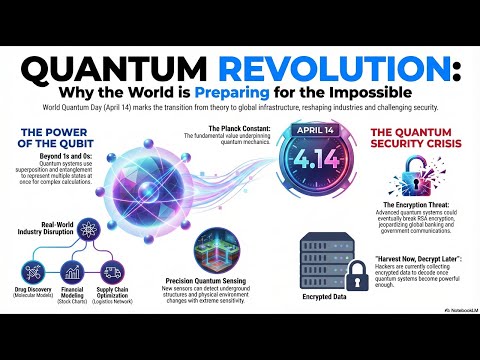
On April 14th, a seemingly ordinary date on the calendar, a revolutionary narrative unfurls—a mathematical homage reaching into the very weave of the universe. The unassuming sequence, 4.14, echoes the Planck constant (4.14 × 10⁻¹⁵), a cornerstone of quantum mechanics, and heralds World Quantum Day.
Based on content from Eddy Says Hi #EddySaysHi
But what is World Quantum Day, really? At first glance, it might appear as a niche celebration for physicists until you step closer and note the vibrant movement bridging science and society, bringing forth the quantum revolution. This day articulates the movement from theoretical confines to tangible applications in our quotidian lives, a testament to quantum’s astonishing journey from rarefied labs to the mainstream consciousness.
Imagine standing on the cusp of a paradigm shift where computers no longer simply oscillate between ones and zeros. Instead, they embrace a symphony of potential states. This isn’t an expanse from a science fiction novel; it’s the world of quantum computing—a realm defined by superposition and entanglement.
Consider superposition as the spinning coin’s magic—the infinite possibilities occupying the space before it lands. Then, there’s entanglement, a phenomenon promising connection across cosmos—a handshake defying distance, where change in one particle instantaneously reflects in another, miles apart. These are not only abstract wonders but the fibers crafting the fabric of quantum computing.
The “qubit”—an elegant and almost ethereal entity. Unlike the binary bit, a qubit thrives like a dimmer switch, embodying a spectrum of possibilities concurrently, poised in a state of graceful complexity. The repercussions of this are profound, empowering quantum computers to unravel myriad possibilities simultaneously, unfurling a banner for innovations previously dormant in the shadows of impossibility.
Just envision: designing life-saving medicines with precise molecular simulations or optimizing global supply chains instantaneously, avoiding disruptive shortages. Let’s consider materials yet undiscovered or sensors with the sensitivity to predict natural calamities. These advancements mark a pivot from incremental gains to exponential leaps across industries.
Yet, with this promise comes a shadow. The same versatility threatening the status quo of encryption—the digital sentry guarding our data, rendered vulnerable by quantum’s fierce potential. The current cryptographic protocols rest on problems too formidable for classical computers; however, quantum could potentially rip through these defenses with unprecedented ease. The threats aren’t just theoretical—security experts warn of a looming strategy: “harvest now, decrypt later.” A chilling premonition, as adversaries stockpile encrypted data, waiting for the day quantum computing can unveil its secrets.
This precipice ignites a global race, a frantic choreography to reinforce our digital fortifications before a breach. Efforts to engineer quantum-resistant cryptography—led by entities like NIST—form the frontline defense, yet transitioning this innovation across our digital landscape remains an arduous battleground of time and cooperation.
Despite these looming challenges, the quantum dream is staggeringly fragile, constrained by error-prone machinery demanding delicate, super-cooled environments. The path to a stable, fault-tolerant quantum computer is a monumental engineering odyssey. Herein lies an opportunity—a window to construct a responsible dawn for what quantum could render possible.
Thus, World Quantum Day emerges not merely as a scientific festival but a clarion call for collective action. A call inviting engineers, software architects, cybersecurity experts, policymakers, and ethicists into this delicate, burgeoning ecosystem. This isn’t merely about appreciating the buzzword “quantum”; it’s about converting awareness into engagement, from education to policy.
Envision a student redirected onto a new professional journey, a corporation positioning for quantum readiness, or simply more informed conversations shaping the ethical landscape of our high-tech future. Harnessing this knowledge responsibly dictates whether quantum becomes a beneficent tool or an unruly disruptor. As we celebrate World Quantum Day, consider this: the quantum future isn’t just approaching. It’s here—and whether we sculpt it with intention or fall subject to its will, is a story yet to be written—a story with stakes lifted by each of us. Are we ready?
—