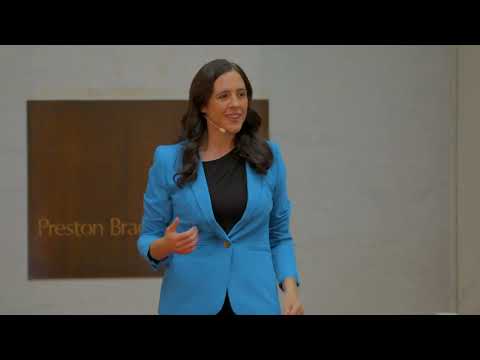
Some conversations change the way you look at an entire field, and my interview with Natasa Nadoveza, a researcher specializing in nuclear quantum dynamics, was one of those rare moments. I went in expecting to learn about quantum chemistry. I walked away understanding far more about how the invisible world shapes every reaction, every spark, and every molecule we rely on. IQ Podcast Taping_ Natasa Nadov…
Natasa brings an unusual blend of clarity, humility, and precision. She never oversold the field, but she made its possibilities feel bigger, not smaller. Here’s what I learned from her that genuinely excited me.
1. Chemical Reactions Are Far Stranger and More Beautiful Than We Think
We tend to imagine chemical reactions as simple “mix-and-change” processes. Natasa reframed that. At the quantum level, a reaction is really a story about vibrations, rotations, and the way molecules “dance” with quantized energy.
She explained that molecules don’t move continuously. Their energy levels come in discrete steps, like stairs. You cannot stand between the stairs, and molecules cannot exist between those quantized energy states either. This idea alone reshaped how I think about reactivity and why some processes happen quickly while others barely do.
2. We Still Can’t Simulate Reality in Full — But We’re Getting Closer
One of Natasa’s most fascinating insights is how limited even our best simulations are.
Her doctoral work focused on methane, one of the simplest molecules. Even then, the computational complexity was enormous. Following the motion of nuclei, calculating bond-breaking probabilities, and modeling tunneling all require substantial supercomputing resources.
What excited me was her vision for the future: the dream of simulating everything at once—electrons, nuclei, and all interactions in full fidelity. Today, that’s impossible. In the future, with better quantum algorithms and hybrid computing, it might become attainable.
That’s not just a technical milestone. It’s a new era for chemistry, biology, medicine, energy, and materials.
3. Quantum Chemistry Will Change Industry, Not Just Academia
Natasa made something obvious: the move from theory to industrial application will define the field’s next phase.
For example, she discussed methane bond breakage, a key reaction in hydrogen production. Understanding it precisely could transform the economics of cleaner fuels. The same logic applies to catalysis, photovoltaics, artificial photosynthesis, and CO₂ capture. Quantum chemistry underpins all of it.
She is personally drawn to the biological and medical side, but the excitement spans every primary industry.
4. Quantum Effects Are Everywhere — Including Inside Us
My favorite moment in the conversation was when she talked about vision. There is a moment inside the human eye, during the isomerization of one molecule, where quantum effects become essential for sight itself. That stopped me cold.
Quantum chemistry isn’t just an abstract discipline. It helps explain how we perceive the world. IQ Podcast Taping_ Natasa Nadov…
5. Curiosity Matters More Than Certainty
When I asked Natasa if there were quantum concepts she still found mysterious, she answered, “Most of them.”
And that might be the most exciting takeaway. Even experts don’t pretend the field is simple. It demands curiosity, not certainty. It rewards people who can ask new questions, not just recite old answers.