Imagine a world where your messages can’t be hacked, forged, or even peeked at, no matter who’s trying. A world where passwords or firewalls don’t enforce trust, but the laws of physics do.
That’s the promise of the quantum internet. It isn’t an upgrade like 5G or fiber optics. It’s more like rewriting the rules of reality, an infrastructural overhaul at the level of nature itself.
Unlike the web we know, which transmits bits of zeros and ones, the quantum internet will transmit quantum states. These are particles that can exist in multiple conditions at once or remain linked across any distance in perfect synchrony. Albert Einstein once called this “spooky action at a distance,” although today it feels more like the nervous system of a new digital world forming beneath our feet.
This isn’t science fiction. The first threads of this network are already being woven, quietly but furiously, in labs and testbeds across the world.
The Global Battlefront
If you imagine the internet as a vast ocean, the quantum internet is still a series of shimmering tide pools: experimental, fragile, yet full of potential. And nations are racing to claim them first.
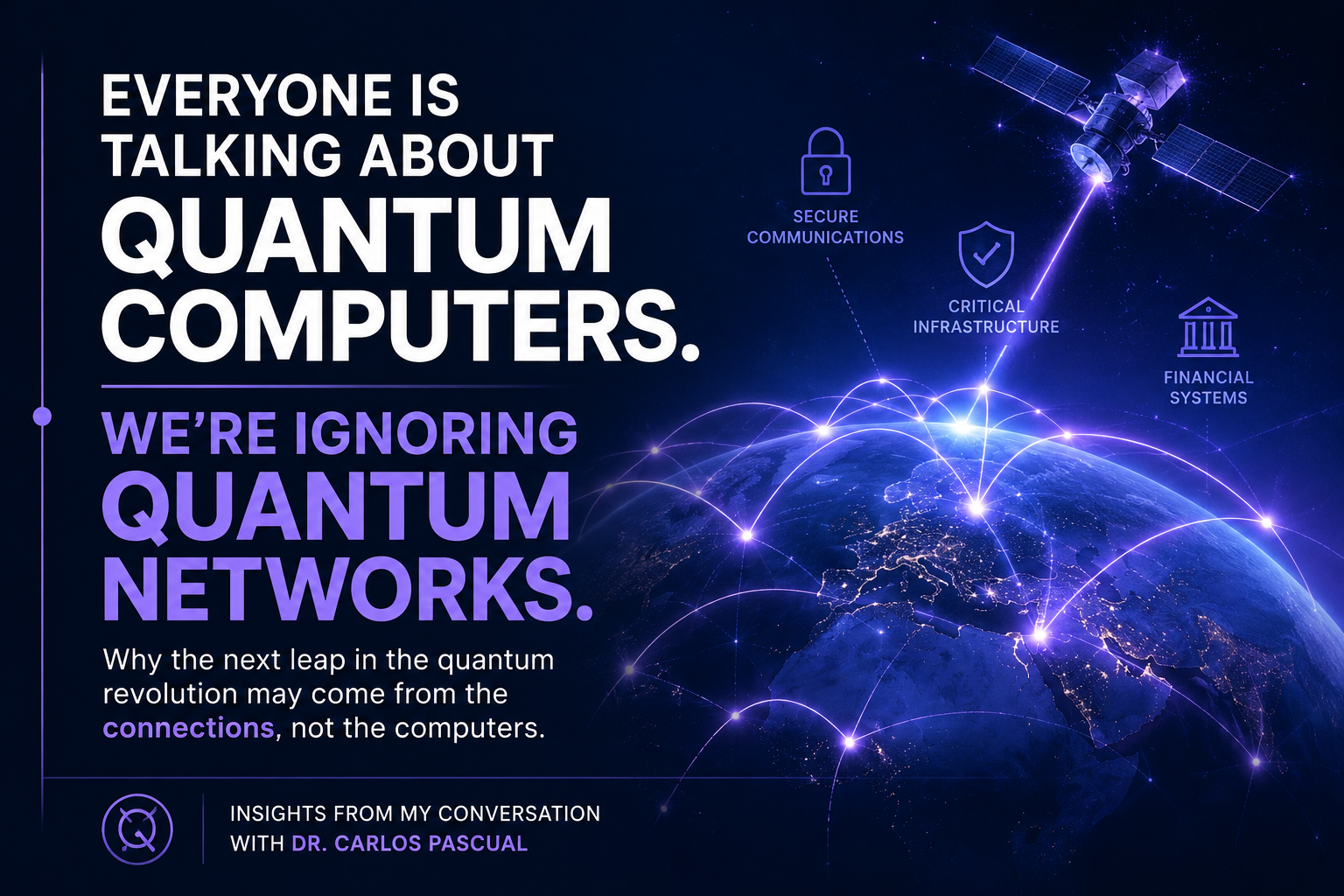
China surged ahead early. Its Micius satellite, launched in 2016, achieved something once thought impossible: secure quantum communication between Beijing and Vienna over thousands of kilometers. It proved that quantum encryption could leap from theory into orbit.
The United States is now accelerating with interagency collaborations connecting the Department of Energy, NIST, and DARPA. From Chicago to New York, regional quantum testbeds are linking national labs and universities into a prototype network that could become the country’s quantum backbone.
Meanwhile, Europe is moving with a long-term strategy rather than competition. The European Quantum Communication Infrastructure (EuroQCI) aims to connect all 27 member states under one quantum-secure framework, reinforcing digital sovereignty while ensuring technological independence.
Emerging players such as Japan, Canada, India, Australia, and the UAE are also developing national strategies to avoid reliance on foreign quantum systems. In this race, stepping aside is not a neutral act; it means surrendering influence over the next era of communication.
Behind every testbed and treaty, the motivations are clear. Nations are pursuing this technology for security, economic advantage, and control over information itself.
Beyond Encryption: The Coming Applications
Most headlines describe the quantum internet as “unhackable communication.” That’s only the beginning. Beyond it lies a landscape that could transform science, medicine, and intelligence.
1. Quantum-Secured Communication
Imagine a message so secure that if anyone tries to intercept it, the act of spying destroys the information. That is the essence of quantum key distribution. Banks, militaries, and governments will be the first to use it, but in time, these systems could protect personal data, critical infrastructure, and even space transmissions.
2. Distributed Quantum Computing
Today’s quantum computers are fragile and limited in scale. When connected via quantum networks, they could operate as a single, massive system, similar to neurons forming a single brain. This shared power could revolutionize drug discovery, materials science, and the fusion of AI with quantum algorithms. As IBM researchers note, connecting quantum systems will expand what is computationally possible far beyond current limits.
3. Quantum Sensing and Metrology
Quantum-linked sensors are so precise that they can detect the slightest variations in gravity or magnetic fields. Networks of these devices could map underground structures, detect earthquakes, or locate submarines without sonar. In effect, they could turn the planet into one vast, intelligent sensor.
The Stakes: Geopolitics, Espionage, and Power
The rise of the quantum internet may not begin a war, but it will redefine what power means.
The Quantum Divide
Countries that develop operational quantum networks will hold communication systems that others cannot penetrate. The balance of global espionage could change overnight. Intelligence agencies that once relied on interception will face an unfamiliar silence where the old methods no longer work.
A New Cold War of Capabilities
The twentieth century was shaped by nuclear deterrence. The twenty-first may be defined by quantum deterrence. Instead of competing over warheads, nations will measure their strength by control of unbreakable networks and interconnected quantum machines.
Global Realignment
Alliances such as NATO, the Quad, and the European Union are already designing frameworks for quantum security. Technological neutrality may soon be impossible, as participation becomes essential to national resilience.
Our Quantum Future
The dream is extraordinary, but the road is complex.
Quantum signals are delicate and easily disrupted by noise or distance. The repeaters needed to extend their range are still in development. Most quantum hardware must operate at temperatures near absolute zero, which makes scaling difficult.
A fully global quantum internet may not appear this decade. However, regional or sector-based networks linking research institutions, defense centers, and financial hubs could be active by 2030. Think of it as a constellation forming gradually, connection by connection.
As this invisible web spreads, important questions will emerge.
Who governs access to quantum-secure communication?
How do we prevent a world divided between those with quantum protection and those without it?
Can openness survive if absolute security becomes possible?
These are not theoretical concerns. They are choices being made right now in policy rooms, corporate labs, and international councils.
The Call to Awareness
The quantum internet will not arrive with a press release or a global countdown. It will appear quietly, link by link, until one day we stop worrying about whether our data can be stolen, simply because theft will no longer be possible.
That future brings both comfort and responsibility. If only a few control the channels that no one else can access, what happens to transparency, to shared trust, to collective progress?
This is not just physics. It is also policy, security, and imagination combined. The real question is not who will build the quantum internet, but why it should be built in the first place.
Because beneath all the entanglement and precision lies a choice: whether we use this power to deepen division or to create a future where trust and cooperation are embedded in the very fabric of our communication.
Stay Connected
Follow our journey and be part of the conversation:
🔗 Find us on LinkedIn
📬 Join our mailing list
📺 Subscribe to our YouTube channel