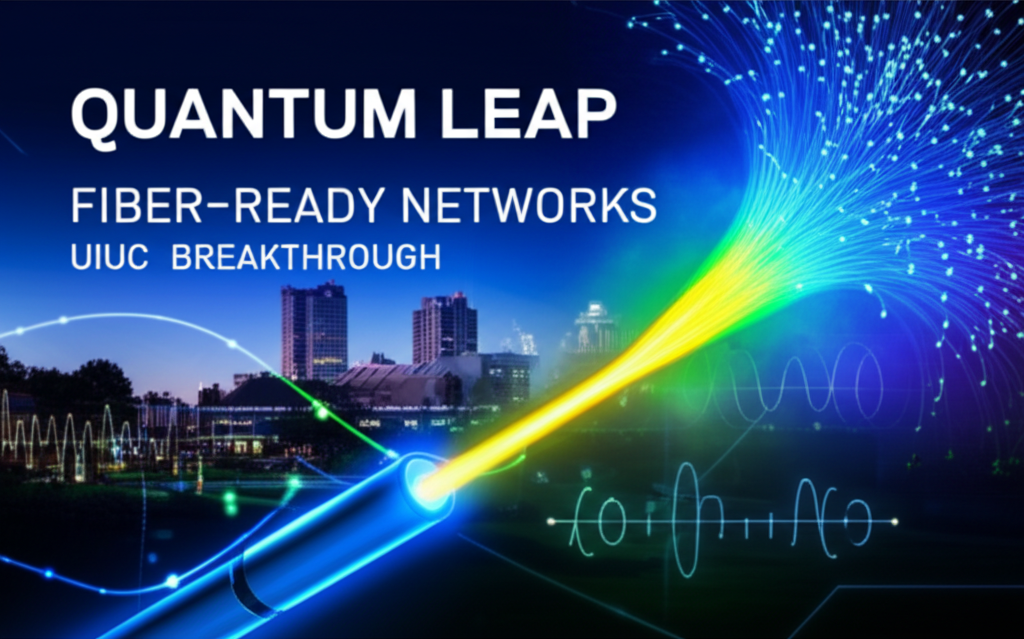
Scientists at the University of Illinois Urbana-Champaign just pulled off something that could shift the trajectory of quantum networks. In the labs of the Grainger College of Engineering, they’ve managed to entangle neutral atoms with telecom-wavelength photons in parallel. Translation? They’ve taken a huge step toward building quantum networks that aren’t just theory—they could actually work across real-world fiber-optic systems without bleeding signal or drowning in noise.
Here’s the problem with most quantum network designs: they rely on photons in the visible or near-UV range, where atomic transitions typically occur. But to send those photons over long distances—like through optical fiber—you have to shift them into the telecom band (around 1300–1600 nm). That frequency conversion step? It’s messy. It’s noisy. It drops signal like a weak Wi-Fi connection in a concrete basement.
However, the Illinois team bypassed that entire issue. Instead, they engineered their system around ytterbium-171 atoms that naturally emit photons at 1389 nm—already deep in the telecom range. No conversions. There are no additional layers involved. Just direct entanglement between the atom and the photon.
Even better, they did this procedure with arrays—plural—of atoms. That means multiple channels firing at once, a key feature if you want quantum networks to scale. They kept the entanglement clean, too—high fidelity and preserved coherence among untouched atoms, so the whole system doesn’t fall apart when a few nodes get used for communication.
Of course, it’s not perfect. Photon collection remains an issue—too many photons escape uncaptured, which slows everything down. However, they’re already exploring optical cavities and improved collection strategies to narrow that gap.
What’s next? Entangling atoms with each other via photons. That’s the real prize—atom-to-atom connections across a network, enabling quantum computing modules to sync and quantum clocks to tick together across continents. The potential? Better navigation, tighter timekeeping, and an actual quantum internet.
This isn’t just lab-bench magic—it’s a real move toward fiber-ready, scalable quantum networks, built around atoms and photons that actually speak the same wavelength.
The announcement was made here.
Stay Connected
Follow our journey and be part of the conversation:
🔗 Find us on LinkedIn
📬 Join our mailing list
📺 Subscribe to our YouTube channel