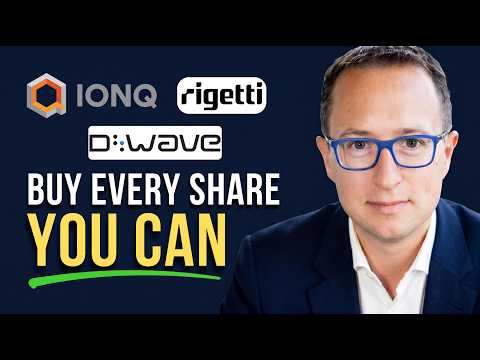
In a world teetering on the nexus of innovation and financial intrigue, Dylan Jovine’s bold claims about an elusive “Quantum Dollar” transform the abstract into potential economic fortunes. Our exploration into these assertions reveals the throbbing pulse of both technological fascination and skeptical inquiry, centered around a small company named Rigetti Computing.
The whispers about quantum computing’s revolution have long danced among forward-thinking circles, suggesting seismic shifts that challenge the foundational stones of current technology. Yet, like unruly weather, this forecast remains uncertain. One of the central pitches is that America might transition from the petrodollar to a currency imbued with the unmatched prowess of quantum technology. If history echoes true, such transitions come with seismic winners and invisible losers. But is this vision of a “quantum-backed dollar” too ephemeral, a siren’s trap constructed more of marketing allure than economic inevitability?
Based on content from Dylan Rieger
Jovine’s claims are bolstered by reasoning that unfolds like a carefully composed symphony. He speaks of historical parallels — the petrodollar replacing gold in the 1970s — and impending geopolitical shifts, with quantum computing positioned as the twin guardian of security and currency stability in a world riddled with electronic vulnerability.
For Rigetti, this grand narrative places them at the heart of the storm’s eye. A small company, with aspirations vast as the quantum realm itself, finds its name in whispered circles promising massive returns. Publicly traded, this company centers its mission on developing potentially transformative quantum computers using superconducting circuits. It boasts intriguing ties with government interest — a purported federal funding proposal of up to $100 million, and the allure of potential government ownership stakes.
But let us pause, examining Rigetti in isolation and apart from the greater story woven around it. Financially, Rigetti is a fledgling. Its recent revenue uptick to $4.4 million, while a growth marker, constitutes but a fragment of its grand valuation. Operating losses and a significant cash burn paint a dichromatic picture: one of promising innovation and relentless fiscal challenges.
No investment comes sans risk, and here, the specter wears the abstract garment of undeveloped utility. Rigetti’s possibility lies not in present performance but in a hope placed far into the horizon — a future where quantum computing unfurls its true potential, ossifying the enigmatic to the tangible. The science, complex to the point of arcane to even devoted scholars, creates a speculative riddle rather than an investment certitude.
As we ponder the broader truths hinted at by Jovine’s narrative, we find layers deserving measured skepticism. The tale of the Quantum Dollar finds its truth not in empirical evidence but in the amplification of potential. Sound reasoning demands that we anchor expectations securely, acknowledging that even if quantum computing is the distant destination, the journey remains unfathomably long and fraught with commercial and scientific hurdles.
For those inclined towards aggressive speculation, Rigetti could be the embodiment of relentless curiosity, where belief interlaces with the unknown. It fits a portfolio niche less of a constellation and more of a twinkling nebula, slight and emergent.
The story, powerful in its thematic resonance, ultimately serves as a discerning call to thoughtful investment — to weigh possibilities with care, allowing not dreams, but reality, to navigate financial choices. As time languidly unwinds, what Rigetti and others like it evolve into remains to be seen, but today, they stand as a testament to humanity’s unfettered pursuit of the cutting edge. Whether this edge becomes the mainstream watermark of the quantum age, well, only time will ink that tale.
And so, the questions remain: Is Rigetti a wise purchase rooted in strategic forethought, or just another sequence in an unfolding narrative of speculative zeal? The answers will only emerge in time, as the dance of shadows and light around quantum computing continues to play out on the global stage. Meanwhile, the prudent investor remains ever-vigilant, balancing between the exuberances of possibility and the grounding forces of reality.
—