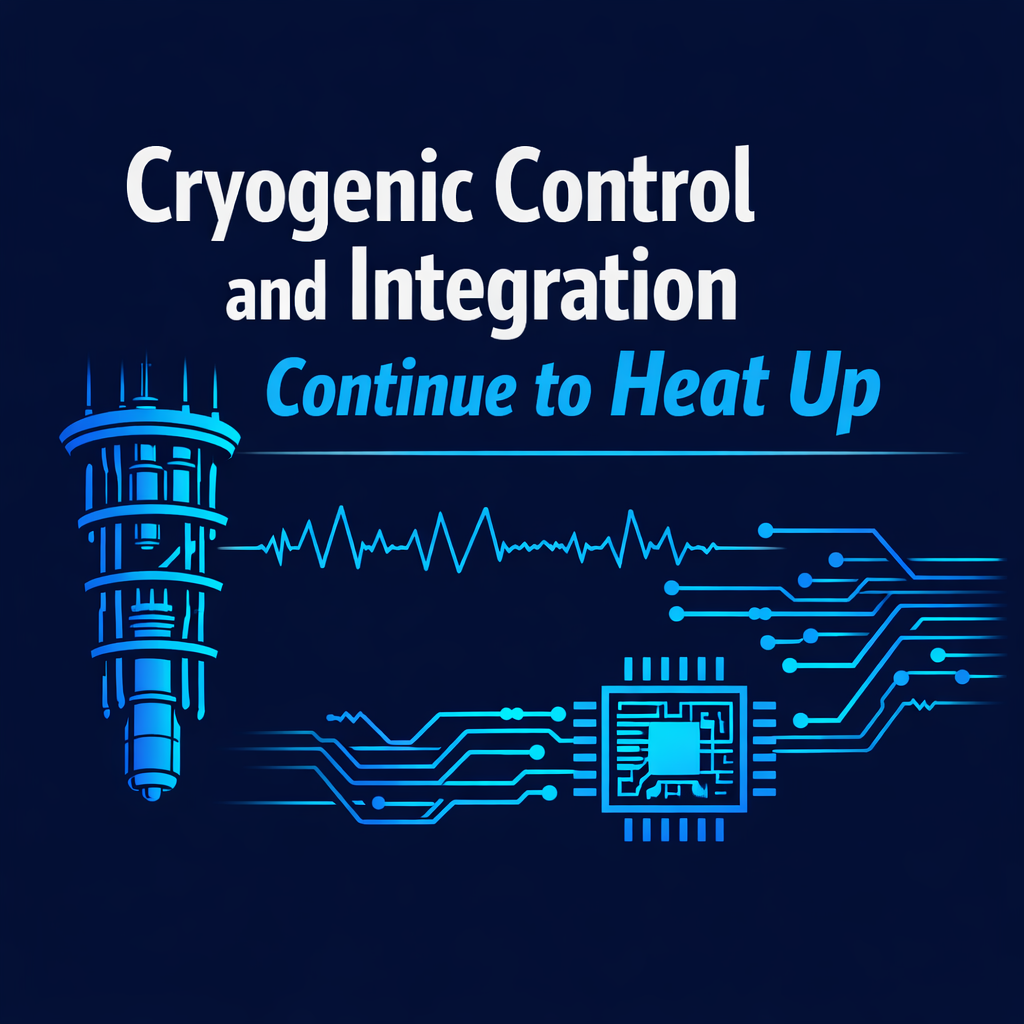
If you’ve been watching the quantum hardware landscape closely, you’ve probably noticed something subtle but significant happening behind the scenes. While headlines still gravitate toward qubit counts and error rates, a quieter revolution is underway inside dilution refrigerators. The focus: on-chip cryogenic control electronics.
It may not sound glamorous. It will not generate splashy demo videos. But make no mistake. This is quickly becoming one of the most decisive layers in the race toward scalable quantum systems.
Across the ecosystem, signals are stacking up. More research teams and hardware companies are demonstrating control electronics that can operate directly inside cryogenic environments. Roadmaps increasingly emphasize co-design between control hardware and qubit chips. And perhaps most urgently, engineers are confronting what many now call the “cable explosion” problem.
For years, quantum computing architecture followed a relatively straightforward pattern. Qubits lived in the coldest stage of the dilution refrigerator, while most control electronics remained at room temperature. Signals traveled down through bundles of coaxial cables, carefully filtered and attenuated along the way.
That approach worked when systems contained tens or even a few hundred qubits.
It does not scale cleanly to thousands.
Every additional qubit typically requires multiple control and readout lines. As systems grow, the wiring burden grows even faster. The result is not just physical clutter. It is a multi-dimensional engineering constraint that touches thermal load, signal integrity, mechanical complexity, and ultimately cost.
This is why the “cable explosion” is not just an inconvenience. It is a structural bottleneck.
Each wire that enters a dilution refrigerator carries heat from warmer stages down toward the millikelvin environment where fragile quantum states must live. Multiply that by thousands of lines, and the thermal budget becomes extremely tight. At some point, simply adding more cables becomes impractical, regardless of how good your qubits are.
This is where cryogenic control electronics enter the story.
By moving portions of the control stack closer to the qubits and operating those electronics at cryogenic temperatures, teams can dramatically reduce the number of high-bandwidth cables that must penetrate the coldest stages. Instead of running individual lines for every qubit, architectures can begin to multiplex, aggregate, and locally manage signals within the fridge.
The implications are profound.
First, wiring complexity becomes more manageable. Fewer cables mean cleaner mechanical layouts and reduced assembly burden. Anyone who has seen the interior of a heavily instrumented dilution refrigerator understands how quickly cabling can dominate the physical design.
Second, thermal load improves. With fewer high-frequency lines conducting heat downward, the cooling system can maintain stability more efficiently. This directly supports larger qubit arrays.
Third, system reliability and manufacturability begin to look more like classical high-performance computing systems rather than bespoke laboratory setups. That shift is essential if quantum hardware is ever going to move from research platforms to industrial infrastructure.
This is why your framing of cryogenic control as part of the industrialization layer is increasingly on target.
The quantum industry is entering a phase where raw qubit demonstrations are no longer the only story. Integration, packaging, control electronics, and system architecture are moving to center stage. In many ways, the winners of the next phase may be determined less by who can build a single excellent qubit and more by who can build an entire scalable quantum machine.
We are also seeing early signs of deeper co-design philosophies taking hold. Instead of treating qubits and control electronics as separate engineering domains, teams are beginning to design them together from the outset. This mirrors the evolution seen in classical semiconductor scaling, where system-level co-optimization became essential once simple transistor scaling hit practical limits.
Expect this trend to accelerate.
As quantum processors push toward the thousands-of-qubits regime, the pressure on interconnect density, thermal budgets, and control bandwidth will only intensify. Cryogenic CMOS, low-power microwave control, and highly integrated cryo-multiplexing schemes are likely to become standard components of serious scaling roadmaps.
None of this is flashy. None of it makes for easy headlines.
But this is exactly what industrialization looks like.
The quantum community is slowly, methodically building the layers that turn delicate physics experiments into engineered systems. And right now, one of the most important battles is being fought not at room temperature, but deep inside the coldest part of the stack.
If momentum continues at the current pace, cryogenic control integration may well be remembered as one of the pivotal enablers that helped quantum computing move from promising prototypes to truly scalable machines.