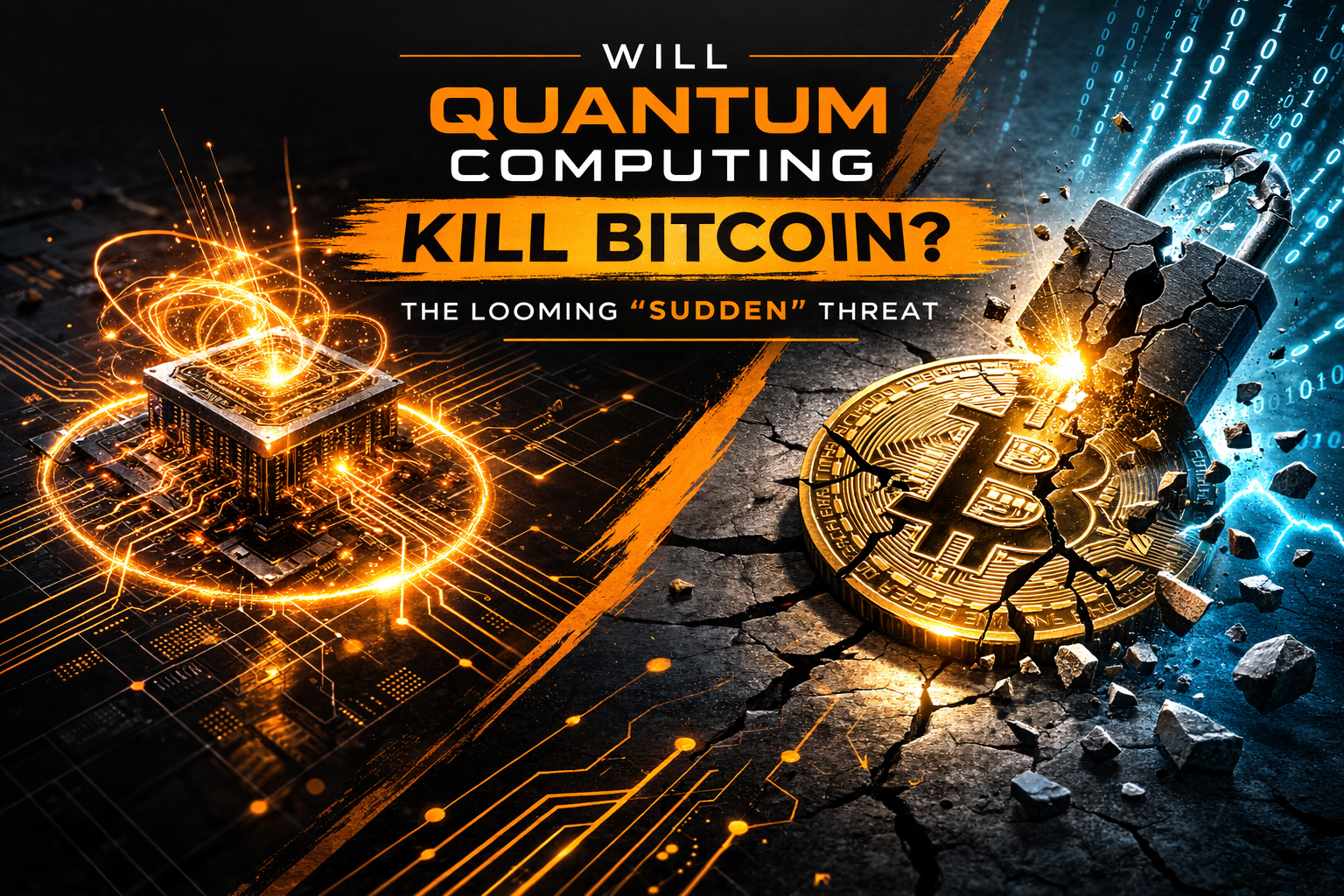
In the fast-converging worlds of fintech and quantum physics, few questions generate as much heat as this one: Will quantum computing kill Bitcoin?
The topic resurfaced recently through physicist Sabine Hossenfelder’s analysis, which challenges one of crypto’s most comfortable assumptions: that the industry will have plenty of warning before quantum machines become dangerous. Her argument lands squarely in the Impact Quantum zone: the real risk may not be gradual disruption but a nonlinear technological shock.
For builders, investors, and infrastructure leaders, this is less about fear and more about timing. Because in quantum, timing is everything.
The Core Conflict: Cryptography vs. Quantum Capability
Bitcoin’s security model rests on modern public-key cryptography, specifically elliptic curve cryptography (ECC). Today, this system is effectively unbreakable using classical computers. The computational effort required would exceed the age of the universe.
Quantum computers change the rules of the game.
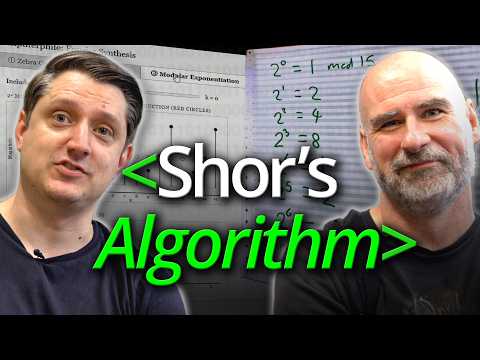
Using Shor’s algorithm, a sufficiently large, fault-tolerant quantum computer could theoretically derive a private key from a public key. If that capability becomes practical at scale, an attacker could impersonate wallet owners and move funds without authorization.
That is the true existential risk not mining, but key recovery.
And, importantly, for the Impact Quantum audience: this is one of the few quantum use cases where the algorithmic advantage has already been mathematically proven. The bottleneck is entirely hardware maturity.
The Mining Myth: Why Speed Isn’t the Real Problem
A persistent narrative in crypto circles is that quantum computers will “mine all the Bitcoin overnight.” That scenario makes headlines, but it is not the primary threat.
Quantum algorithms such as Grover’s could, in theory, provide a modest speedup for hash-based mining. But estimates suggest the advantage is closer to a quadratic improvement, roughly a factor of two, not the exponential leap required to destabilize the network overnight.
When you factor in:
- Cryogenic infrastructure
- Error-correction overhead
- Capital cost of quantum hardware
- Energy requirements
…it becomes clear that quantum mining arbitrage is economically unattractive in the near to medium term.
The real vulnerability remains the cryptographic layer protecting existing holdings.
The “Advance Warning” Assumption Under Pressure
For years, the Bitcoin community has relied on a comforting thesis: we’ll see quantum threats coming.
The reasoning goes like this:
- RSA encryption (used widely across the internet) is easier to break than Bitcoin’s ECC.
- When RSA falls, the world will have years of warning.
- Bitcoin can upgrade to post-quantum signatures in time.
Hossenfelder’s concern — and one increasingly discussed across the quantum ecosystem — is that this timeline may be overly optimistic.
While breaking Bitcoin does require significantly more logical qubits than breaking RSA, technological progress in quantum hardware is unlikely to be linear. Once key bottlenecks fall especially in:
- Logical qubit scaling
- Error-correction efficiency
- Fabrication yield
- Control stack automation
…the field could enter a phase of rapid capability expansion.
Impact Quantum readers will recognize this pattern. We are already seeing early signals of industrialization across superconducting, trapped ion, and photonic platforms.
The “Nothing… Nothing… BOOM” Dynamic
One of the more compelling aspects of Hossenfelder’s argument is the threshold effect.
For decades, artificial intelligence produced incremental progress with limited real-world disruption. Then, seemingly overnight, foundation models crossed a usability threshold, and the entire technology landscape shifted.
Quantum computing may follow a similar trajectory.
The difference, and this is critical, is that the core cryptographic-breaking algorithms are already known. Researchers are not searching for the math. They are engineering toward it.
That means the moment of risk is tied primarily to hardware maturity, not theoretical discovery.
From an Impact Quantum perspective: this reinforces a broader theme we are tracking closely:
The quantum race is increasingly an engineering and manufacturing race not a physics race.
Reality Check: Bitcoin Is Not Dead
It is important to stay grounded.
Today’s quantum systems are nowhere near the scale required to threaten Bitcoin’s cryptography. Estimates for breaking ECC typically require:
- Millions of physical qubits (depending on architecture)
- High-fidelity error correction
- Sustained logical coherence
We are not there yet.
Moreover, the Bitcoin ecosystem is not static. The community could, in principle, migrate to post-quantum cryptography (PQC) if the threat becomes sufficiently credible.
Migration at a global scale is slow, political, and operationally complex. The risk is not inevitability; it is preparedness.
What the Impact Quantum Community Should Watch
For those tracking the real signal, the key indicators are not crypto price movements. They are hardware milestones.
Watch for:
- Demonstrations of large-scale logical qubit arrays
- Breakthroughs in fault-tolerant architectures
- Manufacturing partnerships moving toward volume production
- Government funding increasingly tied to cryptographic disruption
- Early PQC migration pressures across financial infrastructure
These will tell us far more about Bitcoin’s long-term security posture than any single headline.
Absence of Evidence Is Not Evidence of Safety
Bitcoin is not facing an immediate quantum collapse. But the complacent assumption of decades-long safety windows is increasingly being questioned by serious voices in the physics community.
The most important takeaway for the Impact Quantum audience is this:
Quantum risk is likely to arrive non-linearly.
Not as a slow drip.
Not with polite advance notice.
But potentially as a capability threshold that, once crossed, forces a rapid global response.
In high-stakes financial, governmental, or cryptographic systems, resilience belongs to those who prepare early.
Because in the quantum era, the most dangerous moment is often the one that appears quiet right before the curve bends upward.