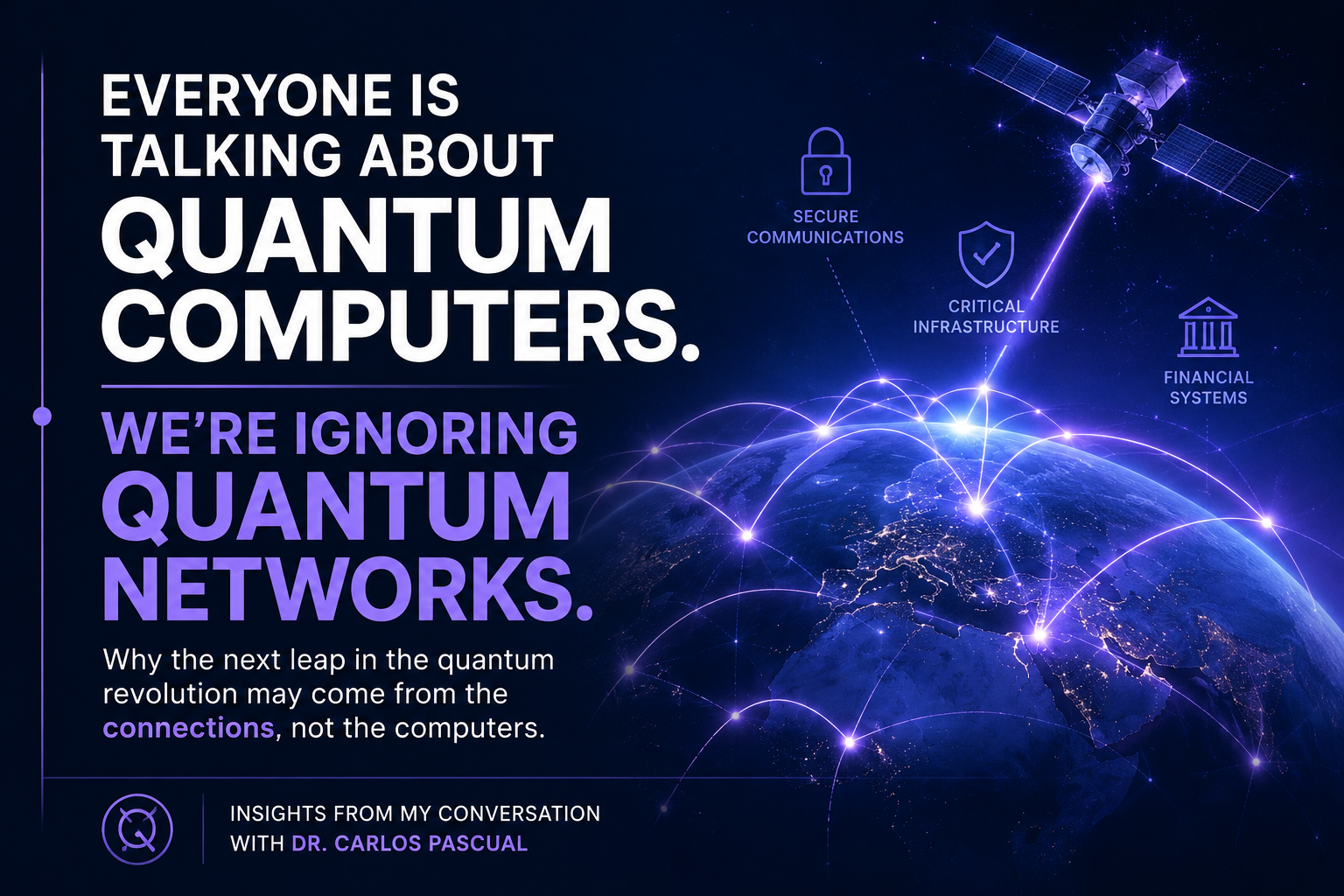
In the world of deep tech, we often talk about “quantum” as a distant, ethereal concept, something confined to super-cooled dilution refrigerators and high-security basement labs. But this week, the narrative shifted. In a landmark collaboration, Cisco and the Brooklyn-based startup Qunnect successfully established a metro-scale quantum network between Brooklyn and Manhattan, proving that the “Quantum Internet” is no longer just a whiteboard dream.
This wasn’t a sterile lab test; it was a gritty, real-world deployment through the “rat’s nest” of New York City’s existing fiber optic infrastructure.
From Hogwarts to Hardware
For years, I’ve described the path of quantum technology as the transition from “Hogwarts to Hardware” moving away from the magical, fragile phenomena of the lab and toward the rugged reliability of telecommunications gear.
The GothamQ network trial spanned 17.6 km of commercial-grade fiber. These are the same cables that carry your Netflix streams and high-frequency trades, snaking under subway lines and through chaotic patch panels. Historically, quantum signals (photons) are so delicate that the slight vibration of a passing train or a shift in temperature could collapse their state.
By maintaining a 99% polarization fidelity across this urban gauntlet, Cisco and Qunnect have essentially built a quantum-grade bridge across the East River.
The Breakthrough: Room-Temperature Nodes
If there is one thing that has kept quantum networking grounded, it’s the need for extreme cooling. Usually, every node in a quantum network requires a cryogenic setup—a massive, expensive fridge that keeps hardware near absolute zero.
The Cisco-Qunnect partnership flipped the script with a centralized cooling architecture:
- The Hub: A single central location handles the heavy lifting of cryogenic cooling.
- The Spokes: The connected nodes in Brooklyn and Manhattan run at room temperature.
This “spoke-and-hub” model is a massive win for scalability. It means a telecom provider doesn’t need to turn every neighborhood data center into a cryogenic lab. They can simply plug Qunnect’s Carina hardware into a standard server rack, and Cisco’s software—acting as a “digital air traffic controller”—handles the complex orchestration of the quantum states.
Why the World Just Got “More Concrete”
The metrics from this trial are staggering. The team achieved entanglement swapping rates (the process of “linking” two quantum particles that have never met) of 5,400 pairs per hour over the deployed fiber. Locally, that rate hit 1.7 million pairs per hour, a performance boost roughly 10,000 times better than previous benchmarks for similar platforms.
Real-World Impact: The “Candace Lens”
Why does this matter to the average person or the C-suite executive?
- Provable Security: This isn’t just better encryption; it’s a “Quantum Alert” system. Because quantum states collapse when observed, any attempt to tap the fiber is immediately detectable.
- Financial Synchronization: For high-frequency trading, where microseconds are worth millions, quantum networks offer time-stamping precision that classical GPS-linked systems struggle to match.
- Distributed Computing: We are entering the era of the “Quantum Data Center,” where multiple small quantum computers can be linked to act as a single giant supercomputer.
“Today, we didn’t just break a record; we did it in NYC using some of the noisiest, most chaotic fiber on Earth,” noted Mehdi Namazi, CSO of Qunnect.
The Takeaway
The “Quantum Internet” is no longer a “someday” technology. It is a “this week” technology. By proving that entanglement can be managed via software and run over the existing “messy” infrastructure of a major metropolis, Cisco and Qunnect have provided the blueprint for the global quantum grid.
The hardware is ready. The software is orchestrating. The fiber is already under your feet.