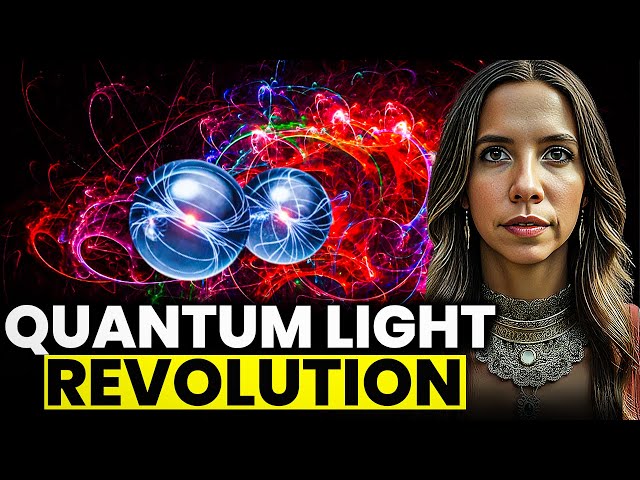
Ever found yourself marveling at a magic trick? That fleeting moment where reality seems to bend at the will of the magician? Now, imagine if that elusive, almost supernatural twist wasn’t just a clever sleight of hand, but grounded in the latest scientific breakthroughs. It’s happening right here, right now, in the realm of quantum physics and the manipulation of light itself. And trust me, this isn’t just pulling a rabbit out of a hat—it’s reinventing the hat, the rabbit, and even the very concept of ‘pulling out.’
This video is from Julia McCoy.
Today, I’m diving deep into a revolutionary field that stitches the fabric of quantum physics with tangible technological innovations, much like the integration of complex machinery under the hood of a car that transforms raw fuels into kinetic energy. Recently, researchers at Witz University and Barcelona have unveiled their findings in the prestigious journal Nature Photonix, showcasing their work on engineering quantum light. This isn’t merely an incremental advance in technology; it’s a complete overhaul of the system that governs how information travels through the universe.
Let’s break it down using a metaphor that’s close to home. Think of traditional communication as sending a letter with a single word on it — straightforward but limited. Quantum structured light, on the other hand, is like folding that letter into an intricate origami crane where every crease and fold bears additional bits of information. These structured photons—light particles—are not just carriers of data; they are data themselves, multifaceted and dense with information, existing in several states at once.
This manipulation of light into what are termed high-dimensional quantum states could potentially turn every photon into a multi-dimensional messenger of data. The implications of this are profound, transforming bandwidth and information security landscapes beyond our current comprehension. Each photon could carry exponentially more data than entire traditional data streams. Moreover, due to their quantum nature, these communications are fundamentally secure—any attempt at interception disrupts the quantum state, instantly alerting the sender.
But there’s a catch. Quantum states are notoriously delicate. Noise, the nemesis of quantum communication, can easily disrupt the entanglement necessary for these systems to function. Here’s where topology comes into play—another concept from mathematics creeping into physical application. By encoding data into the topological properties of quantum states, scientists can safeguard information. This encoding in the topology of quantum states is akin to writing a message not with ink on paper, but in the shape of the paper itself. Despite disturbances, the structural integrity of the data remains unmarred, readable even in less-than-ideal conditions.
Zooming out, this breakthrough has profound implications beyond just sending secure messages or enhancing communication networks. Quantum structured light stretches into realms like medical diagnostics, where it can aid in imaging cellular structures without damaging tissues, or even further into revolutionary areas like detecting gravitational waves.
Beyond the lab, this quantum leap is being miniaturized onto chips no larger than a fingernail. Gone are the days when sprawling laboratory setups were the playgrounds of quantum experiments. Now, these integrated photonic chips are compact, scalable, and increasingly integrated into everyday technology. This mirrors the evolution seen in computing, where bulky, room-sized computers shrank into the smartphones we carry in our pockets—a true “iPhone moment” for quantum optics.
As with any emergent technology, there are hurdles. The distance these structured photons can travel remains limited, and the broader, practical implementations of like connecting quantum computers into coherent networks are yet unfolding. However, every technological revolution has to overcome its infancy challenges, and as Andrew Forbes, a leading researcher in this area, puts it, these challenges are not barriers but beckons to unearth new solutions and pathways.
Reflecting on this ties beautifully with broader technological trends in AI, robotics, and autonomous systems. Each began with theoretical foundations, progressed through technological translation into practical applications, and is now rapidly evolving, leveraging recursive improvements.
This journey into the fabric of quantum structured light isn’t just a dive into the foundations of future tech—it’s a spotlight on the potential pathways humanity could tread in the upcoming decades. The ability to manipulate and master such profound properties of nature doesn’t merely signal a step forward; it indicates a leap towards a new epoch of human ingenuity and interaction with the cosmos.
For those who ponder the future and track the tremors of emerging technologies, this is a frontier as exhilarating as it is essential. Whether we’ll harness this quantum revolution to its fullest potential remains to be seen, but one thing is certain—the horizon is luminous with possibilities. We cannot afford to look away.
So, as we stand on the brink of redefining the very reality we understand, let’s not just be observers. Let’s engage, question, and explore.