If you’ve been following the heartbeat of the quantum revolution, the latest announcement from the University of Chicago’s Pritzker School of Molecular Engineering feels like a jolt of pure discovery. Their scientists just set a new record in quantum networking—demonstrating a method to link quantum systems over 2,000 kilometers of optical fiber. That’s roughly 200 times farther than what’s been possible before.
To put it in perspective: imagine a quantum computer humming away on the UChicago campus. Until recently, it couldn’t reliably talk to another quantum node across town. Now, that same system could theoretically connect to one near Salt Lake City. With some additional tweaks, researchers believe they can extend the range to 4,000 kilometers.
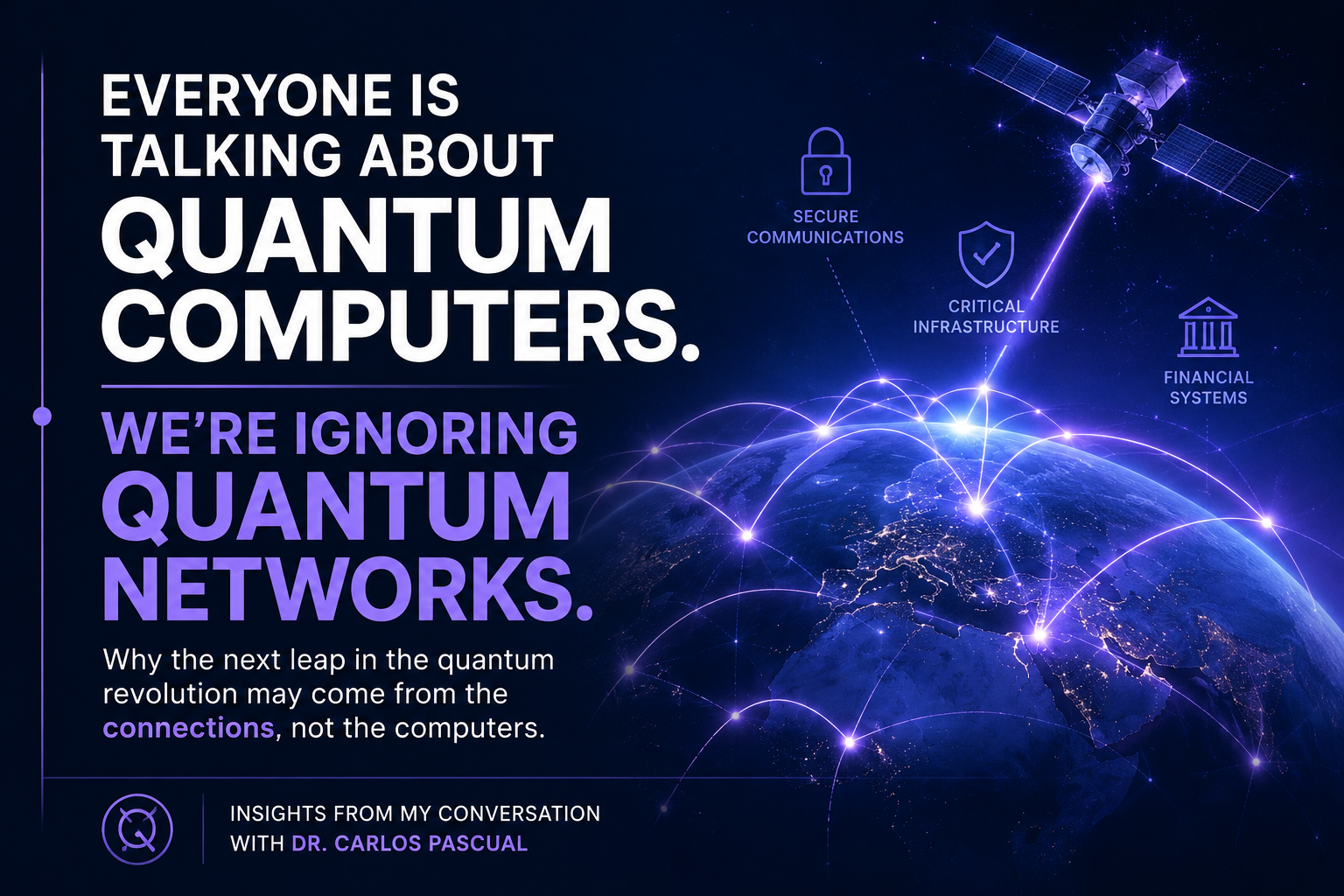
This is far more than an academic milestone—it’s a foundational leap toward a working quantum internet. This network will one day connect quantum computers, sensors, and communication systems worldwide.
Why Quantum Networks Are So Hard to Build
At first glance, quantum networking might sound like a sci-fi version of Wi-Fi. But quantum information behaves very differently from the data we send over classical networks.
A classical signal—say, an email or video stream can be amplified whenever it weakens. You boost it, resend it, and the information stays intact. Quantum signals, however, play by different rules.
A photon, a single particle of light might represent each quantum bit (or qubit). What makes it powerful is its quantum state, a delicate combination of possibilities that can represent both 0 and 1 simultaneously. But the moment you measure that photon to check what state it’s in, you destroy the very quantum information you were trying to preserve. This is known as the no-cloning theorem: you can’t copy or amplify a quantum state without changing it.
Two main villains emerge from this physics:
- Fiber Attenuation – As photons travel through optical fibers, some get absorbed or scattered. Over long distances, too many are lost.
- Decoherence – Even if a photon survives the trip, it’s constantly jostled by its environment. Those interactions scramble its quantum state, erasing the very information it carried.
To overcome these problems, scientists have been working on quantum repeaters devices that don’t amplify quantum signals but instead recreate entanglement step-by-step across a network of “nodes.” Each node contains a quantum memory capable of holding a quantum state long enough to perform a kind of quantum relay called entanglement swapping.
In theory, this allows you to extend entanglement—one of the core components of quantum communication over arbitrarily long distances. In practice, it’s not been easy to make quantum memories that stay coherent long enough to do the job.
The UChicago Breakthrough: Rare-Earth Atoms with Staying Power
Enter erbium, a rare-earth element that glows at the exact wavelength used by today’s telecom networks around 1.5 micrometers. That compatibility alone makes it a dream candidate for quantum networking, since it plays nicely with the fiber infrastructure already spanning our planet.
The UChicago team took this further by embedding erbium atoms in a carefully engineered crystal. Here’s the key: in quantum systems, coherence time, which is how long a quantum state can stay “alive” before it decoheres, is everything.
Before now, erbium-based quantum memories managed coherence times of only 0.1 milliseconds. That’s barely enough time for light to cross a city block. The UChicago researchers stretched that to over 10 milliseconds, with some systems reaching a stunning 24 milliseconds.
That’s 240 times longer enough time to perform multiple entanglement swaps, corrections, and synchronizations between distant nodes.
How did they do it? Think of it like giving the erbium atoms a calm, quiet home. The team meticulously purified the crystal, removed noisy isotopes, and minimized tiny structural imperfections anything that might jiggle or disturb the atoms’ fragile quantum states. The result was a serene quantum environment where entanglement could linger far longer than before.
Longer coherence times mean:
- More time for quantum operations like entanglement generation and error correction
- Higher fidelity entanglement, meaning fewer errors and more stable links
- Fewer repeater nodes, since each one can handle longer distances
In other words, this isn’t just a materials science win—it’s an engineering revolution.
Why This Changes the Quantum Internet’s Map
A 2,000-kilometer link doesn’t just extend the range—it changes the entire architecture of the quantum internet.
- Secure Global Communication – Quantum Key Distribution (QKD), which utilizes quantum mechanics to create unhackable encryption keys, can now extend its reach beyond city networks to intercontinental scales.
- Distributed Quantum Computing – Multiple quantum processors could work together across countries, each handling part of a complex problem, with entanglement keeping them synchronized.
- Quantum Sensor Networks – Vast grids of entangled sensors could measure gravitational shifts, magnetic fields, or seismic activity with extreme precision.
And because erbium-based memories use the same wavelengths as our current telecom infrastructure, integrating quantum links into today’s fiber networks becomes much more feasible. It’s the difference between needing to build an entirely new highway system or just upgrading the one we already have.
What Comes Next
UChicago’s 2,000-kilometer milestone doesn’t mark the end of the race; it opens the next lap. The following steps involve embedding these long-lived memories into fully functional quantum repeater nodes, performing live entanglement swapping, and gradually assembling the backbone of a global network.
What’s striking is how tangible this future feels now. The once-theoretical dream of a quantum internet where data moves in perfect secrecy, where computers collaborate across continents, and where sensors think the Earth’s most minor tremors is starting to take physical shape.
As one researcher at the lab put it, this work is about “shrinking the quantum divide.” Every extra millisecond of coherence, every kilometer of entanglement, brings us closer to an internet woven not from copper or code, but from the fabric of quantum reality itself.