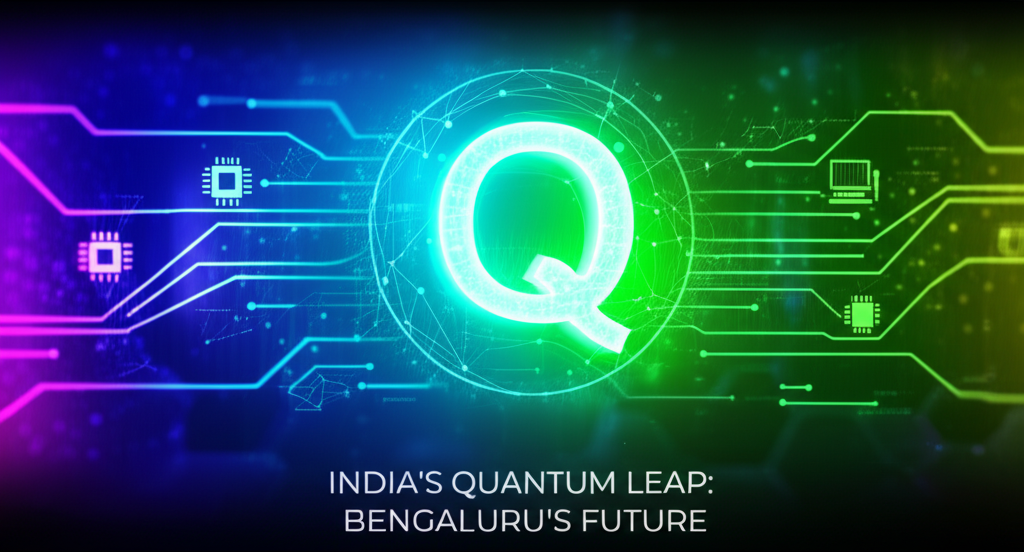
The Karnataka government’s decision to approve Quantum City in Bengaluru isn’t just news—it’s a signal. A quiet, calculated step that suggests India no longer intends to simply keep pace with global tech trends. It plans to set them.
This isn’t about building another tech park. It’s about building infrastructure for the unknown—for quantum futures we’re only beginning to imagine.
Quantum technologies aren’t incremental. They’re foundational. Where classical computing moves in predictable steps, quantum leaps—literally and conceptually.
- Quantum computing offers pathways to solve problems far beyond the capacity of even today’s supercomputers—everything from molecular modeling to logistics optimization.
- Quantum communication has the potential to redefine security with near-unbreakable encryption.
- Quantum sensing could transform diagnostics, navigation, and environmental monitoring.
By anchoring a dedicated hub in Hesarghatta, Karnataka is doing something brilliant for government-led innovation: it’s not just throwing money at a trend. It’s creating a systemic ecosystem—a place where research, industry, and government intersect in a meaningful, sustained way.
At 6.2 acres, Quantum City isn’t physically massive—but that’s not the point. Its value lies in the concentration of complexity. Advanced laboratories. Startup incubation spaces. Quantum hardware fabrication. High-performance computing infrastructure. All intentionally designed to collide in productive, idea-rich ways.
This model borrows from global best practices, but it also reflects something distinctively local: a willingness to connect pure research with applied ambition. The parallel expansion of ICTS-TIFR—adding 8 more acres to one of India’s top theoretical institutes—is a signal that the state understands something subtle: you don’t get quantum breakthroughs without deep, slow, meticulous thought.
That’s rare strategic alignment.
Bengaluru has long been seen as India’s answer to Silicon Valley—a startup haven, a software hub, a city of engineers. But that label, while once aspirational, is now too narrow.
With this move, the city begins its transformation into a global quantum hub. This is no longer just about software exports or tech parks. It’s about positioning India as a first-mover in a technology space that will define geopolitics, cybersecurity, advanced manufacturing, and scientific leadership for decades.
This also sets the stage for cross-border collaboration—attracting researchers, investors, and institutions that want to work at the intersection of possibility and principle.
There’s also something deeper here—something not easily captured in press releases or policy documents.
Quantum theory, at its core, is deeply counterintuitive. It challenges binary logic, linear causality, even the notion of objectivity. It requires a tolerance for ambiguity. For paradox. For entanglement.
India, with its long intellectual tradition of embracing dualities and layered truths, is uniquely positioned to engage with this paradigm—not just technically, but culturally and philosophically. A quantum future needs a society comfortable with complexity. That’s not a coincidence. That’s context.
Quantum City isn’t about chasing headlines. It’s about shaping the next chapter of technological progress with patience, precision, and purpose.
India isn’t just joining the global quantum race. It’s about choosing where to stand on the track—and who you want to run with.
And if Bengaluru is the laboratory for this future, then the rest of us should be paying close attention.
Stay Connected
Follow our journey and be part of the conversation:
🔗 Find us on LinkedIn
📬 Join our mailing list
📺 Subscribe to our YouTube channel