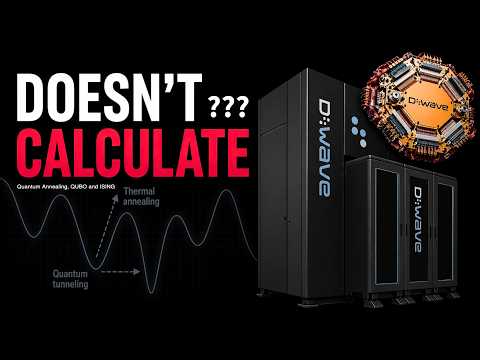
Imagine a world where computers don’t just calculate solutions but instead settle into them—gently persuaded by the fundamental laws of physics. This is the ethereal realm of quantum annealing, a phenomenon that underscores a distinct computational approach embraced by trailblazers like D-Wave. Delving into quantum annealing is akin to peeling back layers of our classical understanding of how machines think—a modern reinterpretation of problem-solving that feels both foreign and intuitive, like tracing a delicate thread interwoven with the fabric of reality itself.
Based on content from Quantlock
Imagine a world where computers don’t just calculate solutions but instead settle into them—gently persuaded by the fundamental laws of physics. This is the ethereal realm of quantum annealing, a phenomenon that underscores a divergent method of computation embraced by trailblazers like D-Wave. Delving into quantum annealing is akin to peeling back layers of our classical understanding of how machines think—a modern reinterpretation of problem-solving that feels both foreign and intuitive, like tracing a delicate thread interwoven with the fabric of reality itself.
At the heart of quantum annealing lies the bedeviling allure of optimization problems—the so-called combinatorial explosions that industry experts everywhere fear like an insurmountable mountain. Visualize a galaxy-sized haystack within which lies a single, illustrious needle—the optimal solution amid a vast expanse of possible answers. For companies like UPS or FedEx, orchestrating the most efficient routes for legions of delivery vehicles is more than a logistical headache; it’s a billion-dollar predicament. These challenge-rich landscapes call out for something beyond traditional brute force.
Before the quantum paradigm offered its elegant solution, simulated annealing, inspired by the art of blacksmithing, attempted to guide us. Picture it as a ball thrown into a tumultuous landscape of hills and valleys, representing possible solutions. The ‘shaking,’ which reflects thermal fluctuations, allows the ball to jostle into lower energy valleys—ideally the optimal state—but often finds it snagged in local rather than global minima. It’s a fine metaphor for life’s complexities: easy to get stuck, harder still to see the path uninhibited by immediate barriers.
This is where quantum annealing unfurls its magic tapestry, spinning the ideal solution through quantum tunneling—an ability derived from quantum mechanics itself. Here, instead of climbing daunting peaks, it glides over them, rendering the height of the barriers inconsequential, with the focus all on their width. It creates an uncanny passage, eschewing classical constraints and offering speed-ups that seem almost miraculous compared to classical counterparts.
Building such a machine demands a grasp of the adiabatic theorem’s quiet grace. Like a perfectly poised cup of coffee, a quantum system transitions through states with slow deliberation, always tending toward the lowest energy. It’s a dance orchestrated by an evolving Hamiltonian—a DJ’s crossfader turning dynamically through phases from the initial smooth simplicity to the final complex problem configuration.
To voice our problems in the language of quantum annealers, we use models like QUBO with binary variables, or the Ising model with spins. They’re but two dialects of the same underlying mathematics, translating real-world quandaries into landscapes accessible by the annealer’s quantum exploration. However, it’s crucial to distinguish between these specialized quantum annealers and their universal cousins—gate-based quantum computers. The former is a finely tuned instrument for specific tasks, much like a racecar, while the latter serves as a versatile generalist.
Reflecting back, one might ask, why does any of this matter? Beyond the technical marvel, quantum annealing is a poetic ode to letting the universe shoulder the heavy lifting. We encode problems into physics’ own dialect and allow the natural order to unfurl solutions previously deemed impossible. It’s a graceful acceptance of complexity—a viewpoint not about commanding but about understanding, revealing the harmony between our questions and the cosmos’ native logic.
As we peer into the horizon of quantum potential, we’re driven to wonder: what unsolvable mysteries in medicine, finance, or logistics might yield under the quantum lens? This is not just a technological evolution but a philosophical reckoning with our place within the order of things—each quantum shortcut a step towards a future rich with possibility.
Join us next time at Quantlock, where we continue to bridge the gap between the often intimidating realm of quantum computation and the curious minds eager to explore its promise.
—