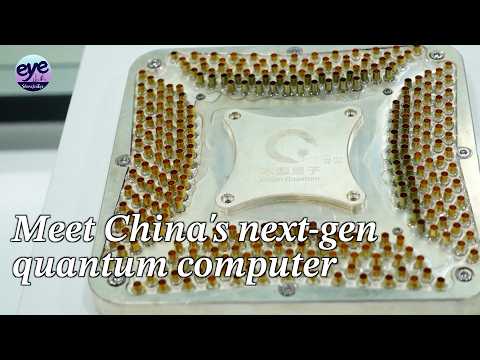
In a world where technological frontiers are continually being redrawn, China is emerging as a significant player in the quantum computing landscape. This isn’t merely about keeping pace with global advancements; it’s about setting new trajectories. Nestled in East China’s Anhui Province, the company Origin Quantum has been at the epicenter of this advancement, with their third-generation superconducting quantum computer, aptly named Origin Wukong, at the forefront.
Based on content from ShanghaiEye魔都眼
For over two years, Origin Wukong has quietly performed at the bleeding edge of quantum computing technology. Despite its complexity, the essence of this machine’s power is distilled into a singular component: the Wukong 72-qubit superconducting chip. Within the sprawling lab, where futuristic dreams and meticulous engineering intersect, a low hum envelops the air—a symphony conducted by the array of dilution refrigerators that cradle the chips, keeping them at a frosty essence of minus 273°C. It’s a delicate dance with temperature and magnetism, ensuring the qubits sit in serene stability, like sentinels of a new age.
The story here isn’t just about the impressive specifications or the impressive numbers; it’s about the philosophy that shapes this pursuit. The head of the hardware development team speaks with a matter-of-fact confidence about achieving self-reliance. “We insisted on a full-stack, self-developed approach,” they explain, emphasizing the quest to conquer every element of the quantum domain. Over 80% of the core components are self-developed, each protected under their intellectual umbrella. Such a high localization rate not only speaks to technological sovereignty but to a deeper ethos of creation and ownership.
Beyond the tangible advancements, Origin Quantum introduces another layer to their innovation—accessibility. The world’s first freely available quantum operating system, released in February, underscores this mission. Picture this: if quantum computers are locomotives of progress, this operating system serves as the network that coordinates their sleek trajectories. Users, from 163 countries, have accessed Origin Wukong remotely 47 million times—a testament not just to its capacity, but to a shared global curiosity about the potentials it unlocks.
As with any leap, there’s a broader gaze into the horizon. Quantum computing promises profound shifts—for science, for industry, and for global dynamics. Yet, it’s essential to understand the complexity and uncertainty it also harbors. Questions linger about real-world applications, scalability, and ethical considerations inherent in such potent capability. There’s a quiet undercurrent of skepticism—the question of usability, of technology not outpacing our means to understand it fully.
The dance of qubits and the pursuit of domestic technological mastery isn’t an isolated tale of success or challenge. It’s a piece of a larger mosaic, the grandeur of human pursuit interwoven with humility. As quantum dials up from theory to application, China’s role and programs like Origin Quantum become far more than milestones; they’re woven into narratives of a collective future. We are left pondering not just what can be achieved with such technology, but how we choose to weave it into our shared fabric. Surely, within the soft hum of their dilating refrigerators lies not just the cold seat of computation but a warm bed of future potential.
—