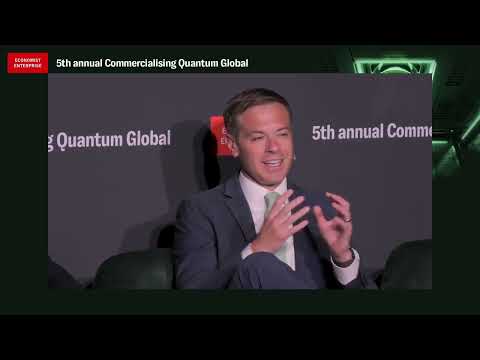
When I sat down with Brian Lenahan, Founder & Chair of the Quantum Strategy Institute, I expected to be spun into a whirlwind of qubits, cryogenic coolers, and spooky entanglement. Instead, what I walked away with was something far more urgent—and, frankly, more useful: a reminder that in 2025, the biggest challenge with quantum isn’t the science. It’s the storytelling.
Brian didn’t start his quantum journey under a lab coat. He began at MIT’s AI Strategy Program, where he learned something far more scalable than any code: how to spot emerging tech that solves actual problems. That mindset now shapes everything he does at QSI. He doesn’t sell quantum as magic—he sells it as opportunity, packaged in language that CEOs, board members, and regulators can act on.
And therein lies the rub. According to Brian, executives are still asking the wrong question: “Why do I need a quantum computer?” The more strategic frame, he suggests, is “Where could quantum break what I rely on today?” And that’s where cryptography comes in—the looming Q-Day event where quantum machines could, theoretically, crack today’s encryption standards like brittle candy shells.
That’s when heads start nodding in boardrooms.
But even when the risk lands, the execution gap looms large. Brian notes that the real bottleneck isn’t in the lab—it’s in the translation layer. It’s the people who can connect the dots between photon entanglement and supply chain optimization. Between quantum annealing and portfolio risk modeling.
“The gap isn’t lasers,” he says. “It’s language.”
Brian also made it clear that adoption isn’t moving at the same pace across the board. Defense, for instance, isn’t sitting back. DARPA, NASA, and other military agencies are already using quantum sensing to push the boundaries of detection and navigation. In Brian’s words, “They’re not waiting for the future—they’re living in it.”
Meanwhile, financial services—traditionally first to the tech buffet—may already be late to the post-quantum security conversation. Brian points out that upgrading digital infrastructure to be quantum-safe isn’t a 6-month sprint. It’s a multi-year transformation. And many banks haven’t even started stretching.
Even in cybersecurity circles, awareness is dangerously thin. Brian mentioned that at an upcoming international security summit, he’ll be the only speaker talking about quantum. Think about that. In a room full of people obsessed with risk, one voice is talking about what may be the biggest shift in digital trust since the internet itself.
What struck me most about Brian wasn’t his optimism—it was his clarity. He doesn’t oversell. He doesn’t mystify. He urges business leaders to start building roadmaps today. Not because quantum is mature, but because its impact is inevitable.
As he put it: “You don’t have to spend millions now. But you do need to start thinking in quantum terms.”
Because the future of quantum isn’t someday—it’s already calling collect.
Stay Connected
Follow our journey and be part of the conversation:
🔗 Find us on LinkedIn
📬 Join our mailing list
📺 Subscribe to our YouTube channel