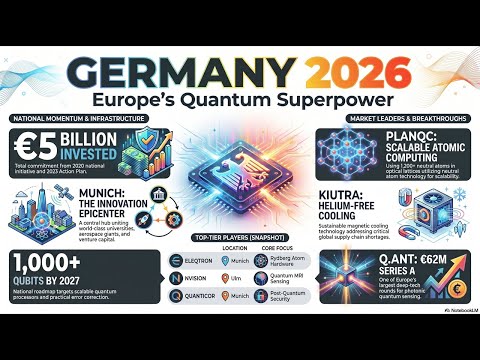
In the hallowed halls of cutting-edge technology, a quiet revolution is quietly unfolding—a revolution as profound as it is transformative. Germany, a nation often celebrated for its engineering prowess and automotive excellence, has officially emerged as a formidable force in quantum technology. Through strategic investments that total an impressive €5 billion, Germany has declared its intention to lead the global race toward quantum supremacy.
Based on content from Eddy Says Hi #EddySaysHi
The Munich Quantum Valley stands as the epicenter of this remarkable shift, an incubation hub where the boundaries of what’s possible are relentlessly redefined. It’s a place where the future is not just imagined but engineered, piece by careful piece. As one traverses from Munich to Stuttgart, and further still to Lower Saxony, what becomes apparent is a meticulously woven ecosystem, alive with the energy of innovation and discovery.
Focusing first on the hardware pioneers, organizations such as EleQtron and PlanQC have taken quantum mechanics into new territory. They are at the forefront of experiments with Rydberg atoms and optical lattices to create processors that promise groundbreaking computations. Meanwhile, Kiutra offers a unique solution to an age-old challenge: cooling quantum systems without relying on the exceptionally rare helium-3. This, in itself, represents a subtle shift toward sustainable innovation.
In the intricate dance between hardware and its algorithmic partners, we find companies like HQS Quantum Simulations and QuantiCor. Here, in the creation of sophisticated software capable of interpreting complex real-world problems into quantum-solvable puzzles, lies the heart of the quantum endeavor. It’s a symphony of logic and realization where new medicines and materials are dreamt into existence.
Security, ever the guardian of progress, takes on a new dimension with QuantiCor and Keequant. These companies forge the keys and locks of tomorrow’s digital world, preemptively securing it against threats yet unseen. It’s in such endeavors that the concept of quantum resistance moves from the realm of theory into practical, crucial reality.
We find sensory innovation, too, in the work of Q.ANT, whose photonics-based sensors open doors to controlling prosthetics with neural signals—a blend of biology and technology that feels poised on the edge of magic.
Germany’s quantum project isn’t just about technological might; it’s an ecosystem nurtured by network effects, a phenomenon where the whole becomes significantly greater than the sum of its parts. By clustering top minds, substantial funding, and the fertile soil of collaborative research, Munich Quantum Valley acts as a powerful catalyst for innovation.
The implications of Germany’s ascent are notable on a global scale. As international titans like IBM and IQM establish footholds within German borders, Germany has become a vital node in the global quantum community. For those wondering if Germany will win the race, it’s important to note that the race is multifaceted, influencing realms from national security to medicine, finance to cryptography.
Germany’s ambition is clear: by aiming for systems boasting over 1,000 qubits within a decade, Germany’s quantum aims are not mere dreams; they are blueprints backed by precision engineering and strategic foresight. Their Federal Research Minister, Bettina Stark-Watzinger, encapsulates this vision with a bold commitment to reaching parity with leading global quantum powers.
And so we pause to reflect: amidst the quantum convergence of science, security, and computation, we bear witness to a nation crafting its destiny anew. Germany’s journey is not merely to compete—it is to redefine the race itself. The future, it seems, isn’t just waiting to be seized; it is being painstakingly constructed, and Germany is determined to be at its core.
—