When most people hear the word “quantum,” they think about quantum computers. That’s understandable. Every week, there seems to be another headline announcing more qubits, lower error rates, bigger investments, or a breakthrough that promises to change everything from drug discovery to artificial intelligence. Quantum computing has become the face of the industry, and deservedly so. It’s exciting. It’s tangible. It’s easy to imagine the possibilities.
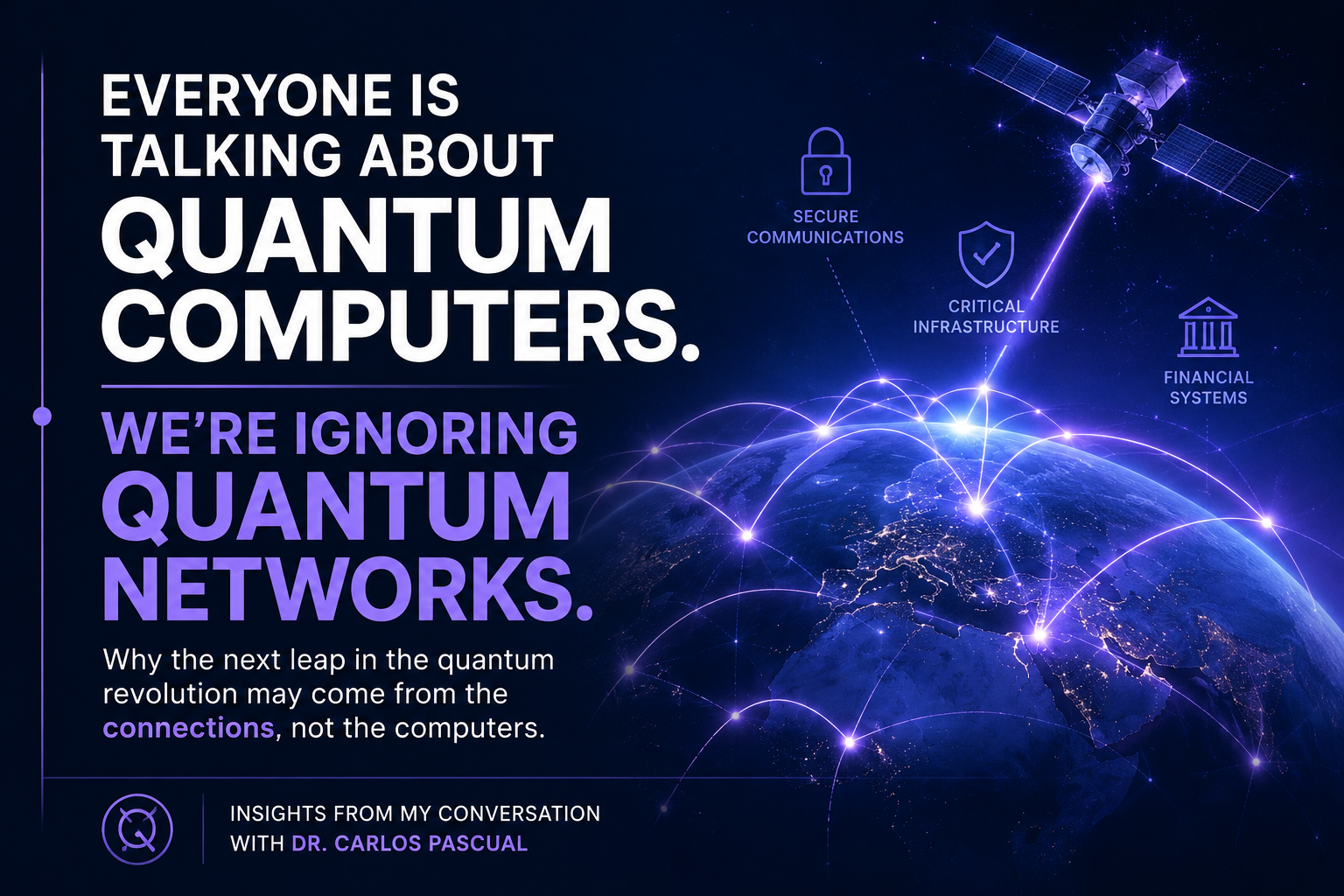
But after my recent conversation with Dr. Carlos Pascual Garcia, I left thinking about something else entirely. What if the biggest opportunity in quantum isn’t the computer itself? What if it’s the network that will eventually connect them?
It’s a question that doesn’t get asked nearly enough.
When investors talk about quantum, the conversation almost always revolves around hardware. Which company has the best processor? Who is scaling qubits the fastest? Who will reach fault tolerance first? Those are important questions, but they aren’t the only ones worth asking.
Carlos pointed out that quantum networking receives only a fraction of the attention that quantum computing does, despite the fact that it could become one of the most important pieces of the entire ecosystem. That observation stopped me for a moment because we’ve seen this pattern before. The technologies that quietly become indispensable are often the ones nobody is talking about while they’re being built.
Think about the internet.
The internet didn’t change the world because someone invented a better computer. It changed the world because computers could suddenly communicate with one another. A single computer is useful. Millions of connected computers transformed commerce, science, healthcare, education, and nearly every aspect of modern life.
The same may prove true for quantum technologies.
Right now, much of the industry’s attention is focused on building increasingly capable quantum processors. That’s necessary work, and the progress has been remarkable. But eventually those processors won’t exist in isolation. They’ll need to exchange information, work together across distances, and operate as part of larger systems. That’s where quantum networking enters the picture.
It isn’t as flashy as a new quantum processor.
You can’t walk into a lab, point to a refrigerator-sized machine, and say, “There’s the future.”
Networking rarely gets that kind of attention. It operates quietly in the background, and most of us only notice it when it stops working. Yet almost every technology we depend on today exists because reliable networks made it possible.
Quantum networking could follow the same path.
One of the most fascinating parts of our conversation centered on security. Carlos explained that as quantum computers become more capable, some of today’s widely used encryption methods will eventually become vulnerable. That’s why conversations around quantum security have accelerated so dramatically over the past few years.
Most executives have at least heard of post-quantum cryptography. Fewer have heard about Quantum Key Distribution, or QKD.
Carlos has a gift for making complex ideas approachable, and his explanation completely reframed the way I think about secure communications. Rather than relying solely on increasingly difficult mathematical problems, QKD uses the laws of quantum physics themselves to detect whether someone has intercepted a communication. It’s a fundamentally different way of thinking about cybersecurity, and one that feels less like an incremental improvement and more like a new chapter altogether.
What I appreciated most was that he didn’t present post-quantum cryptography and QKD as competitors.
Too often, we look for a winner.
His perspective was much more practical. The future probably isn’t about choosing one over the other. It’s about understanding that they solve different problems and will likely work together to create stronger, more resilient security. That feels like a much healthier way to think about emerging technologies in general.
Then the conversation moved somewhere I wasn’t expecting: satellites.
Before this interview, I hadn’t spent much time thinking about the relationship between satellites and quantum networking. Carlos explained that quantum signals weaken significantly as they travel through optical fiber over long distances. Free-space communication—including satellites—offers a way to extend secure quantum communication across countries and continents. Suddenly, satellites weren’t just part of a space story. They became part of a cybersecurity story, an infrastructure story, and ultimately a story about how the future internet may operate.
That realization broadened my perspective.
Quantum networking isn’t simply about connecting research labs.
It’s about connecting hospitals that hold sensitive patient data.
Financial institutions processing trillions of dollars every day.
Governments protecting national infrastructure.
Defense systems.
Critical communications.
Entire countries.
When you start looking at it through that lens, quantum networking stops feeling like a niche research topic. It begins to look like foundational infrastructure.
History has taught us something interesting about infrastructure. It rarely generates the biggest headlines while it’s being built. Railways weren’t exciting because of the steel tracks. Power grids weren’t celebrated because of transmission lines. Fiber-optic cables don’t usually make the evening news.
But remove any one of those systems, and modern society slows to a crawl.
Infrastructure quietly enables everything else.
That may be exactly where quantum networking fits into this story.
I’m not suggesting we’ve placed too much emphasis on quantum computing. We absolutely need continued breakthroughs in hardware, error correction, software, and algorithms. Those advances are essential.
What I’m suggesting is that perhaps we’ve been looking at only half the picture.
The future of quantum won’t be built by a single revolutionary computer sitting in a laboratory. It will emerge from an ecosystem of quantum processors, secure communications, networking technologies, satellites, cloud platforms, software, and the people building the connections between them.
Sometimes the most important innovations aren’t the ones making the loudest noise.
Sometimes they’re quietly laying the foundation that everything else will stand on.
As I continue talking with researchers, founders, engineers, and entrepreneurs across the quantum ecosystem, one thing becomes clearer with every conversation: this industry is much bigger than quantum computers alone.
Maybe it’s time our conversations reflected that.
Because if quantum computing is the engine driving this revolution, then quantum networking may be the roads that allow it to reach the rest of the world.
And that leaves me with one question I can’t stop thinking about:
Are we investing in the engine while ignoring the roads?