As we stand on the cusp of an unprecedented era in computing, the quantum revolution promises vast improvements in processing power and problem-solving strategies. Yet, standing silently beside its promise is a looming threat—to the security protocols that govern our digital landscapes today. Sylvain Chénard of Nokia Canada, a leading voice in this conversation, brought the future intertwined with both challenge and opportunity to the fore during a recent Open Compute Project summit.
Based on content from Open Compute Project
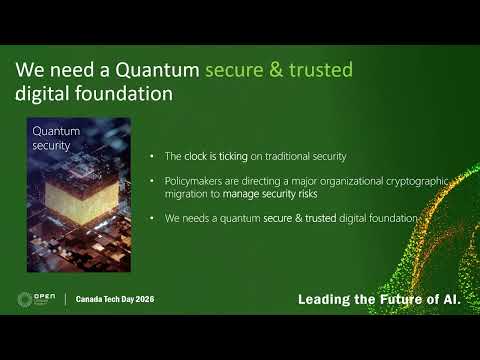
Chénard begins by grounding us in the past. When most current cryptographic systems were devised, they suited the classical computing era’s needs, reliant on mathematical problems infeasible for computers to solve in any reasonable timeframe. However, quantum technologies flip this paradigm. They pose a “systemic risk” to these established norms, hinting at a future where today’s unassailable encryption could become tomorrow’s cracked code. The urgency here isn’t speculative. It’s real and pressing.
Key to navigating this future, Chénard argues, is trust layered with risk management—a principle that becomes visible as cryptographic paths unfurl into the quantum realm. Here, the marriage of classical communications and quantum tactics signifies not just innovation, but also a retreat to the principles of analog—an unexpected fusion. In suggesting defense in depth, Chénard paints a landscape where quantum-derived keys and post-quantum cryptography reinforce our infrastructures, ensuring they are robust against an evolving digital eavesdropper.
The heart of Chénard’s argument emphasizes the importance of embedding quantum-safe security within open communications infrastructure before quantum computing reaches full maturity. Manifold reasons exist for this proactive stance. It ensures not just the integrity of AI frameworks and cloud interfaces but also offers a safeguard for the intricate data pathways connecting our increasingly digital economy.
In a conversation peppered with technical gravitas, it’s easy to lose sight of the human element—the stewards and architects of technology who must balance foresight with practical implementation. Questions linger: How best can we retrofit existing networks with quantum-safe measures? What part should intuitive, yet rigorous protocols play to protect ‘data in flight’? Chénard contends that these are not just technological concerns but philosophical ones about the preservation and futureproofing of trust.
The intertwining of quantum security and AI highlights the delicate symbiosis between what goes into the mighty machine of computation and what comes out. Herein lies an implicit warning: corrupted input can lead to compromised output—a new economic peril if unchecked. Thus, diversifying cryptographic defenses becomes as much about maintaining functional technology as it is about sustaining informational integrity.
Yet, Chénard cautions against a monocultural cryptographic approach where reliance on singular solutions leads to vulnerabilities. Instead, he champions a layered approach blending the best of mathematical standard-bearers and physical cryptographic keys, each contributing uniquely to an interlinked defense network. Each layer of technology—from application to core network—should be examined under this rubric, maintaining a resilience girded in scientifically rigorous randomness.
As he rounds off his insights, Chénard points to present leaders already implementing these strategies. Financial sectors, government bodies, and healthcare providers are seen as vanguards, duly motivated by the quantum paradigm’s complexities. Yet, for those looking ahead, he leaves a tangible call to action: Engage with environments ripe for innovation. Canadian efforts, as evidenced by collaborative labs and shared expertise, illuminate a path promising both challenge and opportunity.
In closing, the quantum-safe journey offers not a destination, but a roadmap to guide our societal trust systems through times of digital change. As we stand on the brink of a connected future, stakeholders are urged to move beyond idle speculation. Instead, consider the best mix of mathematical and physical defenses—solid, trusted, and nuanced approaches—to stabilize the technology of tomorrow.
—