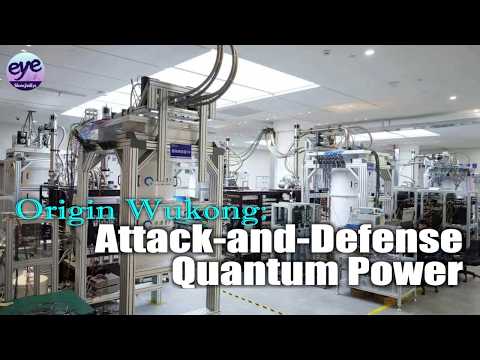
In the hushed halls of technological advancement, where innovation whispers rather than shouts, China’s “Origin Wukong” quantum computer has quietly emerged as a dual powerhouse. It’s a machine not just of zeroes and ones but of paradoxes, embodying the age-old dilemma of attack and defense in its superconducting circuits. As we turn to face a future that treads the uncertain line between potential and peril, the “Origin Wukong” offers a case study in balance.
Based on content from ShanghaiEye魔都眼
Quantum computing, a realm once reserved for futuristic speculation, has transformed into a stage where actors like “Origin Wukong” perform, not with loud proclamations, but with a steady hum that signals over 1 million completed tasks globally. This frequency of activity, though silent, resonates with a profound clarity: here is a technology capable of reshaping the world’s computational landscape while simultaneously securing it through a post-quantum cryptography (PQC) framework.
Consider the nature of contemporary encryption systems—fortresses built on complex mathematical problems. Problems that classical computers struggle to solve. But in the quantum realm, these fortresses risk being ephemeral, dissolved in the face of a robust quantum assault. Enter PQC, the ingenious “anti-quantum attack shield,” now integrated as a cornerstone of “Origin Wukong.” Named “Origin Rock,” this cryptographic module is crafted not just to withstand the pressures of today but to peer into a future where both classical and quantum threats are very real.
This dual “spear-and-shield” approach heralds a nuanced paradigm, one that embraces the transformative power of quantum computing while remaining mindful of its potential vulnerabilities. The journey to this point hasn’t been linear; it’s the product of two years of relentless operation and over 49 million remote visits from a tapestry of nations around the globe, all woven together by the common thread of progress.
Yet, as with any leap into the new, questions linger in the margins. How sustainable is this dual capability? Will the very protections we prize today serve us effectively in an era of even greater quantum capabilities? And crucially, as quantum technology becomes more accessible, how will the landscape of security transform?
For now, amid these questions lie quiet certainties: “Origin Wukong” stands as a testament to both the potential and the pitfalls inherent in technological evolution. As institutions and enterprises begin to embrace this quantum shield, we are reminded of the resilience found in adaptation. In seeking duality, “Origin Wukong” doesn’t just exist as a machine; it communicates a philosophy, one that challenges us to rethink the fabric of computation and security.
The broader implications for global security frameworks are undeniable; they compel us not only to observe but to participate in sculpting systems that are prepared, both architecturally and ethically, for what comes next. As the contours of this quantum era continue to coalesce, we find ourselves on the brink—poised, curious, and perhaps just a little more secure.
—