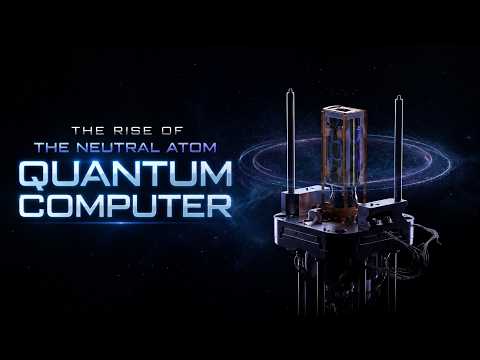
In the often bewildering landscape of quantum computing, a new contender has recently emerged, quietly captivating the attention of industry and academia alike: neutral atom quantum computing. While the quest for a fault-tolerant quantum computer has, until now, seemed like the pursuit of a technological Holy Grail, neutral atoms are beginning to sketch a credible roadmap that may lead us there sooner than anticipated. This modality, overlooked by many until recently, has begun to accelerate, building momentum and leaving a significant imprint on the broader quantum computing narrative.
Based on content from The Quantum Bull
Take, for instance, QuEra’s recent announcement, which has rippled across the sector: the company plans to bring cloud-accessible fault-tolerant quantum computing to early commercial and research workflows by 2028 through its Libra system, in collaboration with Amazon Web Services. This ambitious plan is not just a fleeting promise; it’s a construct shaping how investors and technologists view the potential of neutral atom technology, offering both a glance into the future and a jolt of excitement in the present.
But what, exactly, sets neutral atom quantum computing apart? The charm lies in its unique architecture. This modality leverages very large qubit arrays, which exhibit microscopic uniformity and optical reconfigurability, all while operating within environments at room temperature. Laser cooling, a high-level marvel, plays a significant role in maintaining the fidelity and functionality of these systems. By employing optical manipulation, neutral atoms avoid the complexity of physical wiring and the constraints of cryogenic temperatures that other architectures, such as superconducting qubits, must contend with.
Let’s walk through the landscape of comparisons. Against superconducting qubits, neutral atoms may trade in speed, but they shine with graceful scaling and reduced wiring complexity. Opposed to trapped ion systems, they may sacrifice some global coupling capabilities but can achieve higher qubit counts faster and embody more flexible geometries. And while photonics might inherently integrate into networked environments more naturally, neutral atoms provide deterministic local processing, promising more immediate utility in everyday environments.
Within this promising new paradigm, several companies are paving distinct paths. QuEra, Atom Computing, Pasqal, and Infleqtion are front runners in the race towards useful logical qubits. Each brings unique strengths to the table—QuEra’s ambition is tempered by a robust implementation plan, Atom Computing’s precision offers a tailored approach to error correction, and Pasqal’s hybrid model stands poised for fruitful industrial application. Infleqtion, in particular, stands on the verge of intriguing possibilities, combining a diverse array of technologies into its market offerings, thereby commanding more investor attention than currently appreciated.
As we reflect on this burgeoning field, the significance of neutral atoms transcends the realm of theoretically enticing futures. Practically, they have initiated a transition from niche exploration to serious deployment, underlined by compelling commercial potential in quantum simulation, optimization, materials science, and chemistry. Government testbeds further solidify this standing, showcasing a modality ready to contribute to the spectrum of quantum-enabled advancements.
So, as we traverse further into this intricate weave of quantum innovation, we find ourselves poised not only to witness but also to partake in the unfolding story of neutral atoms. This isn’t merely the ascent of another technology; it’s the opening of a new chapter in our understanding of computation’s frontier. The questions that now linger ask more of our imagination than our skepticism: what unprecedented solutions will we discover as we bring these once-abstract quantum dreams into realized utility? And how might these discoveries redefine the boundaries of our current technological landscape?
—