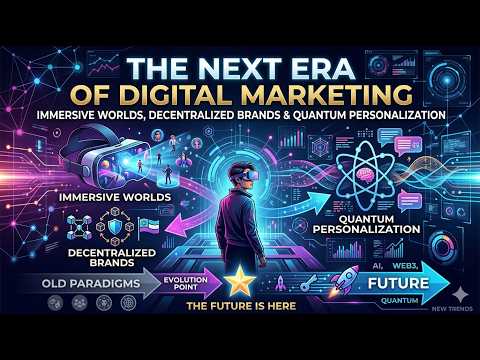
In the hushed, unfolding canvas of the digital age, the marketing landscape stands on the brink of an unprecedented evolution—a transformation as profound as the moment the internet burst into existence. Today, the traditional structures of advertising, once steady and reliable, wobble on obsolete pedestals. Data, once king, demands new thrones built from innovation. The brand hierarchy groans under the weight of a rapidly democratizing market. What emerges at this juncture are three revolutionary axes poised to redefine not just how we market but also to whom; these are the realms of Immersive Worlds, Decentralized Brands, and Quantum Personalization.
Based on content from Digvora
As we prepare to navigate this shift, we must first meditate on the driving force behind it: the insatiable human demand for relevance, privacy, and seamless experiences. Addressing these desires requires an infrastructure designed to overcome the present limits of scale, context, and consent—an interplay of cutting-edge technology and deep understanding of human behavior.
Consider quantum-inspired algorithms. These are not just tools but catalysts—reimagining what it means to optimize in a world overwhelmed by choices. Such algorithms expedite the process of discovering ideal matches within colossal networks, maneuvering through billions of possibilities with the kind of finesse that traditional computing struggles to imitate. This quantum approach allows marketers to allocate resources with pinpoint accuracy, respecting ethical boundaries while optimizing for emotional resonance. The end goal? Scalable, personalized engagement that treads lightly on the privacy-sensitive grounds where we all tread.
Then there is spatial computing, a leap that breathes life into the static data of old. It’s the bridge connecting intention to immersive, context-aware experiences—turning passive impressions into salient interactions that resonate with individuals. Here, in a dance of intention and technology, passive becomes active, unlocking customer journeys that are not just profitable but meaningful.
Trust. In a world increasingly defined by fleeting digital interactions, trust emerges as the currency of choice. It’s here that zero-party data comes into the foreground. It represents a paradigm where users willingly participate in the data exchange, trading bits of identity for genuine, personalized value, knowing their sovereignty remains intact. This interaction transforms customer engagement into a cooperative dance, where privacy-by-design transforms from constraint into competitive advantage.
Look closely also to the rise of synthesized influencers—digital avatars crafted with exquisite care to reflect audience segments’ unique multiplicity. These hyper-real figures harmonize quantum routing with spatial contexts, tailoring both voice and visual presence to resonate at personal frequencies. Through voluntary data exchange, these messages find their mark not by brute force but by soft resonance, landing in the sacred place where attentiveness dwells.
Reflect on how these innovations weave together into a tapestry where immersive shopping becomes the norm. Products rise lifelike within our spaces, holographic displays allowing us to inspect, touch, and trust before purchasing. Spatial computing converts flattened merchandise into textured, present realities, reducing the doubt, the guesswork and even the inevitable returns that plague current e-commerce systems.
Brands now face the daunting yet exhilarating challenge of loyalty—a commodity diluted by endless choice and the ephemeral nature of digital attention. Enter DAOs—Decentralized Autonomous Organizations—that redefine loyalty as a shared journey rather than a momentary transaction. Within these structures, customers evolve from mere spectators to co-authors, engaging in the brand’s narrative through token-based governance and fractional ownership, creating a symphony of engagement that traditional models no longer capture.
So, at this fulcrum of possibility and reality, we are tasked with asking: How will we sculpt this new opus of digital interaction? What roles will we play as both creators and consumers, as architects and inhabitants of these brave new worlds? Here, our journey both continues and begins anew, spurred by curiosity and guided by collaboration. Let us embrace the future and shape it with intention and insight.
For those ready to take the leap, the tools and frameworks are within reach. Start building, experimenting, and participating in these new digital ecosystems, and watch as they reshape the markets we thought we knew. Join the movement forward, for the future of marketing is not just about capturing attention—it’s about genuine connection in the world beyond the pixel.
—