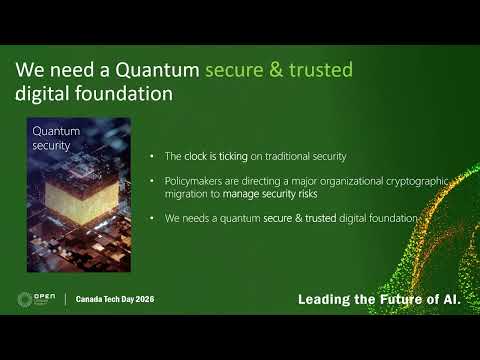
On March 25, 2026, Google announced an unexpected decision—one that should have sent ripples well beyond the walls of cybersecurity firms, into the everyday lives of anyone dependent on digital security. Google accelerated its quantum-safe encryption timeline by six years. Six years. In the quiet corridors of tech giants, when timelines shift this dramatically, it’s as if they’re whispering a secret, a revelation of looming potential that the rest of us have yet to grasp fully.
Based on content from Julia McCoy
The question emerges delicately: what do they know that we don’t? The papers that followed this announcement unveiled truths that gently reshaped how I think about the technology of tomorrow, particularly about how fragile the digital world we trust might truly be.
Let me sift through the revelations for you. First, two groundbreaking papers were released almost simultaneously, one from Google’s own quantum research division, and another from a fledgling company, Oraic, co-founded by an ex-Google researcher. Each paper tackled the ostensibly esoteric, yet fundamentally vital, question—how many qubits do we need to dismantle modern encryption protocols? Their answers, steeped in mathematical precision, shocked even the experts.
Google demonstrated a reduction by a factor of twenty in the quantum resources required to compromise ECDSA-256 encryption. In simpler terms, the quantum machines required to upset the carefully constructed cryptographic safeguards of our internet are not as distant as once believed—they are much smaller, much cheaper, and far closer on the horizon.
Bos Westerbon from Cloudflare put it plainly. With a certain understated severity, he noted that the news jolted the field—prompting Cloudflare to hasten its post-quantum readiness, now targeted for 2029. The NIST, as a contrast, held its ground more cautiously with a 2035 deadline—although in light of this news, Google itself has aligned with Cloudflare’s accelerated timeline.
Here’s where Bitcoin enters this narrative, a name heavy with promise and peril. In a separate piece of research from March 2026, Google’s team suggested a quantum computer with adequate power could crack Bitcoin’s cryptographic shield in less than nine minutes. It is crucial to note, however, that this computer does not yet exist for public applications. Bitcoin’s security, resting on elliptic curve encryption (ECC-256), remains theoretically intact—for now.
Yet the past offers shades of warning. Consider John Carlo Lei’s small, but significant conquest—a quantum attack on a 15-bit key—a 512-fold improvement over previous attempts. It is not the current capabilities we should heed, but rather this velocity of change, this ceaseless, quiet march toward the possible.
The “harvest now, decrypt later” strategies talked about in cybersecurity discussions are not mere hypotheticals. They are active realities, where adversaries quietly collect encrypted traffic today, biding their time for the fateful arrival of “Q-day.”
There are broader patterns hidden here, awaiting any who dare to peer beneath the surface. Technological shifts, seismic in their foundational impacts, possess windows of opportunity. The early adopters of the web have tales of triumph; so too do those who embraced mobile and AI ahead of the curve. Quantum computing fits this lineage—a burgeoning wave, commenced anew by Google’s recent recalibration.
If I were to suggest three actions for the astute observer today, they would be these: audit, skill, mindset. Audit your business dependencies—if you run a venture, inquire about your vendors’ post-quantum plans. Skills should align with this next frontier—those who bridge our present cryptographic capabilities with quantum-resistant solutions will wield considerable influence in the coming years. Lastly, nurture the mindset that quantum is not a distant glimmer of potential. 2029—it is closer than you think, occupying notches on our calendars mere years away.
I chart these waters as part of a community called AI Labs, where foresight harnesses early potential—first with AI and now, with looming inevitability, with quantum computing. Remember, first movers move first. Are you ready to act before the rest awaken?
—