
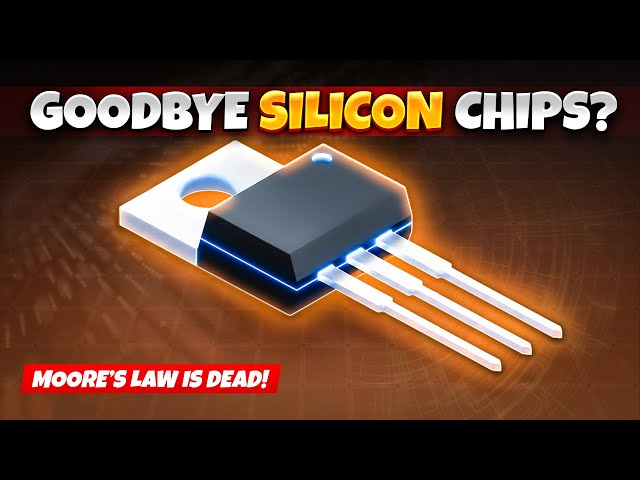
Imagine you’re standing in front of a monumental timeline, tracing the electronic age—that electric epoch where dreams took shape in circuits and silicon. At the heart of this saga is a remarkably straightforward yet profoundly impactful insight by Gordon Moore, co-founder of Intel. Moore observed a trend in 1965 that became a prophetic guide for the tech industry: the prediction that the number of transistors on a chip would double approximately every two years. This observation was so accurate and so influential—it got its own name: Moore’s Law.
This video is from The Forge Empire.
But let’s put that into perspective. You see, Moore’s Law isn’t just about packing more transistors onto chips; it’s about the essence of human ambition and our relentless pursuit of progress. In 1959, a single transistor was an innovation. Fast forward, and today, a modern smartphone harbors about 16 billion transistors. That’s like cramming the entire human population, replicated twice, into a space smaller than a fingernail!
As these tiny switches shrank, devices evolved from room-sized computers to ones that fit in our pockets. The trajectory from the Apollo guidance computer, weaker than an ’80s Nintendo console, to smartphones and gaming powerhouses illustrates a meteoric rise powered by microscopic advancements.
But while technology sprinted forward, other industries seemed almost sluggish by comparison. It underscores a distinct disparity: while we made marginal enhancements in many sectors, semiconductors sprinted ahead, blurring lines between the possible and the fantastical.
Yet, as with all tales of ascent, comes the inevitability of plateaus. After thriving for decades, we’re facing the twilight of Moore’s Law. Why? Because physics plays for keeps. We’ve pushed silicon transistors down to just a few atoms wide, nudging into realms where classical physics dissolves into the probabilistic haze of quantum mechanics. Here, electrons can “tunnel” through barriers as if they were mere suggestions, destabilizing the fundamental binary logic of digital computing.
This phenomenon isn’t just a hiccup; it’s a paradigm shift. It signals a boundary to how far we can stretch our existing methodologies. But here’s where it gets exciting—human innovation doesn’t idle. The pause in one journey heralds the beginning of another. As the curtain falls on Moore’s Law, we’re not stepping back; we’re pivoting towards novel vistas.
Engineers are sculpting transistors in three dimensions and experimenting with materials that sound like sci-fi—graphene and carbon nanotubes. Beyond the fringes, biological computing and quantum computers whisper promises of computational leapfrogs. Quantum computers especially, with their ability to exist in multiple states simultaneously, tease solutions to problems that traditional computers would take millennia to solve.
This pivot isn’t just about finding alternatives; it’s about rethinking our relationship with technology. Much like Moore’s Law encapsulated an era, this new phase could redefine future trajectories. It’s about more than persevering; it’s about transforming challenges into springboards.
As we bid a reverent farewell to Moore’s Law, let’s not see it as the end of an era, but as a spur jolting us from the complacency of tread paths. In its essence, Moore’s Law wasn’t just about transistors; it was about our intrinsic drive to push beyond boundaries, to double what we know and can do repeatedly. That drive doesn’t wane—it just finds new expressions.
One day, looking back, we might see this moment, this inflection point, as the beginning of an era as formative and revolutionary as the one Moore heralded in. For now, we stand on the cusp—poised between a celebrated past and an unwritten future.






