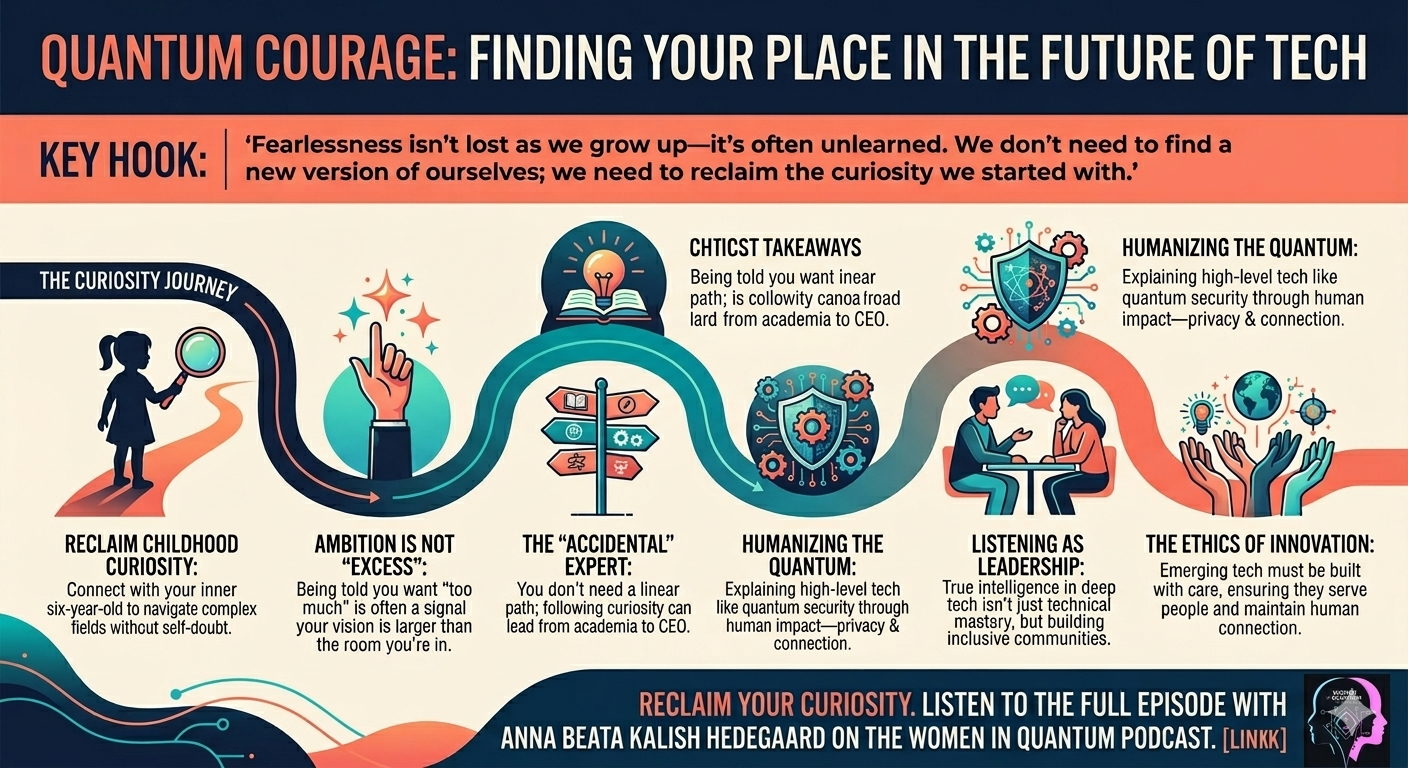
The landscape of quantum computing is often painted in the sterile colors of cold-storage refrigerators and complex linear algebra. But after listening to a recent conversation with Anna Beata Kalisz Hedegaard, CEO at Quantum Security Defense and Quantum Prime, I realized we are missing the most important variable in the equation: the human narrative.
Anna’s journey isn’t just a career path; it’s a masterclass in intellectual rebellion and the art of the “pragmatic pivot.”
The Power of the Cool Female Protagonist
We often talk about “pipeline issues” in STEM as if they are a simple logistical failure. Anna suggests something deeper and more structural: a failure of imagination.
She recounts a moment when she watched Frozen with her son. When asked who he wanted to be, he didn’t pick a sidekick or a male character—he wanted to be Elsa. It’s a small observation with massive implications. For decades, we’ve asked girls to find themselves in the “Lois Lanes” of the world while boys got to be Superman.
If we want women in quantum—or any deep tech field—we don’t just need more textbooks; we need more “cool female characters” so compelling that everyone, regardless of gender, wants to be them. We need stories where women aren’t just the “expert” in the room, but the one making the weird jokes, being awkward, or even being the villain. We need the “whole complexity that men have” in our narratives.
The Academic Trap: Smart vs. Valuable
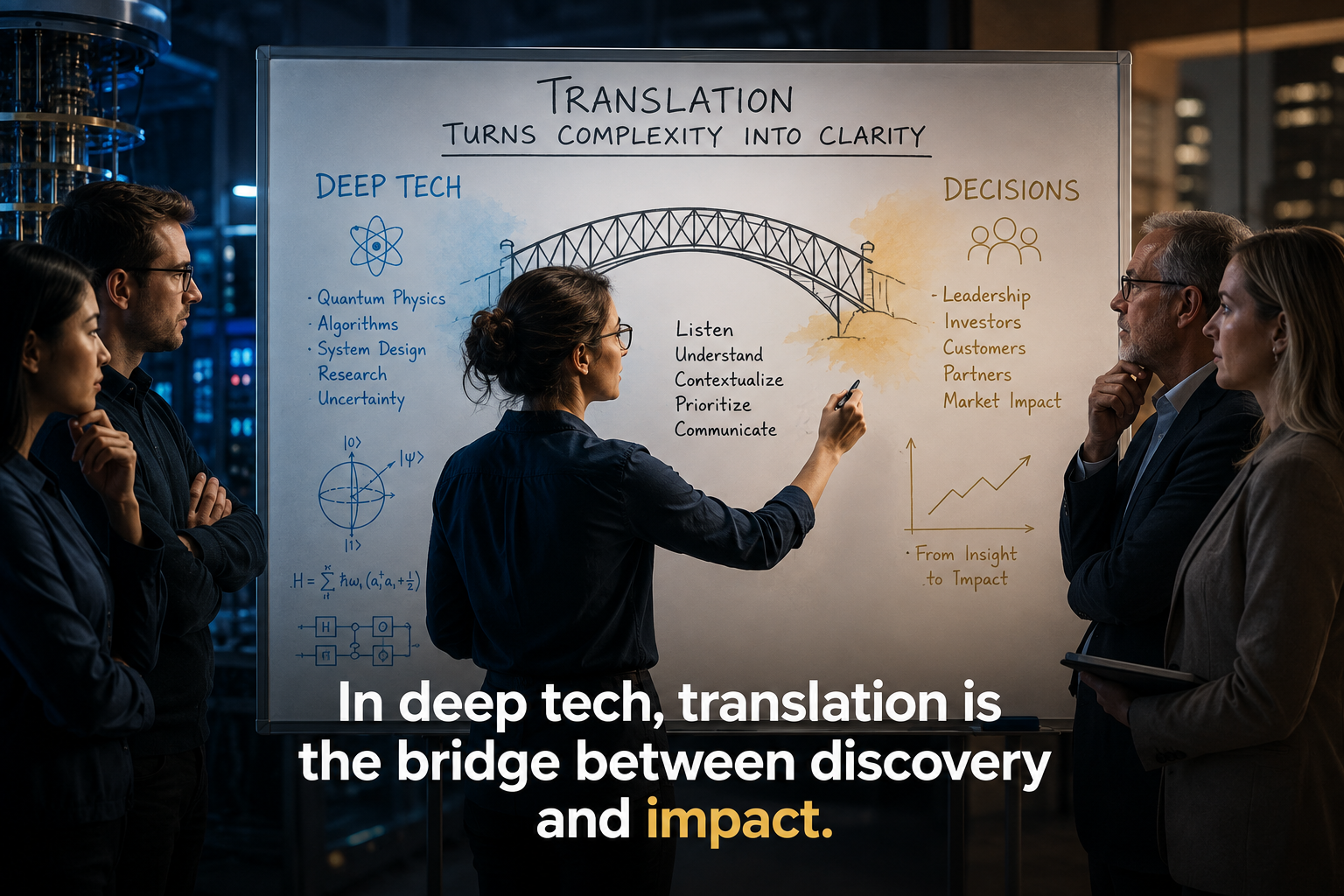
One of the most profound shifts Anna described was the “bridge” between academic science and entrepreneurship. In academia, your currency is your expertise—what you know. Your identity is often tied to being the smartest person in the room.
But in the business world, Anna argues, your “smartness” is almost irrelevant to the customer.
- In Academia: You sell your niche knowledge and prestige.
- In Entrepreneurship: You must let go of yourself and listen to what others need.
This is a painful transition for many. Scaling a business requires a shift in focus from “What do I think is cool?” to “How can I deliver value to someone else?”. It’s the difference between producing a perfect paper and building a functional, pragmatic vehicle for change.
Chasing the “Teleportation” Dream
What keeps a CEO motivated in a field as nascent as quantum? For Anna, it’s a childhood fascination with teleportation. While most of us see teleportation as science fiction, she sees it as a north star for “intelligent networks” and the eventual possibility of teleporting data—or even, perhaps, human consciousness.
She views her companies not just as profit centers, but as “vehicles for a journey”. Her mission with Quantum Security Defense is about connection—bringing people together from around the globe to exchange knowledge and build something contagious.
Reclaiming the Six-Year-Old Self
Perhaps the most personal insight Anna shared was her relationship with confidence. As a child, she describes herself as “fearless” and “wild,” a six-year-old who didn’t care if she lacked talent as long as she had the drive to practice.
But society has a way of reacting to that energy with, “That’s too much”. Over time, this “social heritage” builds a layer of self-doubt. Now, as a leader in one of the world’s most complex industries, Anna’s goal is to “relearn” that childhood oblivion to external criticism—to catch the voices in her head that aren’t hers and rebuild her confidence from the ground up.
A Lingering Reflection:
If your current professional identity is built entirely on “being the expert,” how much of your potential are you holding back to protect that image? What would change if you focused less on being smart and more on being useful?