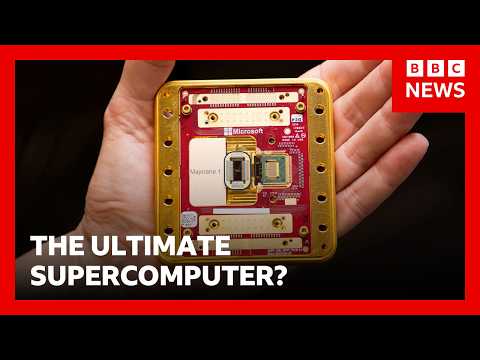
What if the next generation of computers worked less like the machines we use today and more like the human brain? Or used light instead of electrical signals to process information? What if we could use the laws of quantum physics to solve problems that even our most powerful supercomputers struggle with?
These ideas might sound like science fiction, but researchers are already exploring all three approaches.
To understand why, it helps to look at how our computers work today.
The laptops, smartphones, and servers we depend on use classical computing. At their core, they process information using bits, represented as either a 0 or a 1. Billions of tiny transistors work together to perform the calculations behind everything from sending an email to training an artificial intelligence model.
And classical computers are remarkably good at what they do.
But AI is placing growing demands on computing infrastructure. Training and running large models requires enormous processing power, and moving data between memory and processors consumes both time and energy. As AI systems become more complex, these limitations are becoming harder to ignore.
That’s where things get interesting.
Researchers aren’t simply trying to make existing processors faster. They’re exploring entirely different ways to process information, including quantum computing, brain-inspired computing, and photonic computing, which uses light.
Each approach tackles a different problem, and none is a universal replacement for the computers we use today.
What interests me is that the future of computing may not come down to one technology replacing another. We could end up with several kinds of computers working together, each doing what it does best.
And that raises a question worth exploring: What happens when we stop asking how to make today’s computers faster and start asking whether there’s a better way to compute?
Based on content from Learn with Whiteboard
Quantum Computing: The Dance of the Qubit
Imagine a processor not limited to binary answers, but one that plays in the quantum realm. Quantum computing employs qubits, which can exist in superposition, blurring the lines between zero and one. These qubits can entangle, weaving intricate correlations untouched by classical computing. The heart of quantum computing lies not in simultaneous calculation of all possibilities but in carefully crafted algorithms that utilize interference to isolate correct answers—like ripples in water converging to form precise patterns.
Its promise gleams brightest in simulating complex molecules and tackling esoteric mathematical conundrums, yet challenges abound. Today’s quantum devices are quaint and noisy, grappling with error correction complexities that remain a frontier yet to be fully tamed.
Neuromorphic Computing: Mimicking the Mind
In pursuit of energy-efficient computation, neuromorphic computing casts a glance at our own cerebral architecture. Unlike traditional systems, which separate memory from processing, neuromorphic devices intertwine storage and computation in a network analogous to neurons and synapses. These chips propagate data through brief signals or spikes, activating only when events demand attention.
This brain-inspired methodology is particularly promising for autonomous robots and sensors dispersed across diverse environments—places where quick, localized decisions save energy and time. Yet, the field must navigate the labyrinth of programming these chips and integrating them with standard AI software.
Photonic Computing: Harnessing Light
With photonic computing, we enter a realm where light, not electrons, transmits and processes data. Photons coursing through optical components such as waveguides present the tantalizing possibility of high-speed, low-loss data movement. Optical links have infiltrated data centers, promising to alleviate existing data bottlenecks.
The computation with light sharpens focus, potentially reducing energy expenditure for AI’s demanding matrix operations. However, the transition from electronic input to photonic processing—and back again—remains an engineering challenge poised on the horizon.
Towards a Hybrid Future
The path forward may not favor a solitary technological triumph. Classical computing will persist as a reliable constant, orchestrating an intricate dance of specialty processors like quantum, neuromorphic, and photonic systems, each excelling in its assigned tasks. This synergy compels the question not of which is fastest, but of which orchestrates problem-solving most efficiently.
As we venture deeper into this converging future, where disciplines blend and redefine boundaries, it’s these dialogue-worthy distinctions that will capture our imagination and steer the direction of innovation.
Accompanied by these explorations, we stand by the brink, peering into a world where technological diversity cultivates a landscape richer and more nuanced than ever before.
Intrigued by these evolving landscapes? Subscribe to Learn with Whiteboard for video content that distills complex ideas into accessible narratives.
—